


Philippine President Rodrigo Duterte would lift martial law in the southern Philippines by year’s end, his spokesman said yesterday, more than two years after it was imposed in an attempt to stop the Islamic State (IS) group gaining a foothold there.
Duterte put the Mindanao region under military rule in May 2017, hours after gunmen flying the black IS flag seized the mainly Muslim city of Marawi, sparking a five-month battle that left 1,200 people dead.
“The [presidential] palace is confident on the capability of our security forces in maintaining the peace and security of Mindanao without extending martial law” beyond Dec. 31, presidential spokesman Salvador Panelo said in a statement.
Duterte’s security advisers had apprised him of the “weakening of the terrorist and extremist rebellion, a result of the capture or neutralization of their leaders, as well as the decrease in the crime index,” Panelo added.
Martial law had allowed the military to establish control with measures like curfews, checkpoints and gun controls in a nation where many civilians own firearms, either legally or illegally.
Suspects could also be detained for longer periods without criminal charges being filed in court.
However, martial law is a contentious issue in a country ruled for 20 years by former Philippine president Ferdinand Marcos, who Duterte has hailed as the greatest leader the Asian nation ever had.
The Philippine Congress allowed Duterte to extend martial rule over the entire south after government forces recaptured Marawi, ignoring opposition warnings of a creep toward authoritarian rule.
British-based watchdog group International Alert said in a report earlier this year that martial rule has reduced conflict incidents in Mindanao by 30 percent in 2017 and last year.
The group’s Asia peace and conflict policy adviser Francisco Lara told reporters that the military checkpoints curtailed the transport of firearms, which led to fewer kidnappings and clan wars.
However, Mindanao has been hit by a number of deadly suicide bombings in a worrying escalation of militancy driven by the IS influence in Southeast Asia.
These attacks included a January blast during Sunday Mass at a Catholic cathedral on the island of Jolo.
“The deterrence argument seems questionable in light of unprecedented suicide attacks,” political analyst Richard Heydarian told reporters.
“Even after several years of implementation it did not bring any substantial defeat of any armed group in that area,” said Jose Antonio Custodio, a military historian and defense analyst.
The tourism fallout was also substantial, Custodio added, citing frequent travel advisories for Mindanao issued by Western governments.
Philippine Secretary of Defense Delfin Lorenzana earlier told reporters that he had advised Duterte against prolonging martial rule over the region.
“It’s time to go back to normal, and so that we can attract more investors,” Lorenzana told state TV last week.

A plan by Switzerland’s right-wing People’s Party to cap the population at 10 million has the backing of almost half the country, according to a poll before an expected vote next year. The party, which has long campaigned against immigration, argues that too-fast population growth is overwhelming housing, transport and public services. The level of support comes despite the government urging voters to reject it, warning that strict curbs would damage the economy and prosperity, as Swiss companies depend on foreign workers. The poll by newspaper group Tamedia/20 Minuten and released yesterday showed that 48 percent of the population plan to vote
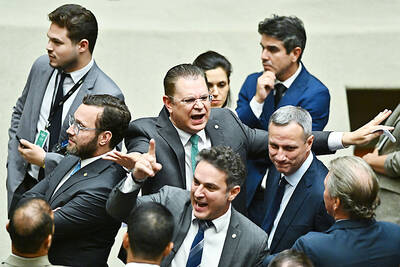
PARLIAMENT CHAOS: Police forcibly removed Brazilian Deputy Glauber Braga after he called the legislation part of a ‘coup offensive’ and occupied the speaker’s chair Brazil’s lower house of Congress early yesterday approved a bill that could slash former Brazilian president Jair Bolsonaro’s prison sentence for plotting a coup, after efforts by a lawmaker to disrupt the proceedings sparked chaos in parliament. Bolsonaro has been serving a 27-year term since last month after his conviction for a scheme to stop Brazilian President Luiz Inacio Lula da Silva from taking office after the 2022 election. Lawmakers had been discussing a bill that would significantly reduce sentences for several crimes, including attempting a coup d’etat — opening up the prospect that Bolsonaro, 70, could have his sentence cut to

A powerful magnitude 7.6 earthquake shook Japan’s northeast region late on Monday, prompting tsunami warnings and orders for residents to evacuate. A tsunami as high as three metres (10 feet) could hit Japan’s northeastern coast after an earthquake with an estimated magnitude of 7.6 occurred offshore at 11:15 p.m. (1415 GMT), the Japan Meteorological Agency (JMA) said. Tsunami warnings were issued for the prefectures of Hokkaido, Aomori and Iwate, and a tsunami of 40cm had been observed at Aomori’s Mutsu Ogawara and Hokkaido’s Urakawa ports before midnight, JMA said. The epicentre of the quake was 80 km (50 miles) off the coast of
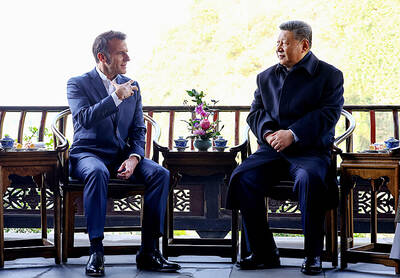
RELAXED: After talks on Ukraine and trade, the French president met with students while his wife visited pandas, after the pair parted ways with their Chinese counterparts French President Emmanuel Macron concluded his fourth state visit to China yesterday in Chengdu, striking a more relaxed note after tough discussions on Ukraine and trade with Chinese President Xi Jinping (習近平) a day earlier. Far from the imposing Great Hall of the People in Beijing where the two leaders held talks, Xi and China’s first lady, Peng Liyuan (彭麗媛), showed Macron and his wife Brigitte around the centuries-old Dujiangyan Dam, a World Heritage Site set against the mountainous landscape of Sichuan Province. Macron was told through an interpreter about the ancient irrigation system, which dates back to the third century


 RSS
RSS