


Criticized by the White House for alleged interference in US politics, China has quietly blazed a path at the UN where it is, little by little, becoming one of the most influential members.
At the UN Security Council, where China holds one of five permanent veto-wielding seats, its statements remain bland, often recalling fundamentals of the UN Charter, such as national sovereignty and principles of non-interference.
“In their interpretation, democracy is optional, as are human rights,” a European diplomat said.
Yet in peacekeeping missions or when jobs are available in the UN’s executive arm at the New York headquarters, Beijing is increasingly making its presence felt.
More than 2,500 Chinese military personnel wear UN blue helmets on peacekeeping missions in Libya, Mali, the Democratic Republic of the Congo and South Sudan.
China has also “enormously increased” its voluntary financial contributions to the world body, while the US under US President Donald Trump has slashed its own financing, one diplomat said.
Funding reports and missions allows China to buy some “influence” and push its candidates into top positions, the diplomat said, adding that to have Chinese in multiple roles across the UN provides “a source of information and influence.”
Another diplomat, also speaking anonymously, said: “China is taking power at the United Nations.”
Last year and this year, the Asian giant, which is economically expanding in Africa and elsewhere, became a key player on two major international crises: North Korea and Myanmar.
Under US pressure, Beijing imposed unprecedented economic sanctions against Pyongyang, but with the hope that an accord on denuclearization of the Korean peninsula would lead to the departure of about 30,000 US troops based in South Korea — China’s behind-the-scenes strategy in the region.
China meanwhile considers the crisis of Myanmar’s Muslim minority Rohingya, 700,000 of whom fled a military crackdown to Bangladesh, as an issue between those two countries, and succeeded in preventing any firm UN Security Council action.
European diplomats have noted that China’s rise at the UN has come at a time when Beijing and Moscow are no longer automatically offering each other immediate reciprocal support.
When Moscow makes use of its veto power, China sometimes simply abstains.
Even in lower-profile situations, such as negotiating texts among the 15 UN Security Council members at the experts level, China is “present on all subjects,” one diplomat said, speaking on condition of anonymity.
Beijing, for example, is seeking to become chief author on texts about Afghanistan, replacing the Netherlands, which on Jan. 1 is to leave its non-permanent Security Council seat, several diplomats said.
The vast majority of UN resolutions are still written by the US, Britain or France — a reflection of an older world order.
China, like Russia, is rarely the author, although it was in charge of the Somalia file in the past.
So how far will China go? Some say this is only the tip of the iceberg.
“For China, multipolarity is just one stop on the underground metro line,” one diplomatic source said.
For Beijing, it then sees a group of two — China and the US, and eventually, China would reign supreme, a diplomat said.
“They are long-term players. They don’t want to create a commotion,” another diplomatic source said.
Speaking to a US think tank last week, Chinese Minister of Foreign Affairs Wang Yi (王毅) dismissed fears that his country is seeking to overtake the US as the pre-eminent world power.
Concluding that China is about to seek hegemony, he said, is “a serious strategic misjudgement.”
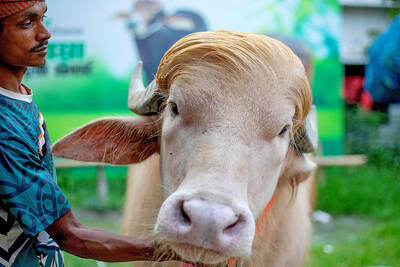
Crowds in Bangladesh are flocking to snap photographs with an unlikely social media star — an albino buffalo with flowing blond hair nicknamed “Donald Trump” that is due to be sacrificed within days. Owner Zia Uddin Mridha, 38, said his brother named the 700kg bull over its flowing helmet of hair resembling the signature look of the US president. “My younger brother picked this name because of the buffalo’s extraordinary hair,” he said at his farm in Narayanganj, just outside the capital, Dhaka. Mridha said that a constant stream of curious visitors — social media fans, onlookers and children — have come throughout

It began as a satirical online project. Now millions of young people in India are flocking to it as an outlet for their frustration. A parody political party called the Cockroach Janta Party, with the insect as its symbol, has exploded across India’s social media by turning absurdist humor into protest. Memes and short videos mocking corruption, joblessness and political dysfunction have flooded social media sites, where millions of users are embracing the cockroach — known for its ability to survive harsh conditions — as a tongue-in-cheek symbol of endurance. The online movement’s rise has been unusually rapid. The Cockroach Janta Party (CJP)
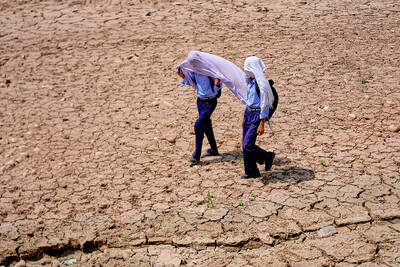
HOTTER: While Indians are accustomed to summer heat, climate change has caused northwestern India to warm faster than other parts of the country, an academic said Roads and markets have emptied during afternoons and some farmers have switched to nighttime work to avoid scorching temperatures as a heat wave grips large parts of India. The India Meteorological Department forecast maximum temperatures for yesterday of about 45°C in the capital, New Delhi, where authorities have opened temporary “cooling zones” to help people cope. The weather department warned that conditions would likely persist across several northern regions in the coming days, with temperatures staying well above seasonal averages. Authorities urged people to stay indoors during the hottest hours and take precautions against heat-related illnesses. India declares a heat wave whenever maximum temperatures
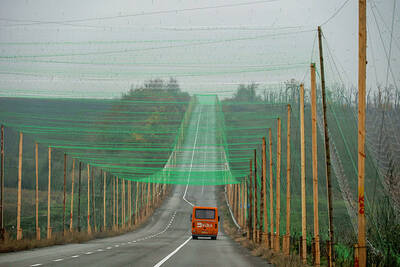
BIGGER ROLE: Beijing has said it maintains an impartial stance on the war in Ukraine, but by training Russian troops, China is far more involved than previously known China’s armed forces secretly trained about 200 Russian military personnel in China late last year, and some have since returned to fight in Ukraine, according to three European intelligence agencies and documents seen by Reuters. While China and Russia have held a number of joint military exercises since Moscow’s full-scale invasion of Ukraine in 2022, Beijing has repeatedly said that it is neutral in the conflict and presents itself as a peace mediator. The covert training sessions, which predominantly focused on the use of drones, were outlined in a dual-language Russian-Chinese agreement signed by senior Russian and Chinese officers in Beijing on


 RSS
RSS