


The UN General Assembly on Tuesday overwhelmingly elected Ecuadoran Minister of Foreign Affairs Maria Fernanda Espinosa Garces as its next president, making her only the fourth woman to lead the 193-member world body in its 73-year history.
She defeated another woman, Honduran Ambassador to the UN Mary Elizabeth Flores Flake, by 128-62 with two abstentions in the secret-ballot vote.
The current assembly president, Miroslav Lajcak of Slovakia, announced the results to loud applause, saying: “Frankly, four out of 73 is not a record to be proud of, but I’m glad we are getting ourselves on track.”
UN Secretary-General Antonio Guterres, who defeated several female candidates and continues the male domination of the UN’s top post, echoed Lajcak, saying: “We can and we must do better.”
Espinosa Garces expressed hope that gender parity continues to make progress and dedicated her election to “all the women in the world who participate in politics today, and who face political and media attacks marked by machismo and discrimination.”
“I would like to pay a special tribute to the women who struggle every day to access jobs on equal terms, to women and girls who are victims of violence, to girls and adolescents who demand access to quality information and education,” she said. “My commitment will always be to them.”
While the presidency of the General Assembly is largely ceremonial, it is also prestigious.
The world body controls the UN budget, adopts treaties, addresses global issues from poverty to climate change, and passes numerous resolutions that, while not legally binding, almost always reflect global opinion.
It is also the UN organ where countries large and small can speak — and the scene of the annual gathering of world leaders in September.
The selection of the assembly president follows a regional rotation mandated by the world body, and it was the turn of Latin America and the Caribbean to preside over the next year-long session that starts just before September’s global gathering.
By tradition, the UN’s regional groups usually nominate a single candidate who is then rubber-stamped by the assembly.
However, this year the election was contested — as it was in 1991, 2012 and 2016 — according to the UN, because Latin American countries could not agree on a nominee.
Espinosa Garces said after her victory that she will also be the first woman from Latin America and the Caribbean to preside over the assembly.
“I offered an open-door presidency and I will hold to that promise,” she said.
“I am a poet as well as a politician,” Espinosa Garces said. “As such, I am fully aware that no view is useful if we do not see, and no word has any value if we do not listen. I will be ready to listen to you all and to work for you and with you.”
For the first time this year, Lajcak decided to follow a new practice that was also used to choose Guterres.
He invited both candidates to appear before assembly members for two hours on May 4 to present their vision for the presidency, and answer questions from diplomats and civil society representatives.
The issues raised ranged from conflict prevention and financing UN goals for 2030 to ending poverty and sustaining the planet to transparency in the president’s office, UN reforms and gender equality.
Espinosa Garces at the time said that she would focus on “delivery, implementation and accountability” to bring the UN’s work closer to people everywhere and convince them that what the UN does “touches upon their daily lives.”
After the election, she said that “strengthening multilateralism is not an option, it’s an obligation.”
Therefore, it is urgent that the UN responds to major global challenges and does more to bring the organization closer to all citizens of the world, Espinosa Garces said.

China’s military news agency yesterday warned that Japanese militarism is infiltrating society through series such as Pokemon and Detective Conan, after recent controversies involving events at sensitive sites. In recent days, anime conventions throughout China have reportedly banned participants from dressing as characters from Pokemon or Detective Conan and prohibited sales of related products. China Military Online yesterday posted an article titled “Their schemes — beware the infiltration of Japanese militarism in culture and sports.” The article referenced recent controversies around the popular anime series Pokemon, Detective Conan and My Hero Academia, saying that “the evil influence of Japanese militarism lives on in

ANTI-SEMITISM: Some newsletters promote hateful ideas such as white supremacy and Holocaust denial, with one describing Adolf Hitler as ‘one of the greatest men of all time’ The global publishing platform Substack is generating revenue from newsletters that promote virulent Nazi ideology, white supremacy and anti-Semitism, a Guardian investigation has found. The platform, which says it has about 50 million users worldwide, allows members of the public to self-publish articles and charge for premium content. Substack takes about 10 percent of the revenue the newsletters make. About 5 million people pay for access to newsletters on its platform. Among them are newsletters that openly promote racist ideology. One, called NatSocToday, which has 2,800 subscribers, charges US$80 for an annual subscription, although most of its posts are available
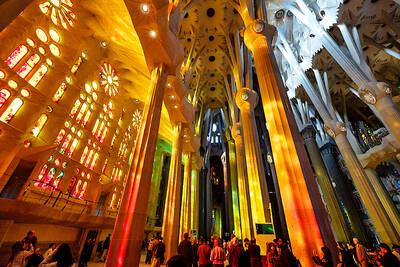
GLORY FACADE: Residents are fighting the church’s plan to build a large flight of steps and a square that would entail destroying up to two blocks of homes Barcelona’s eternally unfinished Basilica de la Sagrada Familia has grown to become the world’s tallest church, but a conflict with residents threatens to delay the finish date for the monument designed more than 140 years ago. Swathed in scaffolding on a platform 54m above the ground, an enormous stone slab is being prepared to complete the cross of the central Jesus Christ tower. A huge yellow crane is to bring it up to the summit, which will stand at 172.5m and has snatched the record as the world’s tallest church from Germany’s Ulm Minster. The basilica’s peak will deliberately fall short of the

Venezuelan Nobel peace laureate Maria Corina Machado yesterday said that armed men “kidnapped” a close ally shortly after his release by authorities, following former Venezuelan president Nicolas Maduro’s capture. The country’s Public Prosecutor’s Office confirmed later yesterday that former National Assembly vice president Juan Pablo Guanipa, 61, was again taken into custody and was to be put under house arrest, arguing that he violated the conditions of his release. Guanipa would be placed under house arrest “in order to safeguard the criminal process,” the office said in a statement. The conditions of Guanipa’s release have yet to be made public. Machado claimed that


 RSS
RSS