


Venezuelan Nobel peace laureate Maria Corina Machado yesterday said that armed men “kidnapped” a close ally shortly after his release by authorities, following former Venezuelan president Nicolas Maduro’s capture.
The country’s Public Prosecutor’s Office confirmed later yesterday that former National Assembly vice president Juan Pablo Guanipa, 61, was again taken into custody and was to be put under house arrest, arguing that he violated the conditions of his release.
Guanipa would be placed under house arrest “in order to safeguard the criminal process,” the office said in a statement. The conditions of Guanipa’s release have yet to be made public.
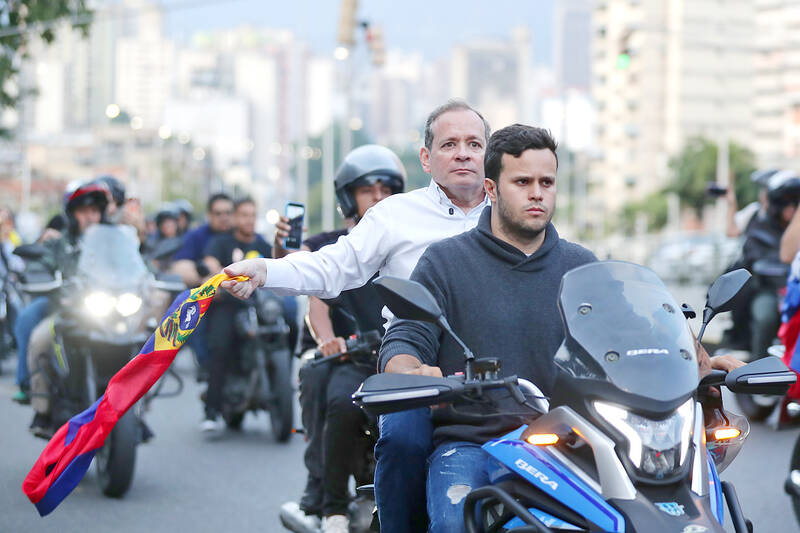
Photo: EPA
Machado claimed that her close ally had been “kidnapped” in the capital, Caracas, by armed men “dressed in civilian clothes” who took him away by force.
“We demand his immediate release,” she wrote on X.
The arrest came after his release from prison on Sunday along with two other opposition figures, and as lawmakers prepared to vote today on a historic amnesty law covering charges used to lock up dissidents in almost three decades of socialist rule.
Shortly after his release, Guanipa visited several detention centers in Caracas, where he met with relatives of political prisoners and spoke to the press.
Guanipa had appeared earlier on Sunday in a video posted on his X account, showing what looked like his release papers.
“Here we are, being released,” Guanipa said in the video, adding that he had spent “10 months in hiding, almost nine months detained here” in Caracas.
Speaking to reporters later on Sunday, he had called on the government to respect the 2024 presidential election, which opposition candidate Edmundo Gonzalez Urrutia was widely considered to have won. Maduro claimed victory and remained in power till last month.
“Let’s respect it. That’s the basic thing, that’s the logical thing. Oh, you don’t want to respect it? Then let’s go to an electoral process,” Guanipa said.
The opposition ally of Machado was arrested in May last year, in connection with an alleged conspiracy to undermine legislative and regional elections that were boycotted by the opposition.
He was charged with terrorism, money laundering and incitement to violence and hatred.
Guanipa had been in hiding prior to his arrest. He was last seen in public in January last year, when he accompanied Machado to an anti-Maduro rally.
Following Maduro’s capture by US special forces on Jan. 3, authorities have started to slowly release political prisoners. Rights groups estimate that about 700 people are still waiting to be freed.
A former Machado legal adviser, Perkins Rocha, was also freed on Sunday. So was Freddy Superlano, who once won a gubernatorial election in Barinas, a city that is the home turf of the iconic late socialist leader Hugo Chavez.
“We hugged at home,” Rocha’s wife, Maria Constanza Cipriani, wrote on X, with a photo of them.
Machado, who was awarded the 2025 Nobel Peace Prize for her efforts to advance democracy in Venezuela, had initially celebrated Guanipa’s release.
“My dear Juan Pablo, counting down the minutes until I can hug you! You are a hero, and history will ALWAYS recognize it. Freedom for ALL political prisoners!!” she wrote on X on Sunday.
Non-governmental organization Foro Penal said it had confirmed the release of 35 prisoners on Sunday. It said that since Jan. 8 nearly 400 people arrested for political reasons have been freed thus far.
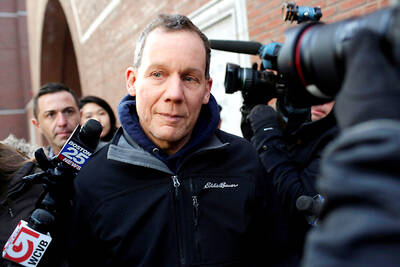
An American scientist convicted of lying to US authorities about payments from China while he was at Harvard University has rebuilt his research lab in Shenzhen, China, to pursue technology the Chinese government has identified as a national priority: embedding electronics into the human brain. Charles Lieber, 67, is among the world’s leading researchers in brain-computer interfaces. The technology has shown promise in treating conditions such as amyotrophic lateral sclerosis and restoring movement in paralyzed people. It also has potential military applications: Scientists at the Chinese People’s Liberation Army have investigated brain interfaces as a way to engineer super soldiers by boosting
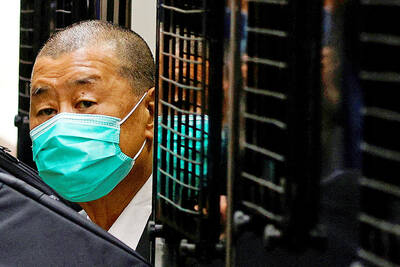
Jailed media entrepreneur Jimmy Lai (黎智英) has been awarded Deutsche Welle’s (DW) freedom of speech award for his contribution to Hong Kong’s pro-democracy movement. The German public broadcaster on Thursday said Lai would be presented in absentia with the 12th iteration of the award on June 23 at the DW Global Media Forum in Bonn. Deutsche Welle director-general Barbara Massing praised the 78-year-old founder of the now-shuttered news outlet Apple Daily for standing “unwaveringly for press freedom in Hong Kong at great personal risk.” “With Apple Daily, he gave journalists a platform for free reporting and a voice to the democracy movement in
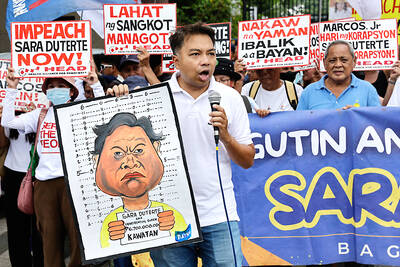
PHILIPPINE COMMITTEE: The head of the committee that made the decision said: ‘If there is nothing to hide, there is no reason to hide, there is no reason to obstruct’ A Philippine congressional committee on Wednesday ruled that there was “probable cause” to impeach Philippine Vice President Sara Duterte after hearing allegations of unexplained wealth, misuse of state funds and threats to have the president assassinated. The unanimous decision of the 53-member committee in the Philippine House of Representatives sends the two impeachment complaints to deliberations and voting by the entire lower chamber, which has more than 300 lawmakers. The complaints centered on Duterte’s alleged illegal use and mishandling of intelligence funds from the vice president’s office, and from her time as education secretary under Philippine President Ferdinand Marcos Jr. Duterte and the
Burmese President Min Aung Hlaing yesterday cut all prisoners’ sentences by one-sixth, a blanket measure that a source close to deposed leader Aung San Suu Kyi said would further shorten her detention. Aung San Suu Kyi has been sequestered since a 2021 military coup, but the senior member of her dissolved National League for Democracy (NLD) party said that while her term had been reduced, her remaining sentence is still unclear. “We also don’t know exactly how many years she has left,” the source told reporters, speaking on condition of anonymity for security reasons. The military toppled Aung San Suu Kyi’s elected government


 RSS
RSS