


The stories seem as tall as the lake is deep. For hundreds of years, visitors to Scotland’s Loch Ness have described seeing a monster that some believe lurks in the depths.
However, now the legend of “Nessie” might have no place left to hide.
A New Zealand scientist is leading an international team to the lake next month, where they are to take samples of the murky waters and conduct DNA tests to determine what species live there.

Photo: AP
University of Otago professor Neil Gemmell said he is no believer in Nessie, but he wants to take people on an adventure and communicate some science along the way.
Besides, his kids think it is one of the coolest things he has ever done, he added.
One of the more far-fetched theories is that Nessie is a long-necked plesiosaur that somehow survived the period when dinosaurs became extinct.
Another theory is that the monster is actually a sturgeon or giant catfish.
Many believe the sightings are hoaxes or can be explained by floating logs or strong winds.
When creatures move about in water, they leave behind tiny fragments of DNA from their skin, feathers, scales and urine, Gemmell said.
He said his team is to take 300 samples of water from different points around the lake and at different depths, then filter the organic material, extract the DNA and sequence it by using technology originally created for the human genome project.
The DNA results would then be compared against a database of known species, he said, adding that they should have answers by the end of the year.
“I’m going into this thinking it’s unlikely there is a monster, but I want to test that hypothesis,” Gemmell said. “What we’ll get is a really nice survey of the biodiversity of the Loch Ness.”
He said the real discoveries might come in determining things like the prevalence of invasive species.
Gemmell, 51, said he first visited Loch Ness in his late 20s while on vacation. Like thousands of tourists before him, he gazed out over the lake trying to catch sight of a monster.
He said he first came up with the idea of testing DNA from the lake a couple of years ago and it resonated with many, including his children, aged seven and 10.
Scottish Society of New Zealand chief Graeme Matheson said he has also visited Loch Ness and gazed out over the water, and that he wishes Gemmell all the best.
“I hope he and his cohorts find something, although I think they’ll be battling,” Matheson said. “Still, it’s a good way to get a trip to Scotland.”
Gemmell said that even if they do not find any monster DNA, it would not deter some Nessie believers.
He said they have already been offering him theories, like that Nessie might be on vacation after swimming to the sea via hidden underwater caves, or that the creature might be extraterrestrial and not leave behind any DNA.
“In our lives we want there still to be mysteries, some of which we will ultimately solve,” Gemmell said. “That’s part of the spirit of discovery, and sometimes, what you find may not be what you were expecting.”

An American scientist convicted of lying to US authorities about payments from China while he was at Harvard University has rebuilt his research lab in Shenzhen, China, to pursue technology the Chinese government has identified as a national priority: embedding electronics into the human brain. Charles Lieber, 67, is among the world’s leading researchers in brain-computer interfaces. The technology has shown promise in treating conditions such as amyotrophic lateral sclerosis and restoring movement in paralyzed people. It also has potential military applications: Scientists at the Chinese People’s Liberation Army have investigated brain interfaces as a way to engineer super soldiers by boosting

Indonesian police have arrested 13 people after shocking images of alleged abuse against small children at a daycare center went viral, sparking outrage across the nation, officials said on Monday. Police on Friday last week raided Little Aresha, a daycare center in Yogyakarta on Java island, following a report from a former employee. CCTV footage circulating on social media showed children, most younger than two, lying on the floor wearing only diapers, their hands and feet bound with rags. The police have confirmed that the footage is authentic. Police said they also found 20 children crammed into a room just 3m by 3m. “So
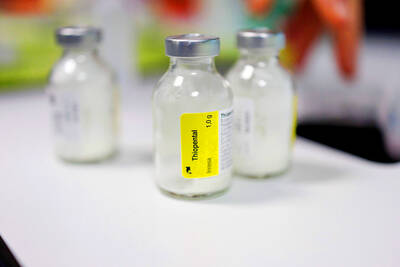
A grieving mother has ended her life at a clinic in Switzerland four years after the death of her only child. Wendy Duffy, 56, a physically healthy woman, died at the Pegasos clinic in Basel after struggling to cope with the death of her 23-year-old son, Marcus. The former care worker, from the West Midlands, England, had previously attempted to take her own life. The case comes as assisted dying would not become law in England and Wales after proposed legislation, branded “hopelessly flawed” by opponents, ran out of time. Ruedi Habegger, the founder of Pegasos, described Duffy’s death as

From post offices and parks to stations and even the summit of Mount Fuji, Japan’s vending machines are ubiquitous, but with the rapid pace of inflation cooling demand for their drinks, operators are being forced to rethink the business. Last month beverage giant DyDo Group Holdings announced it would remove about 20,000 vending machines — about 7 percent of their stock nationwide — by January next year, to “reconstruct a profitable network.” Pokka Sapporo Food & Beverage, based in Nagoya, also said last month it would sell its 40,000-machine operation to Osaka-based Lifedrink Co. “The strength of the vending machine


 RSS
RSS