


Elements of the Taliban are open to talks with the Afghan government, US Secretary of Defense James Mattis said on Tuesday, as he arrived in Kabul on an unannounced visit.
Mattis flew into the war-torn city two weeks after Afghan President Ashraf Ghani unveiled a plan to open peace talks with the Taliban. The insurgents have so far given no formal response to Kabul’s offer for negotiations, but Mattis said some insurgent leaders have expressed an interest in the discussions.
“It may not be that the whole Taliban comes over in one fell swoop, that would be a bridge too far, but there are elements of the Taliban clearly interested in talking to the Afghan government,” he told reporters aboard a military jet.
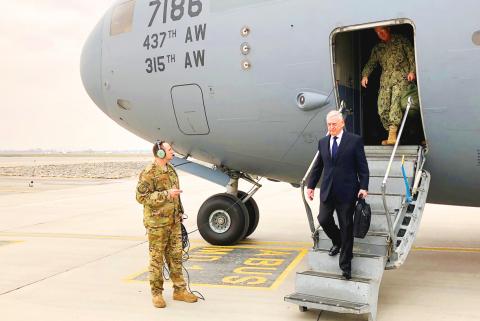
Photo: Reuters
Ghani’s peace plan includes eventually recognizing the Taliban as a political party.
The insurgent group has said it is prepared to negotiate, but only with the US and not with the Afghan government.
The Taliban last week described the Afghan government as “illegitimate” and its peace process efforts as “deceptive,” in a statement calling for a boycott of an Islamic academics’ conference in Jakarta.
“Right now we want the Afghans to lead and to provide the substance of the reconciliation effort,” Mattis said.
Thanks to the political process, Mattis said the US is now looking toward victory in Afghanistan after more than 16 years of conflict.
“What does that victory look like? It’s a country whose own people and their own security forces handle law enforcement and any threats ... certainly with international support for some years to come,” he said.
The US has a renewed focus on Afghanistan after years of drawdowns under former US president Barack Obama and talk by top US generals of “not winning” and of a “stalemate” in the seemingly intractable conflict.
“It’s all working to achieve a political reconciliation, not a military victory,” Mattis said. “The victory will be a political reconciliation.”
As part of the so-called South Asia Strategy, US President Donald Trump last year ordered the increased bombing of Taliban targets — including drugmaking labs and training camps. More than 3,000 additional US forces have also arrived in Afghanistan to boost the training and advising of local troops.
Approximately 14,000 US forces are now in Afghanistan, up from a low of about 8,500 when Obama left office.
Ghani’s offer of peace talks comes as civilian casualties have soared in recent months, with the Taliban increasingly targeting towns and cities in response to Trump’s new and more aggressive military policy.
The Taliban, Afghanistan’s biggest militant group, claimed 472 attacks in January alone, the Washington-based terrorism research group TRAC said — an astonishing number given that the traditional fighting season does not usually start until freezing temperatures have subsided in the spring.
Mattis said the jump in attacks on civilians was an indication that a pressured Taliban is unable to conduct broader, ground-taking operations.
The Afghan security forces were able to stop some attacks, Mattis said, although he added he wanted to see them shift to a more “offensive mindset” in the coming months.
Mattis’ surprise Afghan visit, his third as Pentagon chief, was kept under tight wraps after a security incident during his visit in September last year, when insurgents shelled Hamid Karzai International Airport hours after he arrived.
Mattis also said he had seen some changes in Pakistan’s behavior since Trump blasted the country last year for harboring the Taliban.
“There are operations by the Pakistan military that are helping right now, ongoing as we speak,” he said.

China’s military news agency yesterday warned that Japanese militarism is infiltrating society through series such as Pokemon and Detective Conan, after recent controversies involving events at sensitive sites. In recent days, anime conventions throughout China have reportedly banned participants from dressing as characters from Pokemon or Detective Conan and prohibited sales of related products. China Military Online yesterday posted an article titled “Their schemes — beware the infiltration of Japanese militarism in culture and sports.” The article referenced recent controversies around the popular anime series Pokemon, Detective Conan and My Hero Academia, saying that “the evil influence of Japanese militarism lives on in

ANTI-SEMITISM: Some newsletters promote hateful ideas such as white supremacy and Holocaust denial, with one describing Adolf Hitler as ‘one of the greatest men of all time’ The global publishing platform Substack is generating revenue from newsletters that promote virulent Nazi ideology, white supremacy and anti-Semitism, a Guardian investigation has found. The platform, which says it has about 50 million users worldwide, allows members of the public to self-publish articles and charge for premium content. Substack takes about 10 percent of the revenue the newsletters make. About 5 million people pay for access to newsletters on its platform. Among them are newsletters that openly promote racist ideology. One, called NatSocToday, which has 2,800 subscribers, charges US$80 for an annual subscription, although most of its posts are available

GLORY FACADE: Residents are fighting the church’s plan to build a large flight of steps and a square that would entail destroying up to two blocks of homes Barcelona’s eternally unfinished Basilica de la Sagrada Familia has grown to become the world’s tallest church, but a conflict with residents threatens to delay the finish date for the monument designed more than 140 years ago. Swathed in scaffolding on a platform 54m above the ground, an enormous stone slab is being prepared to complete the cross of the central Jesus Christ tower. A huge yellow crane is to bring it up to the summit, which will stand at 172.5m and has snatched the record as the world’s tallest church from Germany’s Ulm Minster. The basilica’s peak will deliberately fall short of the

Venezuelan Nobel peace laureate Maria Corina Machado yesterday said that armed men “kidnapped” a close ally shortly after his release by authorities, following former Venezuelan president Nicolas Maduro’s capture. The country’s Public Prosecutor’s Office confirmed later yesterday that former National Assembly vice president Juan Pablo Guanipa, 61, was again taken into custody and was to be put under house arrest, arguing that he violated the conditions of his release. Guanipa would be placed under house arrest “in order to safeguard the criminal process,” the office said in a statement. The conditions of Guanipa’s release have yet to be made public. Machado claimed that


 RSS
RSS