


US-backed Iraqi forces yesterday launched a large-scale military operation to dislodge Islamic State group militants from the western half of Mosul, a battle that is expected to be prolonged and difficult due to a densely packed civilian population and older, narrower streets.
In a briefed televised speech on state TV, Iraqi Prime Minister Haider al-Abadi announced the start of the operation, saying the government forces were moving to “liberate the people of Mosul from Daesh oppression and terrorism forever,” using the Arabic acronym for the Islamic State group.
Al-Abadi called on security forces to deal with civilians properly and respect human rights.
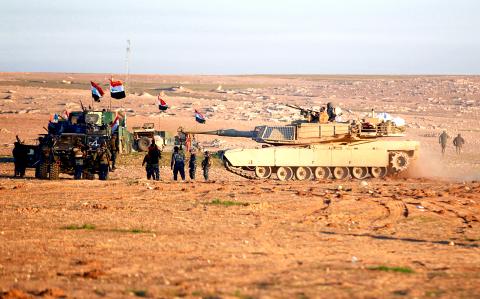
Photo: Reuters
Plumes of smoke were seen rising into the sky early yesterday morning as US-led coalition jets struck militant positions southwest of Mosul and militarized police fired artillery toward the city.
Heavily armed police units were getting ready to move north with their armored vehicles from a base just southwest of the city.
“This is zero hour and we are going to end this war, God willing,” police officer Mahmoud Mansour said as he prepared to move out.
The immediate objective of the operation was to take the villages on the southern outskirts of Mosul airport, a police spokesman told reporters, speaking on condition of anonymity in line with standard procedures.
Police units quickly moved into the village of Athba southwest of the city’s airport, encountering only light resistance, according to a reporter on the scene.
Separately, the army’s 9th armored division moved into the village of Bakhira, also southwest of the city, the Iraqi Ministry of Defense said.
Shortly after the announcement, the UN warned that hundreds of thousands of civilians trapped inside their houses “are at extreme risk” with dwindling fuel and food supplies and scare drinking water and electricity.
“The situation is distressing. People, right now, are in trouble,” UN Humanitarian Coordinator for Iraq Lise Grande said in a statement. “We are hearing reports of parents struggling to feed their children and to heat their homes.”
Citing informants from inside the western side, the UN said nearly half of all food shops were closed and bakeries had shut down due to a lack of fuel and an inability to purchase costly flour. Prices of kerosene and cooking gas have skyrocketed and many of the most destitute families are burning wood, furniture, plastic or garbage for cooking and heating.
Humanitarian agencies were gearing up to aid 250,000 to 400,000 civilians who may flee due to fighting, the statement said.
The UN estimates that about 750,000 civilians may be left in western Mosul.
The commander of Combined Joint Task Force Operation Inherent Resolve, US Lieutenant General Stephen Townsend, hailed the Iraqi forces in a statement as an “increasingly capable, formidable, and professional force.”
“Mosul would be a tough fight for any army in the world, and the Iraqi forces have risen to the challenge,” Townsend said.
“They have taken the fight to the enemy and sacrificed their blood for the people of Iraq and the rest of the world,” he said.

SPEAKING OUT: After Siranudh Scott’s allegations surfaced, celebrities and public figures took to social media to share their own experiences of sexual misconduct and abuse A high-profile alleged sexual abuse case within a wealthy Thai beer brewing family has prompted a wave of painful accounts from survivors of unconnected abuse in the conservative nation. Siranudh Scott, a member of the billionaire Thai family that founded the ubiquitous Singha beer brand, posted an emotional video this month accusing his elder brother Sunit of repeatedly abusing him when he was a teenager. Sunit, who is in his 30s, later denied the allegations in a video posted online, but Singha parent Boonrawd dismissed him from his executive role with the company on Tuesday last week. “I felt I needed to speak

SEEKING ORDER: Rodrigo Paz said that ‘anyone who wants to destroy the nation will have to deal with this president and the full force of the constitution’ Bolivian President Rodrigo Paz on Wednesday said that the nation was at a “breaking point” after nearly a month of protests that have caused shortages of food, fuel and medicine. Paz, who took office six months ago amid the worst economic crisis there in four decades, is battling a groundswell of fury over his policies. The political capital, La Paz, has been besieged by low-income workers and members of the indigenous majority calling for his resignation. “The country needs order and is reaching breaking point,” the 58-year-old said at a public event in La Paz, renewing his appeal for dialogue. On Tuesday, the Bolivian
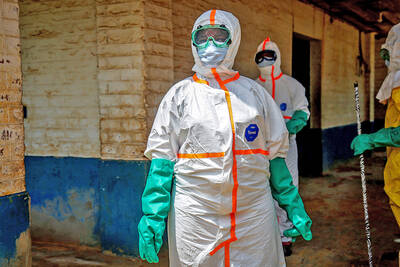
COMMUNITY CONFLICT: Concerns about disease spread from corpses has run up against friends and families’ desire to bury their dead as infection spreads in the area Angry residents of a town at the epicenter of the Ebola outbreak in the Democratic Republic of the Congo (DR Congo) attacked and burned a tent that was part of a health center where people are being treated for the virus, the staff there said Saturday. It was the second such attack in the region in a week. No one was hurt in the attack, according to reports but as patients ran out to escape the fire, 18 people with suspected Ebola infections fled the facility and are unaccounted for, a hospital director said. Angry residents arrived at the clinic in the

Forecasters in Europe yesterday warned of exceptional heat as record temperatures driven by a “heat dome” push temperatures well above seasonal norms across the continent. The surge follows a record-breaking Monday, with France logging its hottest day in the month of May on record, its weather agency said, and the UK also posting unprecedented highs. A so-called “heat dome” of warm air from northern Africa trapped under a high-pressure system over western Europe is behind the high temperatures not usually seen until high summer. Restrictions on outdoor work were imposed in parts of Italy, beaches in southwest France filled earlier than usual and


 RSS
RSS