


Deep from within the Indonesian jungle a solitary, seldom seen forest giant emerges from the undergrowth.
It is a Sumatran rhino, one of the rarest large mammals on Earth.
There are no more than 100 left on the entire planet and Andatu — a four-year-old male — is one of the last remaining hopes for the future of the species.
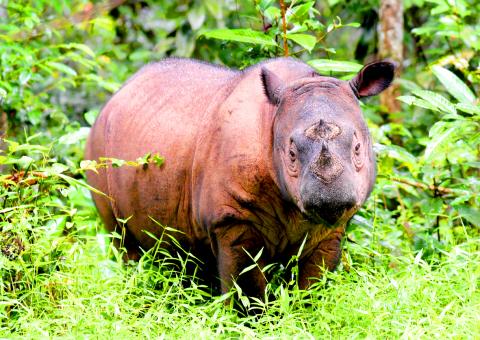
Photo: AFP
He is part of a special breeding program at Way Kambas National Park in eastern Sumatra that is trying to save the critically endangered species from disappearing forever.
The species is so rarely seen that even villagers living near the park were stunned when a wild rhino wandered into their community.
“They thought it was a mythical creature,” Sumatran Rhino Sanctuary at Way Kambas head veterinary surgeon Zulfi Arsan said. “They chased her and so we had to rescue her.”
Sumatran rhinos are the smallest of all rhinos and the only Asian variety with two horns.
Unlike their better-known cousins in Africa, Sumatran rhinos are born covered in shaggy, reddish-brown fur, earning them the nickname “hairy rhino.”
Their woolly covering fades to black or disappears almost entirely over their lifetimes, which span 35 to 40 years.
This hair — coupled with their smaller stature and short horns — gives Sumatran rhinos like Andatu a gentler, softer appearance than their imposing, armor-plated cousins.
They once roamed the vast, dense forests of Sumatra, Borneo and Malaysia, but land-clearing and poaching have devastated their numbers.
Last year, the species was declared extinct in the wild in Malaysia, leaving just tiny herds of two to five rhinos scattered across Sumatra and Indonesian Borneo.
Somewhere within the 1,300km2 of Way Kambas live an estimated 36 wild rhinos, Arsan said.
In Sumatra there are also small clusters in the west and the island’s northern Leuser ecosystem — the last place on Earth where wild rhinos, orangutans, tigers and elephants roam together.
Poaching is a serious threat. The last rhino killed in Way Kambas was in 2006, Arsan said, but staff take no chances in this section of lowland forest.
Armed rhino protection units patrol the habitat, disabling snares, and identifying authorities of intruders and suspicious activity.
“There’s still illegal activities inside the park,” Arsan said. “The demand for the horn, for rhino products, is still there.”
Three males, including Andatu, and four females are kept in a 100 hectare natural rainforest enclosure within Way Kambas, where vets and researchers take every opportunity to study their unusual breeding patterns.
Sumatran rhinos are notoriously difficult to breed in captivity. Females are only fertile for a small window each cycle and need male contact to ovulate. Even then, intercourse does not guarantee conception.
To make matters worse, Sumatran rhinos are solitary by nature and often clash upon interaction.
“In 100 years we’ve had just seven babies. It’s very hard,” Arsan said of historic efforts to breed the rhinos.
Andatu’s birth in 2012 was heralded as a milestone — he was the first Sumatran rhino born in an Asian breeding facility in more than 140 years.
Since then he has been joined by a sister, who arrived this May to much fanfare.
Andatu is close to reaching sexual maturity and conservationists hope he can play a star role in ensuring the longevity of the species.
“Every birth is a hope,” Arsan said.

An American scientist convicted of lying to US authorities about payments from China while he was at Harvard University has rebuilt his research lab in Shenzhen, China, to pursue technology the Chinese government has identified as a national priority: embedding electronics into the human brain. Charles Lieber, 67, is among the world’s leading researchers in brain-computer interfaces. The technology has shown promise in treating conditions such as amyotrophic lateral sclerosis and restoring movement in paralyzed people. It also has potential military applications: Scientists at the Chinese People’s Liberation Army have investigated brain interfaces as a way to engineer super soldiers by boosting

Jailed media entrepreneur Jimmy Lai (黎智英) has been awarded Deutsche Welle’s (DW) freedom of speech award for his contribution to Hong Kong’s pro-democracy movement. The German public broadcaster on Thursday said Lai would be presented in absentia with the 12th iteration of the award on June 23 at the DW Global Media Forum in Bonn. Deutsche Welle director-general Barbara Massing praised the 78-year-old founder of the now-shuttered news outlet Apple Daily for standing “unwaveringly for press freedom in Hong Kong at great personal risk.” “With Apple Daily, he gave journalists a platform for free reporting and a voice to the democracy movement in

PHILIPPINE COMMITTEE: The head of the committee that made the decision said: ‘If there is nothing to hide, there is no reason to hide, there is no reason to obstruct’ A Philippine congressional committee on Wednesday ruled that there was “probable cause” to impeach Philippine Vice President Sara Duterte after hearing allegations of unexplained wealth, misuse of state funds and threats to have the president assassinated. The unanimous decision of the 53-member committee in the Philippine House of Representatives sends the two impeachment complaints to deliberations and voting by the entire lower chamber, which has more than 300 lawmakers. The complaints centered on Duterte’s alleged illegal use and mishandling of intelligence funds from the vice president’s office, and from her time as education secretary under Philippine President Ferdinand Marcos Jr. Duterte and the

As evening falls in Fiji’s capital, a steady stream of people approaches a makeshift clinic that is a first line of defense against one of the world’s fastest-growing HIV epidemics. In the South Pacific nation — a popular tourist destination of just under a million people — more than 2,000 new HIV cases were recorded last year, a 26 percent increase from 2024. The government has declared an HIV outbreak and described it as a national crisis. “It’s spreading like wildfire,” said Siteri Dinawai, 46, who came to be tested. The Moonlight Clinic, a converted minibus parked in a suburban cul-de-sac in Suva, is


 RSS
RSS