


With poppy seeds hidden in his pouch, farmer Affarmer Nematullah from Afghanistan’s Helmand Province sidled out of Taliban territory to explain how he struck gold — two additional opium harvests a year, which could further roil Afghanistan’s conflict.
Afghanistan has all the trappings of a narco-state, with opium production — the lifeblood of the Taliban insurgency — from the traditional spring harvest alone edging toward a record high.
Farmers like Nematullah are now reaping two more crops — in midsummer and autumn — in parts of the volatile south, with experts citing genetically modified seeds and bold farming experiments as irrigation techniques improve and eradication efforts collapse.
“We used to have one annual poppy harvest — we now have three,” said Nematullah, a young farmer from the insurgency-wracked Kajaki district in northern Helmand.
“Helmand has a lot of war, a lot of land, and very little employment except fighting for the Taliban. Poppies are a blessing — it now gives us work throughout the year,” he said.
Nematullah snuck out of his village, a Taliban hotbed, to meet with reporters in the provincial capital, Lashkar Gah, bringing with him a handful of ivory-colored poppy seeds that he said grow well in the two new seasons.
Sourced from local traders, those seeds shorten the growth cycle of the plant to about 70 days compared with the usual five to six months, with largely the same quality of opium resin, many farmers said.
“Some parts of Helmand plant twice a year, because of the favorable climate, but three poppy seasons would be thanks to genetically modified seeds,” Afghanistan Analysts Network researcher Jelena Bjelica said.
“The seeds are believed to originate in China where legal opium cultivation is undertaken for pharmaceutical use,” Bjelica said, adding that it was unclear who was behind their distribution in Afghanistan.
Pink-and-white poppy blooms, which in some areas grow within eyeshot of government buildings, help bankroll the Taliban’s nationwide insurgency and present an existential threat to the Afghan state.
The Taliban, widely likened to a drug cartel, earn up to US$1.2 billion annually from taxing poppy farmers alone, Western officials say.
The new crops could further swell insurgent coffers, underscoring the stunning failure of the multibillion-dollar US war on drugs in Afghanistan as it pursued a war on terror there.
It could enhance not just their financial muscle to recruit more fighters, but also sway corrupt Afghan forces.
“Imagine if our soldiers get 10,000 Pakistani rupees [US$95.4] to defend government checkpoints; our enemy has the capacity to pay 50,000 rupees to abandon the same checkpoints,” a senior Helmand security official said, referring to the new crops.
Opium remains an economic linchpin for many farmers, who apparently have a strong preference for cultivation in areas under Taliban control.
The UN says the insurgents act “more like ‘godfathers’ than a ‘government in waiting.’”
The new poppy crops are reported in northern Helmand districts known for cooler summers, such as Nawzad, Musa Qala, Sangin and Kajaki — almost entirely under Taliban control — as well as some restive areas of neighboring Kandahar, Uruzgan and Zabul provinces.
“Diversification and experimentation by farmers includes the move to three opium poppy crops per year,” said David Mansfield, author of A State Built on Sand: How opium undermined Afghanistan.
“Cheaper technology is a dominating factor that has allowed these advancements,” he wrote.
The second and third crops require almost daily irrigation, and farmers were benefiting with improved access to water pumps and even solar-powered tube wells, Mansfield said.
However, the yields are limited as the crop matures quickly.
Mansfield estimates that cultivation of the second crop is likely to be under 10,000 hectares, while not much is known about the third.
Farmers said that they expect greater yields over the coming years, with many emboldened to experiment further following a cessation of the government’s costly eradication drive.
As multiple harvests become the new normal, poppy farmers are less inclined to do what was deemed necessary when the eradication risk was high: dedicating a part of their farmlands to less profitable cash crops for the sake of food security, he said.
“Opium is money,” Qasim said. “Why should we waste time growing wheat?”
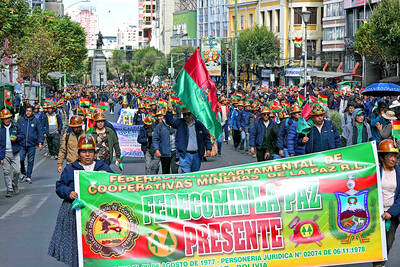
The Bolivian government on Friday struck a deal with protesting miners, but was still grappling with blockades and demonstrations by other workers across La Paz. Other groups are still blocking access roads into the city, which is also the seat of the government. Police on Thursday prevented the miners from entering the main square by using tear gas, while the demonstrators hurled stones and explosives with slingshots. Protests against the policies of Bolivian President Rodrigo Paz have convulsed the Andean nation since early this month, and roadblocks were choking routes into La Paz throughout Friday, the national road authority said. Miners demanded that Paz
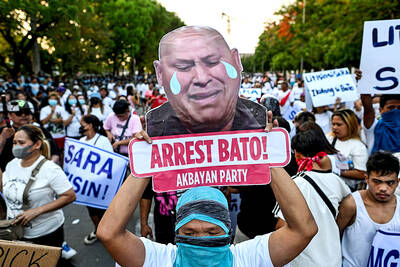
The Philippines said it has asked the country’s Supreme Court to allow it to arrest former Philippine president Rodrigo Duterte’s chief drug war enforcer to stand trial in an international tribunal. The International Criminal Court (ICC) last week unsealed an arrest warrant against Philippine Senator Ronald dela Rosa, accusing him along with Duterte and other “coperpetrators” of the “crime against humanity of murder.” Dela Rosa briefly sought refuge in the Philippine Senate last week while asking the Philippine Supreme Court to stop an ongoing attempt by government agents to arrest him. “By his own conduct, he has placed himself outside the protection of

A ship anchored off the United Arab Emirates (UAE) was seized and taken toward Iran and another — a cargo ship near Oman — sank after being attacked, authorities said on Thursday, as tensions escalated near the Strait of Hormuz. It was not immediately clear who was behind these incidents, but they happened as a senior Iranian official reiterated his country’s claim of control over the waterway and another said it had a right to seize oil tankers connected to the US. The turmoil in the strait has been a sticking point for weeks in talks between the US and Iran to
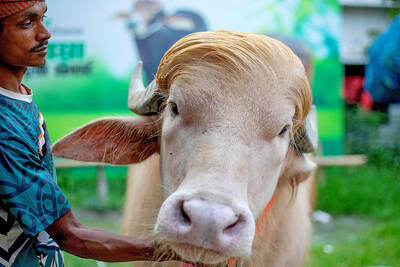
Crowds in Bangladesh are flocking to snap photographs with an unlikely social media star — an albino buffalo with flowing blond hair nicknamed “Donald Trump” that is due to be sacrificed within days. Owner Zia Uddin Mridha, 38, said his brother named the 700kg bull over its flowing helmet of hair resembling the signature look of the US president. “My younger brother picked this name because of the buffalo’s extraordinary hair,” he said at his farm in Narayanganj, just outside the capital, Dhaka. Mridha said that a constant stream of curious visitors — social media fans, onlookers and children — have come throughout


 RSS
RSS