


An explosion that destroyed a New York City home and killed a firefighter has drawn attention to marijuana-making methods that are legal in many US states — but can also be lethal.
A New York fire battalion chief died responding to the blast on Tuesday in a Bronx home that authorities say had been converted into an indoor marijuana farm.
They are investigating whether the alleged growers tampered with gas lines and mishandled other materials in ways that caused the explosion.
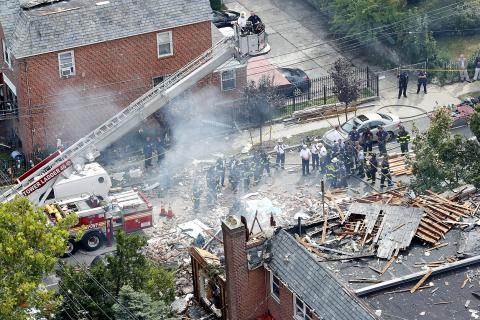
Photo:AP
Indoor marijuana farmers can create potential fire hazards by using natural gas, propane or butane to power carbon dioxide generators that make the plants grow. In recent years across the US, similar methods used to produce more potent marijuana extracts have resulted in explosions and other catastrophes.
Indoor gas use “is a standard way to grow marijuana,” said Michael O’Hare, a professor at the University of California in Berkeley who is an expert in cannabis cultivation. “If you raise the [carbon dioxide] level, it’ll grow faster.”
Some growers rely on propane or butane gas because using large amounts of metered gas from a utility could draw the attention of authorities, who might question why so much fuel is needed for a house of a certain size, O’Hare said.
In those conditions, a gas leak could spell disaster, he said.
An hour before the explosion at about 7:30am on Tuesday in the Bronx, dozens of nearby residents said they could smell gas wafting over the neighborhood.
The house had already been evacuated and fire personnel were on the scene when the blast sent debris flying, killing Chief Michael Fahy, a 17-year fire department veteran and father of three.
His funeral was held on Saturday.
Two suspects, Garivaldi Castillo and Julio Salcedo, were arrested and are being held on drug charges while authorities try to determine whether there is evidence that could result in more serious counts related to Fahy’s death.
Prosecutors said in court this week that the two-story Bronx property was full of combustible items related to the pot operation, including grow lamps and vats of liquid fertilizer. Windows were sealed and other areas covered with extra insulation to retain heat. Plants the size of “small trees” were growing in bedrooms on the upper floor.
A lawyer for the 32-year-old Castillo has questioned his connections to the house. Castillo has pleaded not guilty.
Salcedo, 34, was arraigned late on Friday, pleaded not guilty and was being held without bail.
Firefighters packed the courthouse where Salcedo was arraigned.
Earlier, as he walked into a Bronx precinct, some firefighters told him to “burn in hell,” the New York Daily News reported.

When a hiker fell from a 55m waterfall in wild New Zealand bush, rescuers were forced to evacuate the badly hurt woman without her dog, which could not be found. After strangers raised thousands of dollars for a search, border collie Molly was flown to safety by a helicopter pilot who was determined to reunite the pet and the owner. A week earlier, an emergency rescue helicopter found the woman with bruises and lacerations after a fall at a rocky spot at the waterfall on the South Island’s West Coast. She was airlifted on March 24, but they were forced to

HIGH HOPES: The power source is expected to have a future, as it is not dependent on the weather or light, and could be useful for places with large desalination facilities A Japanese water plant is harnessing the natural process of osmosis to generate renewable energy that could one day become a common power source. The possibility of generating power from osmosis — when water molecules pass from a less salty solution to a more salty one — has long been known. However, actually generating energy from that has proved more complicated, in part due the difficulty of designing the membrane through which the molecules pass. Engineers in Fukuoka, Japan, and their private partners think they might have cracked it, and have opened what is only the world’s second osmotic power plant. It generates

Hundreds of Filipinos and tourists flocked to a sun-bleached field north of Manila yesterday, on Good Friday, to witness one of the country’s most blood-soaked displays of religious fervor, undeterred by rising fuel prices. Scores of bare-chested flagellants with covered faces walked barefoot through the dusty streets of Pampanga Province’s San Fernando as they flogged their backs with bamboo whips in the scorching heat. Agence France-Presse (AFP) journalists said they saw devotees deliberately puncturing their skin with glass shards attached to a small wooden paddle to ensure their bleeding during the ritual, a way to atone for sins and seek miracles from

Chinese dissident artist Gao Zhen (高兟), famous for making provocative satirical sculptures of former Chinese leader Mao Zedong (毛澤東), was tried on Monday over accusations of “defaming national heroes and martyrs,” his wife and a rights group said. Gao, 69, who was detained in 2024 during a visit from the US, faces a maximum three-year prison sentence, said his wife, Zhao Yaliang (趙雅良), and Shane Yi, a researcher at the Chinese Human Rights Defenders group which operates outside the nation. The closed-door, one-day trial took place at Sanhe City People’s Court in Hebei Province neighboring the capital, Beijing, and ended without a


 RSS
RSS