


The Bastille Day attack in Nice — the third terrorist attack to hit France in 18 months — has sparked anger and racism, putting further strain on an already tense political atmosphere.
“What is clear is that it has brought to the surface the fault lines which were always there but which were not so apparent,” sociologist Michel Wieviorka told reporters.
“When people can boo the [French] prime minister and talk in an openly racist way,” norms have been shaken, he said.
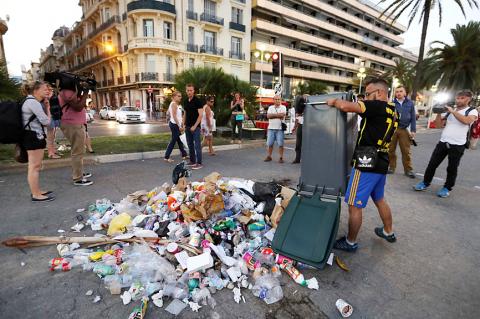
Photo: AFP
French President Francois Hollande has said “anger is legitimate” in the wake of the July 14 attack in Nice, in which Tunisian Mohamed Lahouaiej Bouhlel killed 84 people as he rammed a truck through a crowd watching fireworks for France’s national day.
“After such a shock, anger is legitimate, because our compatriots were killed, and innocent people hit,” Hollande said. “But it cannot degenerate into hate and suspicion.”
In Nice, rubbish has been heaped on the spot on the Promenade des Anglais where Bouhlel — who the Islamic State group has claimed as one of its “soldiers,” although investigators have found no direct proof of allegiance — was finally shot dead.
Chalked on the ground next to the heap of rubbish is the word “coward.”
However, some of the anger has also been directed at Muslims — even though, as the city’s mayor said, they were “probably the worst hit by this attack.”
According to local imams, about a third of the dead were Muslims.
Even at a minute’s silence in the Riviera city for the victims on Monday last week, anger and hatred boiled over as a video which has been viewed more than 6 million times on Facebook makes clear.
“Go back to where you come from,” a middle-aged man shouted at a young woman of North African origin.
“I was born in France, sir,” she replied. “Where should I go?”
“You are a shame on France,” he shouted back, with some in the crowd supporting him, as a policeman stepped in to intervene.
At the same ceremony, French Prime Minister Manuel Valls was a target for sustained booing, with people shouting out that he should resign.
“Violence is lurking a bit everywhere in France,” Wieviorka said, referring to months of clashes at nationwide street protests against changes to the country’s labor laws.
“We are experiencing something which is being made worse by the political context with presidential [and parliamentary] terms coming to an end. All this creates conditions which maximize the impact of terror,” the sociologist added.
In contrast with the huge street protests that united France after the Charlie Hebdo and kosher supermarket killings in January last year, the Nice attack has poisoned the political climate.
Nine months from May next year’s presidential election, the right and far-right opposition parties are lambasting the ruling Socialists, whose popularity has sunk to a record low.
French Minister of the Interior Bernard Cazeneuve has come under intense pressure to resign, claiming that he was the victim of an “undignified” campaign to discredit him orchestrated by Nice’s right-wing former mayor Christian Estrosi.
The row became even uglier on Sunday when a senior policewoman said the minister had pressured her to alter a report into security in Nice on the night of the attack.
Cazeneuve categorically denied the allegations and threatened to sue.
Her claims came only days after local authorities resisted a request to wipe “shocking” security camera footage of the carnage which prosecutors said they feared might leak out.
The Nice massacre was the third mass killing in France in 18 months after the Charlie Hebdo attack and November last year’s carnage in Paris.
In all, 230 people have been killed and several hundred injured, a toll never before seen in peace time in France’s modern history.
Top security officials recently admitted to a parliamentary inquiry that they were worried about the repeated impact of such killings.
“It puts the resilience of French society into question,” France’s Directorate-General for External Security director Bernard Bajolet said.
He said France had to strengthen itself “morally” for a struggle over a very long period.
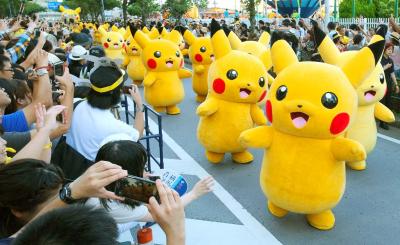
China’s military news agency yesterday warned that Japanese militarism is infiltrating society through series such as Pokemon and Detective Conan, after recent controversies involving events at sensitive sites. In recent days, anime conventions throughout China have reportedly banned participants from dressing as characters from Pokemon or Detective Conan and prohibited sales of related products. China Military Online yesterday posted an article titled “Their schemes — beware the infiltration of Japanese militarism in culture and sports.” The article referenced recent controversies around the popular anime series Pokemon, Detective Conan and My Hero Academia, saying that “the evil influence of Japanese militarism lives on in

ANTI-SEMITISM: Some newsletters promote hateful ideas such as white supremacy and Holocaust denial, with one describing Adolf Hitler as ‘one of the greatest men of all time’ The global publishing platform Substack is generating revenue from newsletters that promote virulent Nazi ideology, white supremacy and anti-Semitism, a Guardian investigation has found. The platform, which says it has about 50 million users worldwide, allows members of the public to self-publish articles and charge for premium content. Substack takes about 10 percent of the revenue the newsletters make. About 5 million people pay for access to newsletters on its platform. Among them are newsletters that openly promote racist ideology. One, called NatSocToday, which has 2,800 subscribers, charges US$80 for an annual subscription, although most of its posts are available
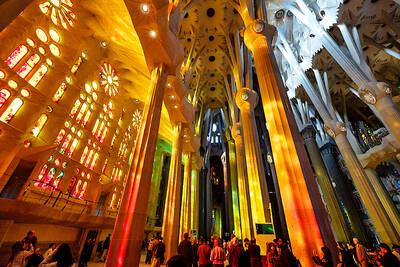
GLORY FACADE: Residents are fighting the church’s plan to build a large flight of steps and a square that would entail destroying up to two blocks of homes Barcelona’s eternally unfinished Basilica de la Sagrada Familia has grown to become the world’s tallest church, but a conflict with residents threatens to delay the finish date for the monument designed more than 140 years ago. Swathed in scaffolding on a platform 54m above the ground, an enormous stone slab is being prepared to complete the cross of the central Jesus Christ tower. A huge yellow crane is to bring it up to the summit, which will stand at 172.5m and has snatched the record as the world’s tallest church from Germany’s Ulm Minster. The basilica’s peak will deliberately fall short of the
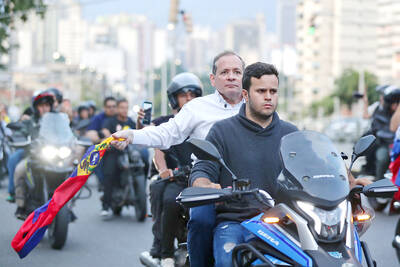
Venezuelan Nobel peace laureate Maria Corina Machado yesterday said that armed men “kidnapped” a close ally shortly after his release by authorities, following former Venezuelan president Nicolas Maduro’s capture. The country’s Public Prosecutor’s Office confirmed later yesterday that former National Assembly vice president Juan Pablo Guanipa, 61, was again taken into custody and was to be put under house arrest, arguing that he violated the conditions of his release. Guanipa would be placed under house arrest “in order to safeguard the criminal process,” the office said in a statement. The conditions of Guanipa’s release have yet to be made public. Machado claimed that


 RSS
RSS