


The doctors told Victoria Vigo her third child must be born by caesarean section.
It was safest, they said — she was seven months pregnant and there were complications.
They cut her open — but they did not stop there. Without telling her, they also tied her fallopian tubes. She would have no more children.
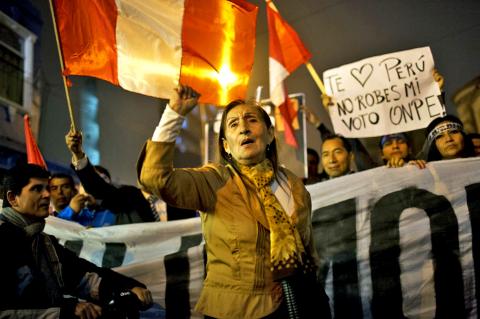
Photo: AP
Her baby died and Vigo became one of 300,000 people campaigners say were forcibly sterilized by the Peruvian state between 1996 and 2001.
Next month, thousands of them hope to learn whether the courts would agree to investigate charges against the man they blame: then-Peruvian president Alberto Fujimori.
“What most upset me was the death of my son. But what’s more, I heard they had sterilized me. I felt impotent, angry,” Vigo said.
“I wasn’t expecting it,” she said. “I was outraged. The doctor had never come and talked about the decision with me.”
Vigo, 32 at the time of the operation, sued the doctor who sterilized her.
“He said he was following orders,” she said.
Five years later, a court awarded her US$2,500 in compensation.
What she really wants is for Fujimori and his former health ministers to go on trial.
Fujimori’s government called it a “reproductive health and family planning” program.
Rights groups say it was something much darker.
“Fujimori said he wanted to guarantee that women could decide how many children they wanted to have,” said Maria Ysabel Cedano, leader of the Peruvian women’s rights group DEMUS.
“In practice, what he wanted was for poor women and men to stop reproducing,” she said.
“Those most affected were poor [indigenous] women, Quechua speakers in rural areas, young women,” she added.
Peru’s first lady at the time was Fujimori’s daughter, Keiko. She wants to follow in her father’s footsteps by becoming Peru’s leader.
Officials are counting the last votes from a presidential election on Sunday.
Fujimori’s rival Pedro Pablo Kuczynski had a slim lead on Wednesday with more than 99 percent of the ballots counted.
Keiko Fujimori, 41, has promised to compensate the victims of the forced sterilizations. She has not admitted the state was to blame.
Kuczynski has described the sterilizations as “a crime against humanity.”
He says the state owes the victims compensation.
“That reassures me somewhat,” 56-year-old Alfonso Ramos said.
His sister Celia died in 1997 after a botched sterilization in the family’s home city of Piura.
He says health officials came repeatedly to his sister’s house pressuring her to agree to be sterilized.
“She did not want to. She resisted,” he said. “They offered the family food and medicine if she would do it. And in the end she did.”
Celia Ramos was in such pain after the operation that doctors gave her a second anesthetic, her brother said. That gave her a heart attack. She fell into a coma and died weeks later.
She was 33 and had three young children.
“The state has never compensated them to help repair the harm done,” her brother said. “It is frustrating, but even so I think that one day there will be justice.”
State prosecutors had been expected to announce in February whether they would formally investigate the victims’ charges against Fujimori and his ex-officials.
The date of that hearing was postponed. It is now expected early next month.
DEMUS said the hearing was postponed due to “political interference” to protect Keiko Fujimori’s election chances.
According to the rights group and Peru’s state ombudsman, about 300,000 people were sterilized under the program. Of those, Cedano estimates that 23,000 were men who were made to undergo vasectomies.
Amnesty International’s regional director Erika Guevara-Rosas last year called the sterilizations “one of the most serious human rights violations in the Americas.”
Cedano says doctors were pressured to meet quotas for sterilizations.
The evidence, she says, is in documents filed by lawyers for more than 4,000 people who are suing the Peruvian state.

PHISHING: The con might appear convincing, as the scam e-mails can coincide with genuine messages from Apple saying you have run out of storage For a while you have been getting messages from Apple saying “your iCloud storage is full.” They say you have exceeded your storage plan, so documents are no longer being backed up, and photos you take are not being uploaded. You have been resisting Apple’s efforts to get you to pay a minimum of £0.99 (US$1.33) a month for more storage, but it seems that you cannot keep putting off the inevitable: You have received an e-mail which says your iCloud account has been blocked, and your photos and videos would be deleted very soon. To keep them you need

For two decades, researchers observed members of the Ngogo chimpanzee group of Kibale National Park in Uganda spend their days eating fruits and leaves, resting, traveling and grooming in their tropical rainforest abode, but this stable community then fractured and descended into years of deadly violence. The researchers are now describing the first clearly documented example of a group of wild chimpanzees splitting into two separate factions, with one launching a series of coordinated attacks against the other. Adult males and infants were targeted, with 28 deaths. “Biting, pounding the victim with their hands, dragging them, kicking them — mostly adult males,
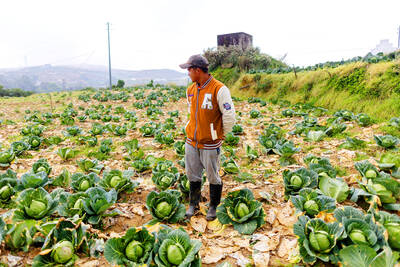
Filipino farmers like Romeo Wagayan have been left with little choice but to let their vegetables rot in the field rather than sell them at a loss, as rising oil prices linked to the Iran war drive up the cost of harvesting, labor and transport. “There’s nothing we can do,” said Wagayan, a 57-year old vegetable farmer in the northern Philippine province of Benguet. “If we harvest it, our losses only increase because of labor, transportation and packing costs. We don’t earn anything from it. That’s why we decided not to harvest at all,” he said. Soaring costs caused by the Middle East
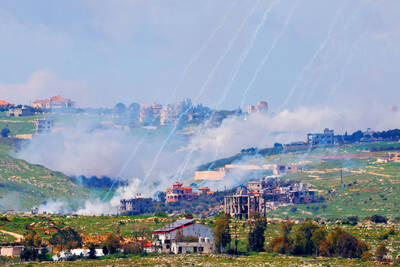
The Israeli military has demolished entire villages as part of its invasion of south Lebanon, rigging homes with explosives and razing them to the ground in massive remote detonations. The Guardian reviewed three videos posted by the Israeli military and on social media, which showed Israel carrying out mass detonations in the villages of Taybeh, Naqoura and Deir Seryan along the Israel-Lebanon border. Lebanese media has reported more mass detonations in other border villages, but satellite imagery was not readily available to verify these claims. The demolitions came after Israeli Minister of Defense Israel Katz called for the destruction of


 RSS
RSS