


Lashes swished and whirled through the air in a burst of celebration around a sea of opium poppies, as farmers in a southern Afghan village rejoiced over a bumper harvest with a traditional rope game.
Hundreds of farm laborers from across Afghanistan’s Pashtun heartland, many of them Taliban, last month congregated in Naqil in Uruzgan Province for the most lucrative time of the year — the poppy harvest.
After laboring all day in the torpid heat, extracting milky opium resin from swollen green pods, they broke into revelry around the bountiful farms.
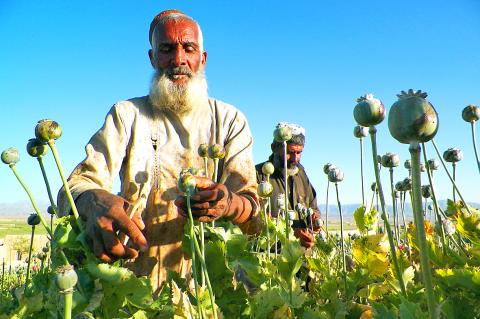
Photo: AFP
Hands tethered to long ropes, men lunged forward and back within a chalk circle, kicking up dust and knocking down opponents with heavy lash strokes.
Hissing and hooting, a crowd of turbaned spectators gathered to watch the bare-knuckle game known colloquially as dora.
A tricycle cart pulled up nearby, selling ice-cream drizzled with raspberry sauce, lending a carnival atmosphere to the harvest that is expected to bring record opium production this year.
“This is the only time of the year to make money,” said Afzal Mohammad, who traveled all the way from Kandahar, standing amid chest-high poppy stalks nearby. “People work here for about 15 days and then are jobless for the rest of the year.”
The revelry highlights how opium — refined into heroin — remains an economic linchpin amid rampant unemployment, and lays bare how the West lost a multibillion US dollar war on drugs in Afghanistan as it pursued a war on terror there.
Afghanistan, the world’s top opium producer, recorded more poppy cultivation in 2014 — at the end of which NATO troops officially ended their combat mission — than in any year since 2002.
Last year saw a sharp decline in production, but the crop failure was more due to drought than any eradication campaign, according to the UN Office on Drugs and Crime.
The drop, observers say, has only intensified efforts to spike production this year.
MAKE OPIUM, NOT WAR
Fighting usually ebbs during the harvest season, illustrating how the Taliban are deeply entwined in the US$3 billion opium trade, believed to be the mainstay of their insurgency against the government.
“As the harvest concludes ... we expect to see an uptick in Taliban efforts to attack [Afghan forces],” said Charles Cleveland, a senior spokesman for US forces in Afghanistan. “There is a concern that the very good poppy crop this year ... is going to result in the Taliban being able to turn that into money for their [insurgent] efforts.”
The ubiquity of opium farms in Uruzgan, a remote mountainous province straddling drug-smuggling routes, is staggering.
Poppy grows within eyeshot of the provincial governor’s office in the capital, Tarin Kot, government buildings and police bases, spurring allegations that officials are also profiting from the opium boom.
“We are in a state of war,” Uruzgan Governor Mohammad Nazir Kharoti said, voicing helplessness. “Forced eradication will increase economic hardship, fueling sympathy for the Taliban and people will start sheltering them in their homes.”
Naqil, hemmed in between verdant hills on the outskirts of Tarin Kot, is a netherworld of opium farmers, drug lords, addicts and, increasingly, the Taliban.
It is officially under government control, but authorities are openly wary about visiting the area.
With rolling fields of white-and-pink flowers splashed between dull green opium pods visible as far as the eye can see, Naqil is a magnet for laborers during harvest time.
‘LANCE WITH LOVE’
The bulbs are typically lanced during the afternoon and left for the night as a sticky resin oozes out and coagulates into a dark brown mass.
The laborers collect the sap in the mornings with a flat blade and wipe it into a plastic can hanging around their necks.
Many wax philosophical about the process, almost as though it were an act of veneration.
“Cradle the poppy bulb gently,” Sher Mohammed said, going from bulb to bulb in his farm, making shallow incisions with sharp blades on the tip of a curved wooden spatula. “Lance the bulb with love.”
For many, the labor-intensive season, which lasts less than a month, is the only productive period; the rest of the year is a hopeless blur.
“Afghanistan has too much war, very little employment,” said tribal elder Abdul Bari Tokhi, whose extended family owns more than 100 hectares of farmland in Naqil. “The world might say: ‘If there was no poppy, there would be no war in Afghanistan,’ but for us, if there was no poppy, there would be no work and no food on the table.”

A humanoid robot that won a half-marathon race for robots in Beijing on Sunday ran faster than the human world record in a show of China’s technological leaps. The winner from Honor, a Chinese smartphone maker, completed the 21km race in 50 minutes and 26 seconds, said a WeChat post by the Beijing Economic-Technological Development Area, also known as Beijing E-Town, where the race began. That was faster than the human world record holder, Ugandan Jacob Kiplimo, who finished the same distance in about 57 minutes in March at the Lisbon road race. The performance by the robot marked a significant step forward

Four contenders are squaring up to succeed Antonio Guterres as secretary-general of the UN, which faces unprecedented global instability, wars and its own crushing budget crisis. Chile’s Michelle Bachelet, Argentina’s Rafael Grossi, Costa Rica’s Rebeca Grynspan and Senegal’s Macky Sall are each to face grillings by 193 member states and non-governmental organizations for three hours today and tomorrow. It is only the second time the UN has held a public question-and-answer, a format created in 2016 to boost transparency. Ultimately the five permanent members of the UN’s top body, the Security Council, hold the power, wielding vetoes over who leads the

An earthquake registering a preliminary magnitude of 7.7 off northern Japan on Monday prompted a short-lived tsunami alert and the advisory of a higher risk of a possible mega-quake for coastal areas there. The Cabinet Office and the Japan Meteorological Agency said there was a 1% chance for a mega-quake, compared to a 0.1% chance during normal times, in the next week or so following the powerful quake near the Chishima and Japan trenches. Officials said the advisory was not a quake prediction but urged residents in 182 towns along the northeastern coasts to raise their preparedness while continuing their daily lives. Prime
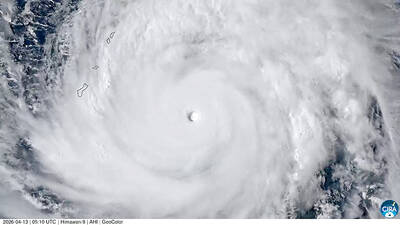
HAZARDOUS CONDITION: The typhoon’s sheer size, with winds extending 443km from its center, slowed down the ability of responders to help communities, an official said The US Coast Guard was searching for six people after losing contact with their disabled boat off the coast of Guam following Typhoon Sinlaku. The crew of the 44m dry cargo vessel, the US-registered Mariana, on Wednesday notified the coast guard that the boat had lost its starboard engine and needed assistance, Petty Officer 3rd Class Avery Tibbets said yesterday. The coast guard set up a one-hour communication schedule with the vessel, but lost contact on Thursday. A Coast Guard HC-130 Hercules aircraft was launched to search for the six people on board, but it had to return to Guam because of


 RSS
RSS