


Colombia’s widespread illegal mining is blamed for causing environmental damage and holding workers in slave-like conditions — and now is also being blamed for a malaria outbreak.
Critics point to stagnant water buildups at the clandestine sites and poor sanitary conditions at the workers’ camps for an increase in mosquitoes spreading the disease, which has quadrupled in jungle regions of the hard-hit and impoverished western department of Choco.
“The country had more or less controlled its malaria problem... The death rate had dropped significantly,” Colombian Minister of Health Alejandro Gaviria said this week. “But because of illegal mining ... we’ve had hotspots since last year and especially this year.”
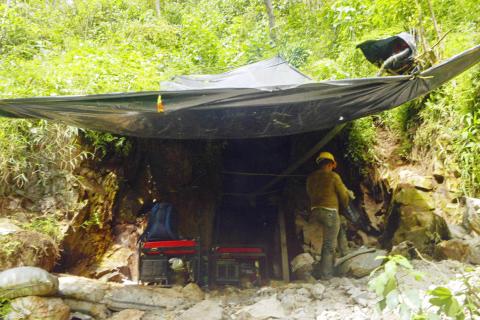
Photo: AFP
Speaking on RCN radio, Gaviria said that malaria was especially on the rise in Choco — which stretches from the border with Panama along a stretch of Colombia’s Pacific coastline — as well as the Bajo Cauca area to the east.
The Colombian National Health Institute counted 18,524 malaria cases and about 300 cases of the disease’s more severe strain.
A year earlier, only 4,740 cases of malaria were recorded.
However, outbreaks of malaria due to clandestine mining are not new.
“Population displacement linked to the exploitation of gold mines [and resulting deforestation] has previously created isolated epidemics of malaria” in Latin America, the health institute said.
Mining is a major source of revenue for Colombia.
In 2012, the last year for which official figures are available, legal mining accounted for 2.3 percent of GDP, or US$8.5 billion.
However, authorities say that more than half of Colombia’s mining sites are illegal.
In these illegal mines, which help finance illegal armed groups, “excavators dig huge holes where water accumulates, perfect breeding grounds for malaria-carrying mosquitoes,” University of Antioquia researcher Ivan Dario Velez said.
And the sites where the miners set up camp “usually lack public utilities and have very poor hygiene conditions, which encourages the spread of mosquito and thus the disease,” he said.
Malaria symptoms include feverish headaches, chills, fatigue, nausea and vomiting.
Last year, about 214 million people suffered from malaria, of which 438,000 died from the disease, according to the WHO.
Most of those who died were children under five, the vast majority of them in Africa.
The malaria death rate has dropped 72 percent in South America since 2000, and the WHO expects to eradicate the disease in eight Latin American countries by 2020.
The outbreak in Choco is also linked to a shortage of medicine to fight the disease, the health minister said.
Gaviria said about 7,000 doses of needed medicine are being sent to the department, the poorest in the country.
From last year to this year, about 30 people died of malaria, most in isolated communities far from urban centers, according to the Office of the Ombudsman, which that warned this week of a “worrisome increase” in cases.
Separately, in February, officials launched an investigation into the deaths of 37 children and the poisoning of 64 others in the Choco region. The victims suffered from symptoms said to be linked to mercury, which is commonly used in illegal mining.
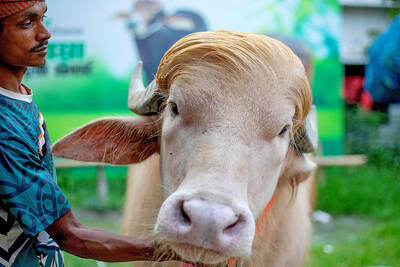
Crowds in Bangladesh are flocking to snap photographs with an unlikely social media star — an albino buffalo with flowing blond hair nicknamed “Donald Trump” that is due to be sacrificed within days. Owner Zia Uddin Mridha, 38, said his brother named the 700kg bull over its flowing helmet of hair resembling the signature look of the US president. “My younger brother picked this name because of the buffalo’s extraordinary hair,” he said at his farm in Narayanganj, just outside the capital, Dhaka. Mridha said that a constant stream of curious visitors — social media fans, onlookers and children — have come throughout

It began as a satirical online project. Now millions of young people in India are flocking to it as an outlet for their frustration. A parody political party called the Cockroach Janta Party, with the insect as its symbol, has exploded across India’s social media by turning absurdist humor into protest. Memes and short videos mocking corruption, joblessness and political dysfunction have flooded social media sites, where millions of users are embracing the cockroach — known for its ability to survive harsh conditions — as a tongue-in-cheek symbol of endurance. The online movement’s rise has been unusually rapid. The Cockroach Janta Party (CJP)
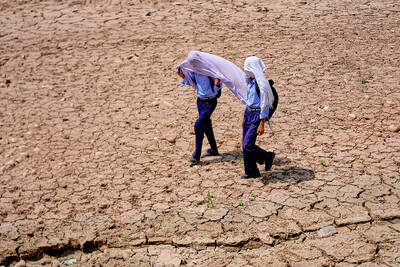
HOTTER: While Indians are accustomed to summer heat, climate change has caused northwestern India to warm faster than other parts of the country, an academic said Roads and markets have emptied during afternoons and some farmers have switched to nighttime work to avoid scorching temperatures as a heat wave grips large parts of India. The India Meteorological Department forecast maximum temperatures for yesterday of about 45°C in the capital, New Delhi, where authorities have opened temporary “cooling zones” to help people cope. The weather department warned that conditions would likely persist across several northern regions in the coming days, with temperatures staying well above seasonal averages. Authorities urged people to stay indoors during the hottest hours and take precautions against heat-related illnesses. India declares a heat wave whenever maximum temperatures

BIGGER ROLE: Beijing has said it maintains an impartial stance on the war in Ukraine, but by training Russian troops, China is far more involved than previously known China’s armed forces secretly trained about 200 Russian military personnel in China late last year, and some have since returned to fight in Ukraine, according to three European intelligence agencies and documents seen by Reuters. While China and Russia have held a number of joint military exercises since Moscow’s full-scale invasion of Ukraine in 2022, Beijing has repeatedly said that it is neutral in the conflict and presents itself as a peace mediator. The covert training sessions, which predominantly focused on the use of drones, were outlined in a dual-language Russian-Chinese agreement signed by senior Russian and Chinese officers in Beijing on


 RSS
RSS