


North Korea yesterday attempted and failed to launch what experts believe was an intermediate-range ballistic missile in defiance of UN sanctions and in an embarrassing setback for leader Kim Jong-un, drawing criticism from major ally China.
The failed launch, as the reclusive country celebrates the “Day of the Sun” on the birthday of Kim’s grandfather, follows the North’s fourth nuclear test in January and a long-range rocket launch in February, which led to new UN sanctions. That has not stopped the North from pushing ahead with its missile program, supervised by Kim, in breach of UN Security Council resolutions.
The US-based 38 North Web site, which specializes in North Korea, said there has been activity at the country’s nuclear site based on satellite imagery and on Wednesday said the possibility of a fifth nuclear test “could not be ruled out.”
China, North Korea’s most important economic and diplomatic backer, has been angered by Pyongyang’s nuclear tests and rocket launches in the face of UN sanctions that China has also backed.
Chinese Ministry of Foreign Affairs spokesman Lu Kang (陸慷) said the UN council was clear on North Korean rocket launches.
“At present, the situation on the peninsula is complex and sensitive,” he told reporters. “We hope all parties can strictly respect the decisions of the Security Council and avoid taking any steps that could further worsen tensions.”
Chinese state media were more direct.
“The firing of a mid-range ballistic missile on Friday by the Democratic People’s Republic of Korea [DPRK], though failed, marks the latest in a string of saber-rattling that, if unchecked, will lead the country to nowhere,” China’s Xinhua news agency said in an English-language commentary.
“Nuclear weapons will not make Pyongyang safer. On the contrary, its costly military endeavors will keep on suffocating its economy,” it said.
Yesterday was the anniversary of North Korean founding president Kim Il-sung’s birthday, which is widely celebrated. In 2012, it was marked by a long-range rocket launch attempt that also failed.
The US Department of Defense said in a statement that the launch at 5:33am in Korea was detected and tracked by the US Strategic Command, which also assessed that it had failed.
“We call again on North Korea to refrain from actions and rhetoric that further raise tensions in the region and focus instead on taking concrete steps toward fulfilling its international commitments and obligations,” a US Department of State official said.
South Korea’s Yonhap news agency said it was likely a Musudan, an intermediate-range ballistic missile with a design range of more than 3,000km that can be fired from a road mobile launcher, but which has never been flight-tested.
“Timing wise, today’s missile was a cannon salute on the Day of the Sun, leading up to the party congress, but now that it has failed, it is an embarrassment,” said Chang Gwang-il, a retired South Korean army general.
The North is to hold its ruling party congress early next month, the first such meeting in 36 years.
The North could not completely ignore the sanctions, but considered it the right time to attempt a missile launch to send a message to the world “we don’t surrender to sanctions,” Chang said.
Some experts had said North Korea may choose to test-fire the Musudan as it tries to build an intercontinental ballistic missile designed to put the mainland US within range.
North Korea, which regularly threatens to destroy South Korea and the US, often fires missiles during periods of tension in the region or when it comes under pressure to curb its defiance and abandon its weapons programmes.
The North and rich, democratic South are technically still at war since their 1950-53 conflict ended in a truce, not a peace treaty.

Crowds in Bangladesh are flocking to snap photographs with an unlikely social media star — an albino buffalo with flowing blond hair nicknamed “Donald Trump” that is due to be sacrificed within days. Owner Zia Uddin Mridha, 38, said his brother named the 700kg bull over its flowing helmet of hair resembling the signature look of the US president. “My younger brother picked this name because of the buffalo’s extraordinary hair,” he said at his farm in Narayanganj, just outside the capital, Dhaka. Mridha said that a constant stream of curious visitors — social media fans, onlookers and children — have come throughout

It began as a satirical online project. Now millions of young people in India are flocking to it as an outlet for their frustration. A parody political party called the Cockroach Janta Party, with the insect as its symbol, has exploded across India’s social media by turning absurdist humor into protest. Memes and short videos mocking corruption, joblessness and political dysfunction have flooded social media sites, where millions of users are embracing the cockroach — known for its ability to survive harsh conditions — as a tongue-in-cheek symbol of endurance. The online movement’s rise has been unusually rapid. The Cockroach Janta Party (CJP)
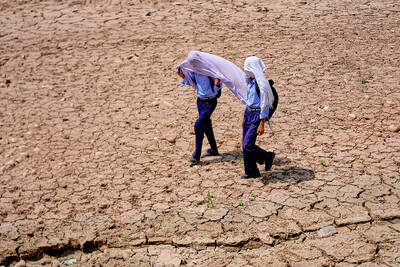
HOTTER: While Indians are accustomed to summer heat, climate change has caused northwestern India to warm faster than other parts of the country, an academic said Roads and markets have emptied during afternoons and some farmers have switched to nighttime work to avoid scorching temperatures as a heat wave grips large parts of India. The India Meteorological Department forecast maximum temperatures for yesterday of about 45°C in the capital, New Delhi, where authorities have opened temporary “cooling zones” to help people cope. The weather department warned that conditions would likely persist across several northern regions in the coming days, with temperatures staying well above seasonal averages. Authorities urged people to stay indoors during the hottest hours and take precautions against heat-related illnesses. India declares a heat wave whenever maximum temperatures
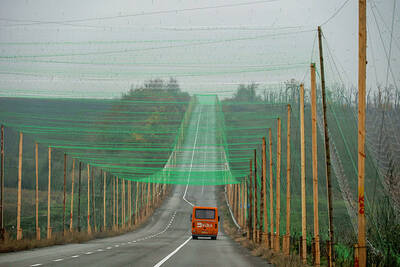
BIGGER ROLE: Beijing has said it maintains an impartial stance on the war in Ukraine, but by training Russian troops, China is far more involved than previously known China’s armed forces secretly trained about 200 Russian military personnel in China late last year, and some have since returned to fight in Ukraine, according to three European intelligence agencies and documents seen by Reuters. While China and Russia have held a number of joint military exercises since Moscow’s full-scale invasion of Ukraine in 2022, Beijing has repeatedly said that it is neutral in the conflict and presents itself as a peace mediator. The covert training sessions, which predominantly focused on the use of drones, were outlined in a dual-language Russian-Chinese agreement signed by senior Russian and Chinese officers in Beijing on


 RSS
RSS