


The armed band of protesters who have taken over administration buildings at a federally owned wildlife refuge near Burns, Oregon, have said they want the property returned to the ranchers who once owned those lands.
However, on Wednesday, the Burns Paiute Tribe demanded that if anyone should get the property back, it should be them.
Their ancestors were roaming the still wild and empty reaches of what is now called the Malheur National Wildlife Refuge perhaps as long as 15,000 years ago, members of the tribe said.
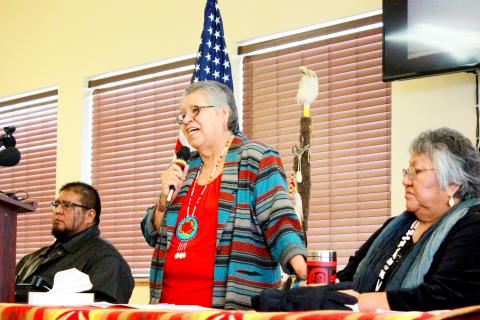
Photo: AP
“Don’t tell me any of these ranchers came across the Bering Strait,” tribal chairwoman Charlotte Rodrique said, referring to the ancient ice age land bridge between North America and Asia that was the conduit for native migration of the Americas.
“We were here first,” she added at a news conference on the reservation. “We’d like the public to acknowledge that.”
Other tribe members, in an even harsher denunciation of the group that has occupied the refuge since Saturday, said the protesters were a public menace and an insult to the local people.
“We, as Harney County residents, don’t need some clown coming in here to stand up for us,” tribal council member Jarvis Kennedy said, when asked about the protest group’s leader, Ammon Bundy. “We survived without them before.”
Residents in the rural area of east-central Oregon are sharply divided over the goals and actions of the protesters.
Some are rallying in support; others, led by the Harney County sheriff, say the protests and the potential for violence have become an economic and social threat to a struggling rural area as schools, government offices and some businesses have shut down out of safety concerns.
“This is having an economic impact,” Harney County Sheriff Dave Ward said. “If this goes any longer, it will have an even greater impact to our tourism and economy.”
The tribe’s position Wednesday, though, touched on even more nuanced questions of law, history and culture as the occupation at the 76,080 hectare wildlife refuge went into its fifth day: Whose land is it, anyway, and for what use is it now best suited?
People like Jason Ward, 33, who grew up there as the son of a timber worker who felled trees in Malheur National Forest, said he thought a combination of bad federal policies and greater federal control in Harney County had coincided with the area’s economic decline.
Cutbacks in the timber harvest in the national forest beginning in the 1990s, Ward and other residents said, led to the closing of a wood mill here that was one of the region’s biggest employers, and things never really got better.
About one in five residents in Harney County live in a household with income below the federal poverty threshold, according to federal figures from 2013. The county — which lost 4 percent of its population from 2010 to 2014, according to census figures — has the second-highest proportion of minimum wage jobs of any Oregon county, almost 10 percent.
Only neighboring Malheur County is worse off, according to a state report last month.
The Paiute tribe members said that their priority for the refuge — short of getting it back, which they said was unlikely — was protection of its natural and cultural heritage.
Tribe members regularly go there to gather reeds for tribal crafts and plants for traditional medicines.
Artifacts have been found there indicating a native presence going back thousands of years, they said, and part of the federal government’s mandate at the site is protection of those resources and artifacts.
Rodrique said her tribe, like most Native American groups, was deeply wounded in the past by the federal government.
“We were forcefully taken out of this country,” she said. “We’re a population that has experienced a lot of heartache by the actions of the US government.”
However, a wildlife refuge is something that benefits all, whatever the scars of the past, she said.
“We have had a good working relationship with the Malheur National Wildlife Refuge,” she said.

Kouri Richins, a Utah mother who published a children’s book about grief after the death of her husband is to serve a life sentence for his murder without the possibility of parole, a judge ruled on Wednesday. Richins was convicted in March of aggravated murder for lacing a cocktail given to her husband, Eric Richins, with five times the lethal dose of fentanyl at their home near Park City in 2022. A jury also found her guilty of four other felonies, including insurance fraud, forgery and attempted murder for trying to poison her husband weeks earlier on Feb. 14, 2022, with a

‘PERSONAL MISTAKES’: Eileen Wang has agreed to plead guilty to the felony, which comes with a maximum sentence of 10 years in federal prison A southern California mayor has agreed to plead guilty to acting as an illegal agent for the Chinese government and has resigned from her city position, officials said on Monday. Eileen Wang (王愛琳), mayor of Arcadia, was charged last month with one count of acting in the US as an illegal agent of a foreign government. She was accused of doing the bidding of Chinese officials, such as sharing articles favorable to Beijing, without prior notification to the US government as required by law. The 58-year-old was elected in November 2022 to a five-person city council, from which the mayor is selected

DELA ROSA CASE: The whereabouts of the senator, who is wanted by the ICC, was unclear, while President Marcos faces a political test over the senate situation Philippine authorities yesterday were seeking confirmation of reports that a top politician wanted by the International Criminal Court (ICC) had fled, a day after gunfire rang out at the Philippine Senate where he had taken refuge fearing his arrest. Senator Ronald “Bato” dela Rosa, the former national police chief and top enforcer of former Philippine president Rodrigo Duterte’s “war on drugs,” has been under Senate protection and is wanted for crimes against humanity, the same charges Duterte is accused of. “Several sources confirmed that the senator, Senator Bato, is no longer in the Senate premises, but we are still getting confirmation,” Presidential

HELP DENIED? The US Department of State said that the Cuban leadership refuses to allow the US to provide aid to Cubans, ‘who are in desperate need of assistance’ US Secretary of State Marco Rubio on Wednesday said that Cuba’s leadership must change, as Washington renewed an offer of US$100 million in aid if the communist nation agrees to cooperate. Cuba has been suffering severe economic tumult led by an energy shortage that plunged 65 percent of the country into darkness on Tuesday. Cuba’s leaders have blamed US sanctions, but Rubio, a Cuban American and critic of the government established by Fidel Castro, said the system was to blame, including corruption by the military. “It’s a broken, nonfunctional economy, and it’s impossible to change it. I wish it were different,” he told


 RSS
RSS