


The Islamic State (IS) group on Sunday abandoned its last stronghold in Ramadi, effectively handing Iraqi forces their biggest victory since a massive nationwide offensive initiated by the extremists last year.
There were still parts of the flashpoint government complex the elite counterterrorism service could not enter, as extremists had rigged the entire area with explosives before retreating.
While pockets of extremists might remain, Iraqi forces said they no longer faced any resistance, and officials were already congratulating them for liberating Ramadi, the capital of Anbar Province.
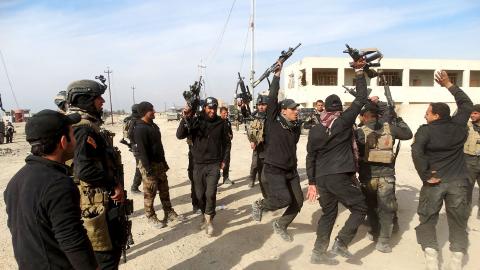
Photo: Reuters
“All DAESH fighters have left. There is no resistance,” Iraqi Counter Terrorism Service spokesman Sabah al-Numan told reporters, using an Arabic-language acronym for the Islamic State group.
“The operation is almost wrapped up,” as a major clearing effort was still needed to allow forces to move in, he said.
People waving Iraqi flags celebrated the Ramadi victory in several cities, including Baghdad and Karbala.
Iraqi Parliament Speaker Salim al-Jubouri issued a statement congratulating the “heroes of the security forces for a great victory, which resulted in the liberation of the city of Ramadi from terrorism.”
The US-led coalition, which was heavily involved in supporting Iraqi forces in Ramadi, also congratulated them on the success of an operation that began soon after they lost the city in May.
“It is the result of many months of hard work by the Iraqi Army, the counterterrorism service, the Iraqi Air Force, local and federal police and tribal fighters all supported by over 600 coalition air strikes since July,” coalition spokesman Colonel Steve Warren said.
Iraqi forces backed by US-led coalition air strikes had punched into the center of Ramadi on Tuesday, in a final push to retake the city.
Fighting had been concentrated around the government complex, whose recapture had become synonymous with victory in the battle for Ramadi.
According to medical sources, 93 members of the security forces were brought in with injuries on Sunday.
“The dead bodies are taken directly to the main military hospital” near the airport, one hospital source said.
At least five government fighters have been killed, but no official has divulged any overall toll for the operation.
Estimates last week put the number of Islamic State group fighters at about 400 in central Ramadi, many of them protecting the government compound.
Those numbers were thought to have drastically declined, with several fighters retreating from the main battle and dozens of others killed in fighting or in suicide attacks.
Local Khaldiya council head Ali Dawood said Islamic State group fighters used civilians as human shields to slip out of the government complex.
“DAESH fighters forced all the families living around the compound to go with them in order to flee toward Sichariyah, Sufiya and Jweiba,” on the eastern outskirts of Ramadi, he said.
He had said on Saturday that more than 250 families had managed to escape the combat zones since the start of the operation and had been escorted to safety by the army.
Ramadi is about 100km west of Baghdad and is the capital of Anbar, which is Iraq’s largest province and borders Syria, Jordan and Saudi Arabia.
A victory there would help boost Iraq’s much-criticized military, which collapsed when the Islamic State group took over large parts of the country in June last year.
The “Hashed al-Shaabi” (Popular Mobilization), a force dominated by Tehran-backed Shiite militias, played a leading role in the recapture of several cities and areas, but stayed on the fringes in Ramadi.
“The prestige goes to the Iraqi military,” political analyst Ihsan al-Shammari said. “As an institution, it’s the first time since the DAESH invasion [in June last year] it has achieved a victory without the support of the Popular Mobilization force,” he said.
Shammari said that the positive outcome in Ramadi would vindicate Iraqi Prime Minister Haider al-Abadi as well as the coalition, both frequently criticized for failing to retake Ramadi faster.
Government forces held off months of Islamic State group assaults in Ramadi until May, when the extremists blitzed them with suicide car bombs and seized full control of the city.
The fightback has often been laborious and poisoned by political wrangling, but Iraqi Minister of Defense Minister Khaled al-Obeidi last week said that Iraqi forces had reclaimed half of the territory lost to the Islamic State group last year.
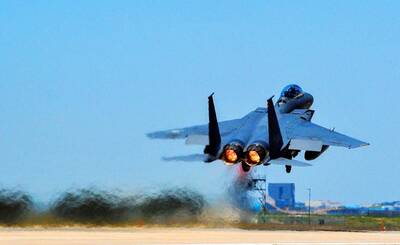
South Korea’s air force yesterday apologized for a 2021 midair collision involving two fighter jets, a day after auditors said the pilots were taking selfies and filming during the flight and held them responsible for the accident. “We sincerely apologize to the public for the concern caused by the accident that occurred in 2021,” an air force spokesman told a news conference, adding that one of the pilots involved had been suspended from flying duties, received severe disciplinary action and has since left the military. The apology followed a report released on Wednesday by the South Korean Board of Audit and Inspection,

Young Chinese, many who fear age discrimination in their workplace after turning 35, are increasingly starting “one-person companies” that have artificial intelligence (AI) do most of the work. Smaller start-ups are already in vogue in Silicon Valley and elsewhere, with rapidly advancing AI tools seen as a welcome teammate even as they threaten layoffs at existing firms. More young people in China are subscribing to the model, as cities pledge millions of dollars in funding and rent subsidies for such ventures, in alignment with Beijing’s political goal of “technological self-reliance.” “The one-person company is a product of the AI era,” said Karen Dai

About 240 Indians claiming descent from a Biblical tribe landed at Tel Aviv airport on Thursday as part of a government operation to relocate them to Israel. The newcomers passed under a balloon arch in blue and white, the colors of the Israeli flag, as dozens of well-wishers welcomed them with a traditional Jewish song. They were the first “bnei Menashe” (“sons of Manasseh”) to arrive in Israel since the government in November last year announced funding for the immigration of about 6,000 members of the community from the states of Manipur and Mizoram in northeast India. The community claims to descend from

‘TROUBLING’: The firing of Phelan, who was an adviser to a nonprofit that supported the defense of Taiwan, was another example of ‘dysfunction’ under Trump, a US senator said US Secretary of the Navy John Phelan has been fired, a US official and a person familiar with the matter said on Wednesday, in another wartime shakeup at the Pentagon coming just weeks after US Secretary of Defense Pete Hegseth ousted the Army’s top general. The Pentagon announced his departure in a brief statement, saying he was leaving the administration “effective immediately,” but it did not provide a reason or say whether it was his decision to go. The sources, who spoke on condition of anonymity, said Phelan was dismissed in part because he was moving too slowly to implement reforms to


 RSS
RSS