


More than a dozen senior commanders and officials who children say recruited them as soldiers in South Sudan should be investigated, Human Rights Watch said on Tuesday.
The UN says 16,000 children have joined armed groups since South Sudan’s civil war erupted two years ago.
“It’s the brutal recruitment that is the most heart wrenching,” Skye Wheeler, the report’s author, told reporters. “Forces come through their village and grab them and force them into fighting. It’s an absolute negation of their basic rights as children, but also as people, not to be treated just as cannon fodder.”
South Sudan was plunged into a civil war in December 2013 when a political crisis triggered fighting between forces loyal to President Salva Kiir and rebels allied with former vice president Riek Machar. The conflict has reopened ethnic faultlines that pit Kiir’s Dinka people against Machar’s ethnic Nuer people.
A peace deal was signed in August, but the two sides have repeatedly accused each other of violations.
A third of 74 boys interviewed who fought in the current conflict said they were forcibly recruited, often at gunpoint.
Many said they were detained until they agreed to fight or simply abducted, handed a gun and sent into battle.
“I had no experience of holding a gun before,” said one boy in the report, who said he was abducted from school by opposition forces. “They told us this is how you use it... Then we began fighting.”
About half of the boys interviewed said they willingly joined armed groups to protect themselves and their communities. About half also said they fought or worked for government forces or their allies.

When a hiker fell from a 55m waterfall in wild New Zealand bush, rescuers were forced to evacuate the badly hurt woman without her dog, which could not be found. After strangers raised thousands of dollars for a search, border collie Molly was flown to safety by a helicopter pilot who was determined to reunite the pet and the owner. A week earlier, an emergency rescue helicopter found the woman with bruises and lacerations after a fall at a rocky spot at the waterfall on the South Island’s West Coast. She was airlifted on March 24, but they were forced to
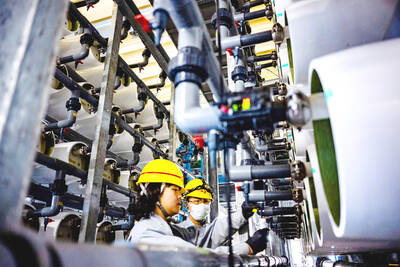
HIGH HOPES: The power source is expected to have a future, as it is not dependent on the weather or light, and could be useful for places with large desalination facilities A Japanese water plant is harnessing the natural process of osmosis to generate renewable energy that could one day become a common power source. The possibility of generating power from osmosis — when water molecules pass from a less salty solution to a more salty one — has long been known. However, actually generating energy from that has proved more complicated, in part due the difficulty of designing the membrane through which the molecules pass. Engineers in Fukuoka, Japan, and their private partners think they might have cracked it, and have opened what is only the world’s second osmotic power plant. It generates
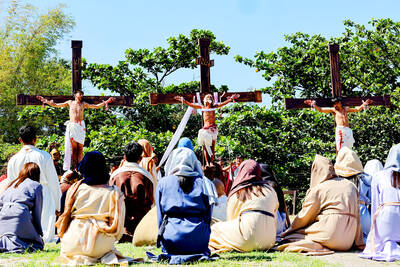
Hundreds of Filipinos and tourists flocked to a sun-bleached field north of Manila yesterday, on Good Friday, to witness one of the country’s most blood-soaked displays of religious fervor, undeterred by rising fuel prices. Scores of bare-chested flagellants with covered faces walked barefoot through the dusty streets of Pampanga Province’s San Fernando as they flogged their backs with bamboo whips in the scorching heat. Agence France-Presse (AFP) journalists said they saw devotees deliberately puncturing their skin with glass shards attached to a small wooden paddle to ensure their bleeding during the ritual, a way to atone for sins and seek miracles from
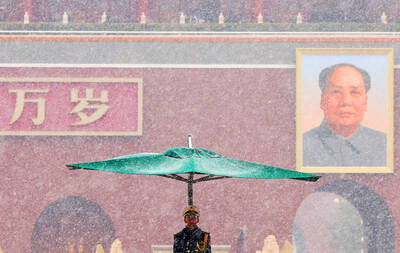
Chinese dissident artist Gao Zhen (高兟), famous for making provocative satirical sculptures of former Chinese leader Mao Zedong (毛澤東), was tried on Monday over accusations of “defaming national heroes and martyrs,” his wife and a rights group said. Gao, 69, who was detained in 2024 during a visit from the US, faces a maximum three-year prison sentence, said his wife, Zhao Yaliang (趙雅良), and Shane Yi, a researcher at the Chinese Human Rights Defenders group which operates outside the nation. The closed-door, one-day trial took place at Sanhe City People’s Court in Hebei Province neighboring the capital, Beijing, and ended without a


 RSS
RSS