


Developing nations on Wednesday warned that a bitter row over money was threatening efforts to seal a historic pact to tame global warming, as hosts France pleaded for compromise.
The UN-brokered talks involving 195 nations are facing a tight deadline of Friday next week to forge an agreement aimed at cutting the greenhouse gases blamed for climate change, and averting its catastrophic impacts.
However, despite more than 150 world leaders opening the talks on Monday with lofty rhetoric about the urgency of the task, bureaucrats became quickly ensnared in familiar rows that have condemned previous efforts to failure.

Photo: AFP
“My message is clear: We must accelerate the process because there is still a lot of work to do,” said French Minister of Foreign Affairs Laurent Fabius, who is presiding over the negotiations.
One of the most fiercely contested issues in the 25-year diplomatic effort to find a solution to global warming has been how much responsibility rich nations must accept for the problem, and therefore how much they should pay.
The US and other developed nations have powered their way to prosperity since the Industrial Revolution by burning coal, oil and gas — the primary cause of the heat-trapping greenhouse gas emissions.
Developing nations say developed ones must largely finance the world economy’s costly shift away from fossil fuels, a debate worth hundreds of billions of US dollars.
A bloc of 134 developing nations — including China, India and all African and South American nations — released a statement near the end of Wednesday’s negotiations in Paris, insisting the rich were again trying to absolve themselves of their financial responsibilities.
“Nothing ... can be achieved without the provision of means of implementation to enable developing countries to play their part to address climate change,” the statement said.
The bloc, known as the G77 plus China, restated a demand for rich nations to follow through on their commitment to mobilize US$100 billion a year into a climate change from 2020. It also demanded as “substantial scaling up of finance” on top of the previously agreed US$100 billion.
The financing issue is central to a complex 54-page draft text that negotiators need to trim down by the weekend, so that ministers have a week to try and finalize it.
Frustration permeated the negotiating halls of a convention center in the northern outskirts of Paris on Wednesday.
“We are not making anywhere near the progress we need to be making at this point,” said Daniel Reifsnyder, one of the two co-chairmen in the talks’ key arena.
Greenpeace East Asia senior climate and energy campaigner Li Shuo (李碩), who has observer status in the talks, described them as “quite messy.”
Still, such frustrations are typical of the start of climate negotiations, where vast interests are at stake and a single word in an agreement can have big repercussions, veteran observers said.
“I remain confident that it will be a hard fought two weeks, but at the end of the day we are likely to achieve, and I believe we will achieve, an agreement,” Australian Minister of the Environment Greg Hunt told reporters.
UN Framework Convention on Climate Change (UNFCCC) Executive Secretary Christiana Figueres cautioned against despair.
“The text of the agreement will go through ups and downs. It is a legally binding text and needs to be reviewed very, very carefully,” she said.
Touching on the rich-poor issue, British charity Oxfam issued a study saying the wealthiest 10 percent of people produce half of Earth’s fossil-fuel emissions, while the poorest half contribute a mere 10 percent. An average person among the richest 1 percent emits 175 times more carbon than their counterpart among the bottom 10 percent, the charity said.
At the core of the talks is the goal of limiting warming to a maximum of 2oC over pre-Industrial Revolution levels.
That objective — along with a more ambitious option of 1.5oC — has been enshrined in the UNFCCC since 2010.
Since then, scientists have pounded out an ever-louder warning that relentlessly climbing carbon emissions are to doom future generations to rising seas and worsening floods, storms and drought — a recipe for hunger, disease and homelessness for many millions of people.
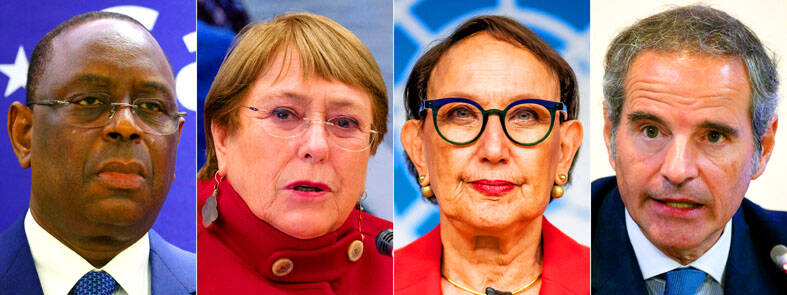
Four contenders are squaring up to succeed Antonio Guterres as secretary-general of the UN, which faces unprecedented global instability, wars and its own crushing budget crisis. Chile’s Michelle Bachelet, Argentina’s Rafael Grossi, Costa Rica’s Rebeca Grynspan and Senegal’s Macky Sall are each to face grillings by 193 member states and non-governmental organizations for three hours today and tomorrow. It is only the second time the UN has held a public question-and-answer, a format created in 2016 to boost transparency. Ultimately the five permanent members of the UN’s top body, the Security Council, hold the power, wielding vetoes over who leads the

South Korea’s air force yesterday apologized for a 2021 midair collision involving two fighter jets, a day after auditors said the pilots were taking selfies and filming during the flight and held them responsible for the accident. “We sincerely apologize to the public for the concern caused by the accident that occurred in 2021,” an air force spokesman told a news conference, adding that one of the pilots involved had been suspended from flying duties, received severe disciplinary action and has since left the military. The apology followed a report released on Wednesday by the South Korean Board of Audit and Inspection,

Young Chinese, many who fear age discrimination in their workplace after turning 35, are increasingly starting “one-person companies” that have artificial intelligence (AI) do most of the work. Smaller start-ups are already in vogue in Silicon Valley and elsewhere, with rapidly advancing AI tools seen as a welcome teammate even as they threaten layoffs at existing firms. More young people in China are subscribing to the model, as cities pledge millions of dollars in funding and rent subsidies for such ventures, in alignment with Beijing’s political goal of “technological self-reliance.” “The one-person company is a product of the AI era,” said Karen Dai

About 240 Indians claiming descent from a Biblical tribe landed at Tel Aviv airport on Thursday as part of a government operation to relocate them to Israel. The newcomers passed under a balloon arch in blue and white, the colors of the Israeli flag, as dozens of well-wishers welcomed them with a traditional Jewish song. They were the first “bnei Menashe” (“sons of Manasseh”) to arrive in Israel since the government in November last year announced funding for the immigration of about 6,000 members of the community from the states of Manipur and Mizoram in northeast India. The community claims to descend from


 RSS
RSS