


Artificial sweeteners may contribute to diabetes, according to a controversial study that suggests the additives could exacerbate the problem they are meant to tackle.
Researchers in Israel found that artificial sweeteners used in diet drinks and other foods can disrupt healthy microbes that live in the gut, leading to higher blood sugar levels — an early sign of diabetes.
Sweeteners such as saccharin, aspartame and sucralose are widespread in Western diets and are often used to cut calories or prevent tooth decay. The additives are so common that scientists behind the latest study called for a reassessment of the “massive usage” of the chemicals.
“Our findings suggest that non-caloric artificial sweeteners may have directly contributed to enhancing the exact epidemic that they themselves were intended to fight,” the authors wrote in the journal Nature.
Eran Elinav, a senior author on the study at the Weizmann Institute of Science in Rehovot, said that while the evidence against the sweeteners was too weak to change health policies, he had decided to give up the additives.
However, the study has left many experts unconvinced, with doubts over the findings which draw largely on tests of just one sweetener in mice.
Large studies in humans have found that sugar substitutes can help people maintain a healthy weight and protect against diabetes.
“This new report must be viewed very cautiously,” said Stephen O’Rahilly, director of the Metabolic Diseases Unit at Cambridge University, “as it mostly reports findings in mice, accompanied by human studies so small as to be difficult to interpret.”
Brian Ratcliffe, professor of nutrition at Robert Gordon University in Aberdeen, Scotland, said: “Most of the effects that they report relate to saccharin with little or no effect of aspartame. Their paper ought to be limited to ‘saccharin’ in the title rather than attributing the effects to all artificial sweeteners.”
The UK is poised to fall in line with WHO recommendations to halve sugar intake to 5 percent of daily calories, a move expected to drive sales of diet drinks and low-calorie foods.
In the first of a series of experiments, the Israeli group found that mice fed on three artificial sweeteners — saccharin, aspartame and sucralose — developed high blood sugar levels. However, when the mice were given antibiotics to kill off their gut microbes, the ill effects disappeared.
The scientists then focused on saccharin. They transferred gut microbes from mice fed on the sweetener to different mice that had no gut bacteria of their own. Soon after, the recipient mice developed high blood sugar levels too.
Genetic analyses of the gut microbes from mice fed on saccharin found that as a group they behaved differently, breaking down more carbohydrate in the diet than normal.
The scientists ran tests on 400 people and found that those who consumed the most artificial sweeteners had different gut microbes and on average were heavier and more glucose intolerant.
In their final set of experiments, the scientists gave seven people the maximum allowed daily dose of saccharin for a week. Each dose was enough to sweeten around 40 cans of diet cola. At the end of the week, four in seven had high blood sugar levels and their gut microbes mirrored the changes seen in mice fed on the additives.
“This large body of work we’ve performed should be studied further because of the potentially harmful effects that could be happening from sweetener consumption to very large subsets of the population,” paper co-author Eran Segal said.
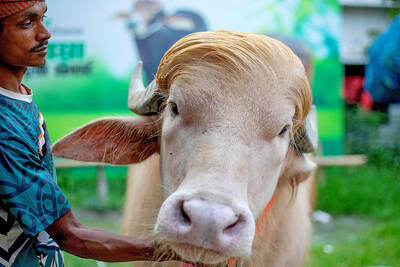
Crowds in Bangladesh are flocking to snap photographs with an unlikely social media star — an albino buffalo with flowing blond hair nicknamed “Donald Trump” that is due to be sacrificed within days. Owner Zia Uddin Mridha, 38, said his brother named the 700kg bull over its flowing helmet of hair resembling the signature look of the US president. “My younger brother picked this name because of the buffalo’s extraordinary hair,” he said at his farm in Narayanganj, just outside the capital, Dhaka. Mridha said that a constant stream of curious visitors — social media fans, onlookers and children — have come throughout

It began as a satirical online project. Now millions of young people in India are flocking to it as an outlet for their frustration. A parody political party called the Cockroach Janta Party, with the insect as its symbol, has exploded across India’s social media by turning absurdist humor into protest. Memes and short videos mocking corruption, joblessness and political dysfunction have flooded social media sites, where millions of users are embracing the cockroach — known for its ability to survive harsh conditions — as a tongue-in-cheek symbol of endurance. The online movement’s rise has been unusually rapid. The Cockroach Janta Party (CJP)
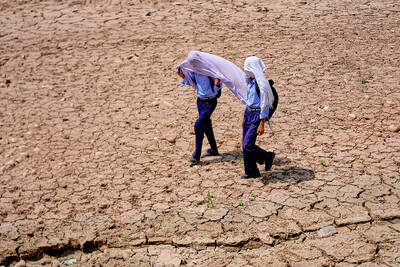
HOTTER: While Indians are accustomed to summer heat, climate change has caused northwestern India to warm faster than other parts of the country, an academic said Roads and markets have emptied during afternoons and some farmers have switched to nighttime work to avoid scorching temperatures as a heat wave grips large parts of India. The India Meteorological Department forecast maximum temperatures for yesterday of about 45°C in the capital, New Delhi, where authorities have opened temporary “cooling zones” to help people cope. The weather department warned that conditions would likely persist across several northern regions in the coming days, with temperatures staying well above seasonal averages. Authorities urged people to stay indoors during the hottest hours and take precautions against heat-related illnesses. India declares a heat wave whenever maximum temperatures
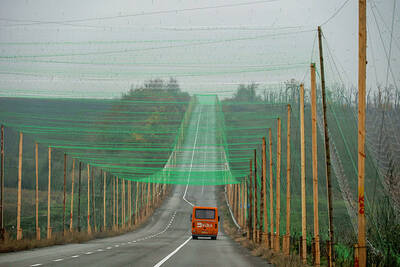
BIGGER ROLE: Beijing has said it maintains an impartial stance on the war in Ukraine, but by training Russian troops, China is far more involved than previously known China’s armed forces secretly trained about 200 Russian military personnel in China late last year, and some have since returned to fight in Ukraine, according to three European intelligence agencies and documents seen by Reuters. While China and Russia have held a number of joint military exercises since Moscow’s full-scale invasion of Ukraine in 2022, Beijing has repeatedly said that it is neutral in the conflict and presents itself as a peace mediator. The covert training sessions, which predominantly focused on the use of drones, were outlined in a dual-language Russian-Chinese agreement signed by senior Russian and Chinese officers in Beijing on


 RSS
RSS