


The diplomat ridding the world of Syria’s chemical weapons is Sigrid Kaag, a statuesque and impeccably dressed mother of four who speaks six languages and is fearless in a war zone.
For nine months she has led the international mission to destroy Damascus’ declared chemical agents, braving mortar fire, jetting between the Middle East, Europe and New York, and liaising with Moscow, Washington and maritime fleets.
Syria may have missed deadlines, but with 93 percent of its declared chemical arsenal out of the country, Kaag is responsible for the only glimmer of good news to emerge from the horror of a war that has killed more than 160,000.
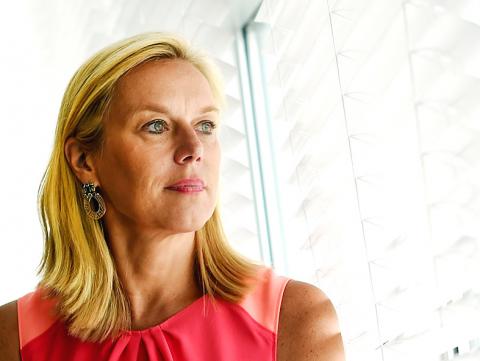
Photo: AFP
Her star is in the ascendancy at UN headquarters, abuzz with praise for the woman who at UNICEF worked with Jordan’s Queen Rania and once dreamed of becoming a singer.
The 52-year-old Kaag speaks fluent Arabic and diplomats say she has done an excellent job.
She is respected too in Damascus, where some have dubbed her the “Iron Lady.”
“She never stops working and practically never sleeps,” one of her local employees confided to reporters.
What seems certain is another big job after her mission concludes in the coming months.
The media have touted her as a possible successor to Lakhdar Brahimi as mediator on the stalled Syrian peace process, although others tip her for a different post in the region.
She quashes any suggestion that a Western woman should find it difficult in the Arab world, saying she has always been treated with respect and never in a derogatory way.
“I think in many negotiations, women have great assets,” she told reporters in an interview, dressed in a black trouser suit, red top and high heels. “You can bring different component parts — be as strong and on message and negotiate, but I think we have a wider skill set available.”
Her husband is a Palestinian former diplomat and having children who are half Arab can also be an asset, she said.
“You’re one foot in, one foot out, but I think ultimately people judge you on the basis of what you bring, if you’re sincere, if you’re committed and if you’re up to the task,” she added.
As head of the joint UN-Organization for the Prohibition of Chemical Weapons mission, she manages a staff of 110.
In Damascus, she said mortars have fallen around the hotel where they live and work, and that she sent away some staff who were unable to cope.
“You’ve got to keep your composure, you’ve got to keep your calm and you’ve got to be in the moment,” she said. “The fact that you don’t get hit, you feel blessed, but you know that you’re in an active war zone.”
It has been a stratospheric rise for the daughter of a music professor who moved to Egypt to study at the American University in Cairo as an undergraduate.
She has a master’s degree from Oxford and worked in the private sector for oil giant Shell in London for two years before joining the Dutch foreign ministry.
Kaag decided to quit the job after meeting her husband in Jerusalem, signing up instead to the UN Relief and Works Agency, which looks after the plight of Palestinian refugees.
In the past 20 years, she has lived in Jerusalem, Jordan, New York, Sudan and Switzerland, adopting one child and giving birth to three more, juggling marriage with a career.
Home is currently in east Jerusalem, where the family moved last year.
She describes herself as “results oriented” and with nerves of steel.
“I don’t panic easily,” she said.

China’s military news agency yesterday warned that Japanese militarism is infiltrating society through series such as Pokemon and Detective Conan, after recent controversies involving events at sensitive sites. In recent days, anime conventions throughout China have reportedly banned participants from dressing as characters from Pokemon or Detective Conan and prohibited sales of related products. China Military Online yesterday posted an article titled “Their schemes — beware the infiltration of Japanese militarism in culture and sports.” The article referenced recent controversies around the popular anime series Pokemon, Detective Conan and My Hero Academia, saying that “the evil influence of Japanese militarism lives on in

ANTI-SEMITISM: Some newsletters promote hateful ideas such as white supremacy and Holocaust denial, with one describing Adolf Hitler as ‘one of the greatest men of all time’ The global publishing platform Substack is generating revenue from newsletters that promote virulent Nazi ideology, white supremacy and anti-Semitism, a Guardian investigation has found. The platform, which says it has about 50 million users worldwide, allows members of the public to self-publish articles and charge for premium content. Substack takes about 10 percent of the revenue the newsletters make. About 5 million people pay for access to newsletters on its platform. Among them are newsletters that openly promote racist ideology. One, called NatSocToday, which has 2,800 subscribers, charges US$80 for an annual subscription, although most of its posts are available

GLORY FACADE: Residents are fighting the church’s plan to build a large flight of steps and a square that would entail destroying up to two blocks of homes Barcelona’s eternally unfinished Basilica de la Sagrada Familia has grown to become the world’s tallest church, but a conflict with residents threatens to delay the finish date for the monument designed more than 140 years ago. Swathed in scaffolding on a platform 54m above the ground, an enormous stone slab is being prepared to complete the cross of the central Jesus Christ tower. A huge yellow crane is to bring it up to the summit, which will stand at 172.5m and has snatched the record as the world’s tallest church from Germany’s Ulm Minster. The basilica’s peak will deliberately fall short of the

Venezuelan Nobel peace laureate Maria Corina Machado yesterday said that armed men “kidnapped” a close ally shortly after his release by authorities, following former Venezuelan president Nicolas Maduro’s capture. The country’s Public Prosecutor’s Office confirmed later yesterday that former National Assembly vice president Juan Pablo Guanipa, 61, was again taken into custody and was to be put under house arrest, arguing that he violated the conditions of his release. Guanipa would be placed under house arrest “in order to safeguard the criminal process,” the office said in a statement. The conditions of Guanipa’s release have yet to be made public. Machado claimed that


 RSS
RSS