


World powers, including the US and China, have joined in the search for the more than 200 schoolgirls abducted by Boko Haram Islamists who have also killed hundreds in the country’s northeast this week.
Amid global outrage over the kidnapping of the teenagers, the US, Britain and France are sending specialist teams to Nigeria.
China promised to supply “any useful information acquired by its satellites and intelligence services” to Nigeria.
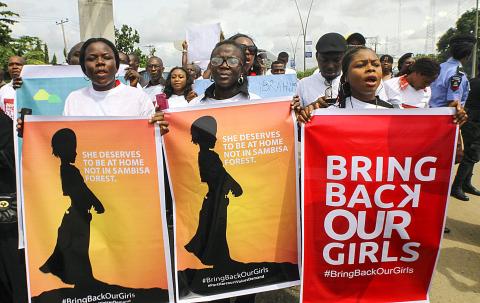
Photo: EPA
The police on Wednesday offered US$300,000 for information leading to the rescue of the girls.
The latest insurgent attack targeted the town of Gamboru Ngala on the border with Cameroon, where gunmen this week razed scores of buildings and fired on civilians as they tried to flee.
Area senator Ahmed Zanna put the death toll at 300, citing information provided by locals, in an account supported by numerous residents. Zanna said the town had been left unguarded because soldiers based there had been redeployed north towards Lake Chad in an effort to rescue the kidnapped girls.
Nigeria’s response to the kidnappings has been widely criticized, including by activists and parents of the hostages, who say the military’s search operation has been inept so far. Nigerian President Goodluck Jonathan’s administration has sought to appear more engaged with the plight of the hostages in recent days, especially after Boko Haram leader Abubakar Shekau released a video threatening to sell the girls as “slaves.”
In a second kidnapping, 11 more girls aged 12 to 15 were seized on Sunday from Gwoza, an area not far from Chibok and also in Boko Haram’s Borno base.
The group’s five-year uprising has killed thousands across Africa’s most populous country and top economy, with many questioning whether Nigeria has the capacity to contain the violence.
Islamist fighters riding in armored trucks and on motorcycles stormed Gamboru Ngala after midday on Monday. The extremists overran the town, making it too dangerous for locals to immediately return, survivors said. When the militants left, residents discovered their town “littered” with dead bodies, said Musa Abba, a witness.
“All economic and business centers have been burnt. The market in the town which attracts traders from all over the area... has been completely burnt,” Zanna said.
Gamboru Ngala has been attacked repeatedly in the past, but Abba said “this [was] the worst Boko Haram attack [the town] has seen.”
The Cameroonian military has reinforced security in the town of Fotokol on the Nigerian border, a medical official said by telephone, requesting anonymity.
“The toll is very heavy. We believe there are more than 200 dead,” the source said, adding that 2,000 Nigerians, including soldiers, had fled to Cameroon.
“Some of the bodies were charred. It was horrific. People had their throats slit, others were shot,” the source added.
In a fresh attack, suspected Boko Haram militants on Wednesday killed seven people in Buji-Buji, also in Borno state, village head Mohammed Garba told journalists.
“Gunmen numbering about 20 invaded our village around 3am while most people were sleeping... The gunmen opened fire on people as they attempted to escape from the ravaging fire. Seven persons died on the spot, while so many others were injured,” he said.
US President Barack Obama has described the Chibok abductions as “heartbreaking” and “outrageous,” and announced that a team of military experts had been sent to help Nigeria’s rescue mission.
US first lady Michelle Obama expressed sympathy for the schoolgirls, in a personal message on Twitter.
“Our prayers are with the missing Nigerian girls and their families. It’s time to #BringBackOurGirls,” she said on her @FLOTUS account, with a photograph of her solemnly holding a sign saying #BringBackOurGirls” scribbled in black on white paper.
The tweet was signed “mo,” meaning she wrote it herself, and it was retweeted more than 8,500 times in just a few hours.
British Prime Minister David Cameron condemned the kidnappers as “pure evil” and said a small team of planning and coordinating specialists would head to Nigeria as soon as possible. Britain is expected to send Abuja-based liaison officers from the SAS special forces to help the rescue mission, the Times reported yesterday.
France and China also pledged assistance.
As well as mounting pressure over the kidnappings, Nigeria has been hit by a spate of bombings.
Just a few hours before the mass abduction in Chibok, a car bombing at a bus station on the outskirts of Abuja killed 75 people. A copycat bombing at the same station killed 19 people on Thursday last week.
Jonathan had hoped that a World Economic Forum summit which opened in Abuja on Wednesday would highlight Nigeria’s economic progress.
Meeting Jonathan in Abuja ahead of what has been dubbed “Africa’s Davos,” Chinese Premier Li Keqiang (李克強) pledged stronger cooperation with Nigeria, Africa’s top oil producer, but public focus has remained fixed on Boko Haram.

‘CROSSING THE LINE’: China’s embassy in Seoul criticized US Forces Korea Commander General Xavier Brunson, asking if his ‘hostile’ remarks were authorized by Washington South Korea and the US are in talks over recent public remarks by the commander of US Forces Korea, Seoul’s presidential office said yesterday, after the comments drew sharp criticism from China. In a recent podcast interview, US Forces Korea Commander General Xavier Brunson described South Korea as “the dagger in the heart of Asia” from China’s east coast, prompting the Chinese embassy in Seoul to say that he had “truly crossed the line.” The interview came amid growing speculation that Washington might seek to expand the role of US Forces Korea in countering the growing regional influence of China, a key

SEEKING ORDER: Rodrigo Paz said that ‘anyone who wants to destroy the nation will have to deal with this president and the full force of the constitution’ Bolivian President Rodrigo Paz on Wednesday said that the nation was at a “breaking point” after nearly a month of protests that have caused shortages of food, fuel and medicine. Paz, who took office six months ago amid the worst economic crisis there in four decades, is battling a groundswell of fury over his policies. The political capital, La Paz, has been besieged by low-income workers and members of the indigenous majority calling for his resignation. “The country needs order and is reaching breaking point,” the 58-year-old said at a public event in La Paz, renewing his appeal for dialogue. On Tuesday, the Bolivian

Through the noise of rushing papers and whirring belts at a print factory in Kyoto, two creators watch their photo essay come to life in broadsheet form — part of an effort to win new audiences in the age of artificial intelligence (AI). Despite the decline of the publishing industry, self-publication and handmade “zine” magazines are growing in popularity in Japan, reflecting the nation’s enduring love of paper in the digital era. While speaking to Agence France-Presse at the plant, his hands black with ink, one of the creators, Kazuma Obara, said: “I think [paper] is a medium that engages all five

Australian researchers have trained lab-grown brain cells on a silicon computer chip to play the 1990s shooter game Doom and said they are just scratching the surface of what the neurons could be capable of doing. It is the science-fiction work of biotech boffins at Cortical Labs, who researched and developed the technology that harnesses the workings of the brain’s networking system. Each so-called “biological computer” contains about 200,000 living human brain cells, grown from stem cells that were harvested from blood donations. Having mastered the simple computer game Pong, where a paddle is moved up and down to send a ball


 RSS
RSS