


Archeologists and forensic scientists who have examined 25 skeletons unearthed in the Clerkenwell area of central London a year ago believe they have uncovered the truth about the nature of the Black Death that ravaged Britain and Europe in the mid-14th century.
Analysis of the bodies and of wills registered in London at the time has cast serious doubt on “facts” that every schoolchild has learned for decades: That the epidemic was caused by a highly contagious strain spread by the fleas on rats.
Now evidence taken from the human remains found in Charterhouse Square, to the north of the City of London (the financial district), during excavations carried out as part of the construction of the Crossrail train line (a 118km railway line serving London and its environs), have suggested a different cause: Only an airborne infection could have spread so fast and killed so quickly.
The Black Death arrived in Britain from central Asia in the autumn of 1348 and by late the next spring it had killed six out of every 10 people in London. Such a rate of destruction would kill 5 million now.
By extracting the DNA of the disease bacterium, Yersinia pestis, from the largest teeth in some of the skulls retrieved from the square, the scientists were able to compare the strain of bubonic plague preserved there with that which was recently responsible for killing 60 people in Madagascar. To their surprise, the 14th-century strain, the cause of the most lethal catastrophe in recorded history, was no more virulent than today’s disease. The DNA codes were an almost perfect match.
According to scientists working at Public Health England (an executive agency of the UK Ministry of Health) in Porton Down, southwest England, for any plague to spread at such a pace it must have got into the lungs of those victims who were most malnourished and then been spread by coughs and sneezes. It was therefore a pneumonic plague rather than a bubonic plague. In other words, it was one in which infection is spread human to human, rather than when a rat flea bites a sick person and then bites another victim.
“As an explanation for the Black Death in its own right, it simply isn’t good enough. It cannot spread fast enough from one household to the next to cause the huge number of cases that we saw during the Black Death epidemics,” said Tim Brooks from Porton Down.
In support of the growing case that this was a fast-acting, direct contagion, archeologist Barney Sloane discovered that in the medieval City of London all wills had to be registered at the Court of Hustings. The documents lead him to believe that 60 percent of Londoners were wiped out.
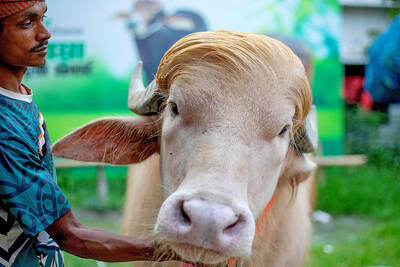
Crowds in Bangladesh are flocking to snap photographs with an unlikely social media star — an albino buffalo with flowing blond hair nicknamed “Donald Trump” that is due to be sacrificed within days. Owner Zia Uddin Mridha, 38, said his brother named the 700kg bull over its flowing helmet of hair resembling the signature look of the US president. “My younger brother picked this name because of the buffalo’s extraordinary hair,” he said at his farm in Narayanganj, just outside the capital, Dhaka. Mridha said that a constant stream of curious visitors — social media fans, onlookers and children — have come throughout

It began as a satirical online project. Now millions of young people in India are flocking to it as an outlet for their frustration. A parody political party called the Cockroach Janta Party, with the insect as its symbol, has exploded across India’s social media by turning absurdist humor into protest. Memes and short videos mocking corruption, joblessness and political dysfunction have flooded social media sites, where millions of users are embracing the cockroach — known for its ability to survive harsh conditions — as a tongue-in-cheek symbol of endurance. The online movement’s rise has been unusually rapid. The Cockroach Janta Party (CJP)

HOTTER: While Indians are accustomed to summer heat, climate change has caused northwestern India to warm faster than other parts of the country, an academic said Roads and markets have emptied during afternoons and some farmers have switched to nighttime work to avoid scorching temperatures as a heat wave grips large parts of India. The India Meteorological Department forecast maximum temperatures for yesterday of about 45°C in the capital, New Delhi, where authorities have opened temporary “cooling zones” to help people cope. The weather department warned that conditions would likely persist across several northern regions in the coming days, with temperatures staying well above seasonal averages. Authorities urged people to stay indoors during the hottest hours and take precautions against heat-related illnesses. India declares a heat wave whenever maximum temperatures

BIGGER ROLE: Beijing has said it maintains an impartial stance on the war in Ukraine, but by training Russian troops, China is far more involved than previously known China’s armed forces secretly trained about 200 Russian military personnel in China late last year, and some have since returned to fight in Ukraine, according to three European intelligence agencies and documents seen by Reuters. While China and Russia have held a number of joint military exercises since Moscow’s full-scale invasion of Ukraine in 2022, Beijing has repeatedly said that it is neutral in the conflict and presents itself as a peace mediator. The covert training sessions, which predominantly focused on the use of drones, were outlined in a dual-language Russian-Chinese agreement signed by senior Russian and Chinese officers in Beijing on


 RSS
RSS