


A Rwandan man was reportedly being sought on Friday by South African police in the death of former Rwandan spymaster Patrick Karegeya, whose body was discovered in a plush Johannesburg hotel on New Year’s Day.
According to the opposition Rwandan National Congress coalition and the local New Age newspaper, the man was the last person to be seen with Karegeya.
However, police would neither confirm nor deny it, saying they were chasing several leads.
Members of the Rwandan opposition claim Karegeya was assassinated at the behest of Rwandan President Paul Kagame.
The New Age quoted Karegeya’s nephew, David Batenga, as saying that he and Karegeya had picked up a Rwandan man at a light-rail station on Sunday last week and taken him to the Michelangelo Towers hotel in the Johannesburg suburb of Sandton.
Batenga said he had left the men after a few hours and tried to call Karegeya on his cellphone on Tuesday evening, but received no response.
The police were alerted when Karegeya’s cellphone was still switched off the following morning, the newspaper reported.
Karegeya was found dead in the man’s hotel room on Wednesday. Police suspect he might have been strangled. His neck was swollen, and a rope and bloodied towel were found.
Theogene Rudasingwa, Washington-based coordinator of the Rwandan National Congress, said in a telephone interview on Thursday: “We have been told the guy who was last seen with Patrick was from Rwanda, a Rwandan whom Patrick knew, who used to go to Rwanda and come back. I think he pretended to be Patrick’s friend.”
HIT SQUAD
The name of the Rwandan national reportedly being sought by police was on a list of seven people claimed in a blog run by Rwandan dissidents to belong to a hit squad sent to South Africa to eliminate Karegeya. The blog said its information came from informers.
Karegeya, the former head of Rwanda’s external intelligence service, had been living in exile in South Africa for more than five years after falling out with Kagame.
Rudasingwa described Karegeya’s death as an assassination that fit a pattern of attacks against prominent opponents of Kagame. The Rwandan government has vehemently denied it targets opponents for assassination.
Gunmen also twice tried to kill Rwandan former chief of army staff Lieutenant General Kayumba Nyamwasa while he was living in exile in Johannesburg in 2010.
‘HUNTED’
Nyamwasa said in 2012 that Kagame has hunted him and other dissidents around the world, “using hired killer squads.”
In a brief telephone interview on Friday, he was reluctant to say who he believed was behind the killing of Karegeya, his friend and former colleague.
“We are not sure. It’s too early to say. We’re still busy piecing all the information together. I believe we should wait for the outcome of the police investigation before commenting on the matter,” Nyamwasa said.
Rwandan High Commissioner Vincent Karega told local broadcaster eNCA on Thursday that talk of assassination is an “emotional reaction and opportunistic way of playing politics.”
He urged people to wait for the police report in South Africa.


HIGH HOPES: The power source is expected to have a future, as it is not dependent on the weather or light, and could be useful for places with large desalination facilities A Japanese water plant is harnessing the natural process of osmosis to generate renewable energy that could one day become a common power source. The possibility of generating power from osmosis — when water molecules pass from a less salty solution to a more salty one — has long been known. However, actually generating energy from that has proved more complicated, in part due the difficulty of designing the membrane through which the molecules pass. Engineers in Fukuoka, Japan, and their private partners think they might have cracked it, and have opened what is only the world’s second osmotic power plant. It generates

When a hiker fell from a 55m waterfall in wild New Zealand bush, rescuers were forced to evacuate the badly hurt woman without her dog, which could not be found. After strangers raised thousands of dollars for a search, border collie Molly was flown to safety by a helicopter pilot who was determined to reunite the pet and the owner. A week earlier, an emergency rescue helicopter found the woman with bruises and lacerations after a fall at a rocky spot at the waterfall on the South Island’s West Coast. She was airlifted on March 24, but they were forced to
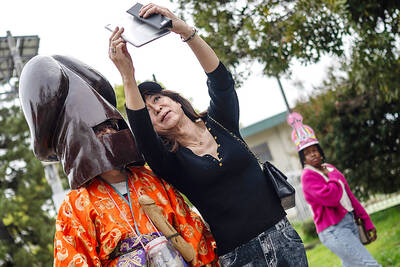
Showcasing phallus-shaped portable shrines and pink penis candies, Japan’s annual fertility festival yesterday teemed with tourists, couples and families elated by its open display of sex. The spring Kanamara Matsuri near Tokyo features colorfully dressed worshipers carrying a trio of giant phallic-shaped objects as they parade through the street with glee. The festival, as legend has it, honors a local blacksmith in the Edo Period (1603-1868) who forged an iron dildo to break the teeth of a sharp-toothed demon inhabiting a woman’s vagina that had been castrating young men on their wedding nights. A 1m black steel phallus sits in the courtyard of

JAN. 1 CLAUSE: As military service is voluntary, applications for permission to stay abroad for over three months for men up to age 45 must, in principle, be granted A little-noticed clause in sweeping changes to Germany’s military service policy has triggered an uproar after it emerged that the law requires men aged up to 45 to get permission from the armed forces before any significant stay abroad, even in peacetime. The legislation, which went into effect on Jan. 1 aims to bolster the military and demands all 18-year-old men fill out a questionnaire to gauge their suitability to serve in the armed forces, but stops short of conscription. If the “modernized” model fails to pull in enough recruits, parliament will be compelled to discuss the reintroduction of compulsory service, German


 RSS
RSS