


The Burmese junta has said that detained former leader Aung San Suu Kyi is “in good health,” a day after her son said he has received little information about the 80-year-old’s condition and fears she could die without him knowing.
In an interview in Tokyo earlier this week, Kim Aris said he had not heard from his mother in years and believes she is being held incommunicado in the capital, Naypyidaw.
Aung San Suu Kyi, a Nobel Peace Prize laureate, was detained after a 2021 military coup that ousted her elected civilian government and sparked a civil war. She is serving a 27-year sentence on charges including incitement, corruption and election fraud — all of which she denies.
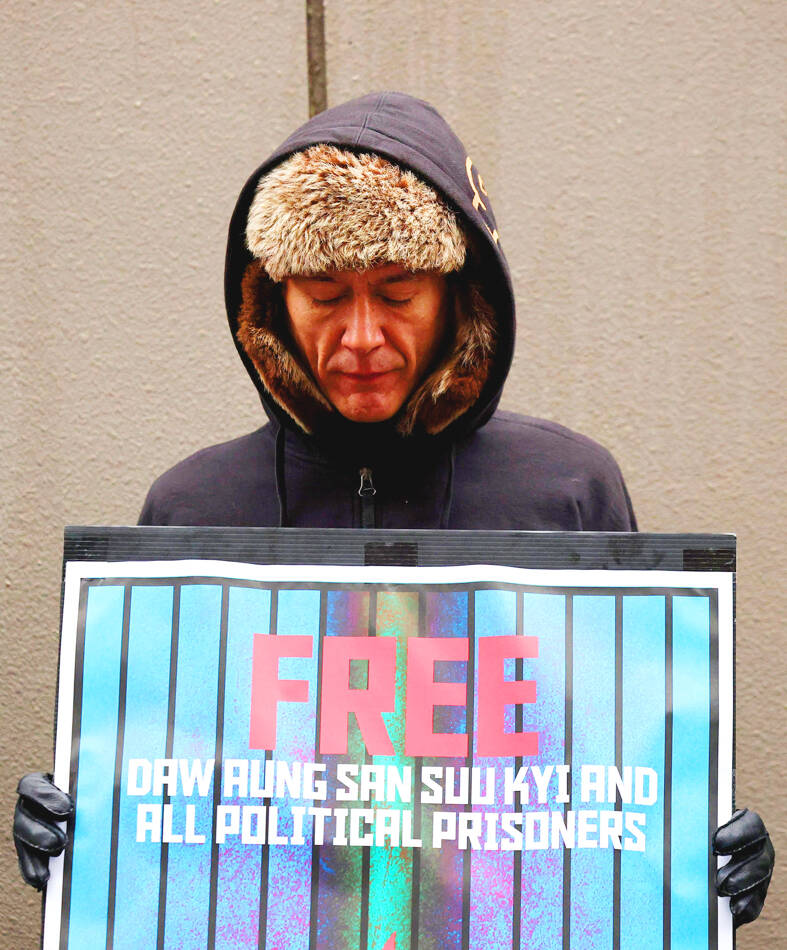
Photo: Reuters
“Daw Aung San Suu Kyi is in good health,” a statement posted on junta-run Myanmar Digital News said on Tuesday, using an honorific for the former leader.
The statement offered no evidence or details about her condition.
“The military claims she is in good health, yet they refuse to provide any independent proof, no recent photograph, no medical verification, and no access by family, doctors, or international observers. If she is truly well, they can prove it,” Aris said yesterday in response to the statement.
A junta spokesman did not respond to calls seeking comment.
In the interview earlier this week, Aris had said he hopes an upcoming multiphase election in Myanmar, starting on Dec. 28, might offer an opportunity for the military to release Aung San Suu Kyi or move her to house arrest.
Myanmar’s military has a history of releasing prisoners to mark holidays or important events. Aung San Suu Kyi was freed in 2010 days after an election, ending a previous long period of detention.
Aris has joined a chorus of critics, including several foreign governments, dismissing the polls as a sham aimed at legitimizing military rule.
The junta accused Aris of trying to disrupt the election — the first general poll since 2020, when the military accused Aung San Suu Kyi of committing fraud.
Aris said he had no intention to interfere in the country’s politics.
“My concern is growing because my mother has been hidden for so long that I now have to ask the most painful question: Is she still alive?” he said.
Meanwhile, the junta yesterday said 229 people were being pursued for prosecution under legislation passed in July to protect the upcoming election from “obstruction, disruption and destruction.”
The law includes clauses forbidding criticism or protest against the vote, and outlining severe punishments.
Additional reporting by AFP

An American scientist convicted of lying to US authorities about payments from China while he was at Harvard University has rebuilt his research lab in Shenzhen, China, to pursue technology the Chinese government has identified as a national priority: embedding electronics into the human brain. Charles Lieber, 67, is among the world’s leading researchers in brain-computer interfaces. The technology has shown promise in treating conditions such as amyotrophic lateral sclerosis and restoring movement in paralyzed people. It also has potential military applications: Scientists at the Chinese People’s Liberation Army have investigated brain interfaces as a way to engineer super soldiers by boosting
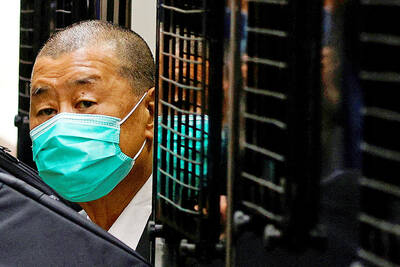
Jailed media entrepreneur Jimmy Lai (黎智英) has been awarded Deutsche Welle’s (DW) freedom of speech award for his contribution to Hong Kong’s pro-democracy movement. The German public broadcaster on Thursday said Lai would be presented in absentia with the 12th iteration of the award on June 23 at the DW Global Media Forum in Bonn. Deutsche Welle director-general Barbara Massing praised the 78-year-old founder of the now-shuttered news outlet Apple Daily for standing “unwaveringly for press freedom in Hong Kong at great personal risk.” “With Apple Daily, he gave journalists a platform for free reporting and a voice to the democracy movement in
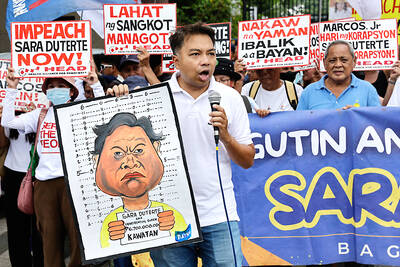
PHILIPPINE COMMITTEE: The head of the committee that made the decision said: ‘If there is nothing to hide, there is no reason to hide, there is no reason to obstruct’ A Philippine congressional committee on Wednesday ruled that there was “probable cause” to impeach Philippine Vice President Sara Duterte after hearing allegations of unexplained wealth, misuse of state funds and threats to have the president assassinated. The unanimous decision of the 53-member committee in the Philippine House of Representatives sends the two impeachment complaints to deliberations and voting by the entire lower chamber, which has more than 300 lawmakers. The complaints centered on Duterte’s alleged illegal use and mishandling of intelligence funds from the vice president’s office, and from her time as education secretary under Philippine President Ferdinand Marcos Jr. Duterte and the

Burmese President Min Aung Hlaing yesterday cut all prisoners’ sentences by one-sixth, a blanket measure that a source close to deposed leader Aung San Suu Kyi said would further shorten her detention. Aung San Suu Kyi has been sequestered since a 2021 military coup, but the senior member of her dissolved National League for Democracy (NLD) party said that while her term had been reduced, her remaining sentence is still unclear. “We also don’t know exactly how many years she has left,” the source told reporters, speaking on condition of anonymity for security reasons. The military toppled Aung San Suu Kyi’s elected government


 RSS
RSS