


Poland has decided to start producing anti-personnel mines for the first time since the Cold War, and plans to deploy them along its eastern border and might export them to Ukraine, the deputy defense minister said.
Joining a broader regional shift that has seen almost all European countries bordering Russia, with the exception of Norway, announce plans to quit the global treaty banning such weapons, Poland wants to use anti-personnel mines to beef up its borders with Belarus and Russia.
“We are interested in large quantities as soon as possible,” Deputy Minister of National Defense Pawel Zalewski said.
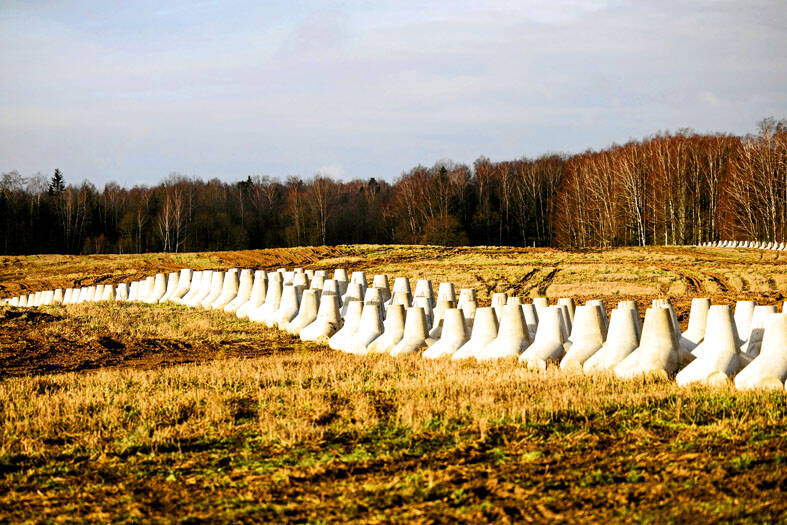
Photo: Reuters
The mines would be part of the “East Shield,” a defensive program aimed at fortifying Poland’s borders with Belarus and the Russian enclave of Kaliningrad, he said.
Asked whether production of mines could begin next year, once the withdrawal process from the Ottawa Convention was completed, Zalewski said: “I would very much like that... We have such needs.”
Poland began the process of withdrawal from the Ottawa Convention in August and had previously said it could start production of anti-personnel mines if needed, but that no formal decision had been taken. Zalewski’s comments are the first confirmation from Warsaw that it will go ahead with the move.
Under the Landmine and Cluster Munitions Monitor, Poland told the UN in 1995 that it had abandoned production of anti-personnel mines in the mid-1980s and the export of such weapons had ceased.
Belma, the state-owned company that already supplies the Polish army with several other types of mines, said the country would be equipped with millions of mines under the East Shield program to secure its 800km eastern border.
“We are preparing for Polish demand ... to amount to 5 [million] to 6 million mines of all types,” Belma CEO Jaroslaw Zakrzewski said.
While the defense ministry has not placed an order yet, the company would be able to produce up to 1.2 million mines of all types, including anti-personnel mines, next year, he added.
Belma currently produces about 100,000 mines per year.
The minister said supplying mines to Ukraine would depend on production capacity.
“Our starting point is our own needs, but, for us, Ukraine is absolutely a priority because the European and Polish security line is on the Russia-Ukraine front,” Zalewski said.
Zakrzewski said that exports to Ukraine were possible and that NATO countries bordering Russia, including the Baltic states, had already signaled interest in buying anti-personnel mines.
Poland’s own needs would take priority, but any excess production could be supplied to allies in the region, he said.
Earlier this year, Lithuania and Finland said they expected to start producing anti-personnel mines next year amid rising concerns about Russia since its full-scale invasion of Ukraine in 2022.
Latvia and Estonia are also leaving the treaty, but have not announced production plans, although officials in Riga said they could launch manufacturing quickly if needed and Estonia sees it as a future option.
Polish anti-personnel mine production could begin once the treaty’s six-month withdrawal period is completed on Feb. 20 next year, the Polish Ministry of Foreign Affairs said.

Through the noise of rushing papers and whirring belts at a print factory in Kyoto, two creators watch their photo essay come to life in broadsheet form — part of an effort to win new audiences in the age of artificial intelligence (AI). Despite the decline of the publishing industry, self-publication and handmade “zine” magazines are growing in popularity in Japan, reflecting the nation’s enduring love of paper in the digital era. While speaking to Agence France-Presse at the plant, his hands black with ink, one of the creators, Kazuma Obara, said: “I think [paper] is a medium that engages all five

‘CROSSING THE LINE’: China’s embassy in Seoul criticized US Forces Korea Commander General Xavier Brunson, asking if his ‘hostile’ remarks were authorized by Washington South Korea and the US are in talks over recent public remarks by the commander of US Forces Korea, Seoul’s presidential office said yesterday, after the comments drew sharp criticism from China. In a recent podcast interview, US Forces Korea Commander General Xavier Brunson described South Korea as “the dagger in the heart of Asia” from China’s east coast, prompting the Chinese embassy in Seoul to say that he had “truly crossed the line.” The interview came amid growing speculation that Washington might seek to expand the role of US Forces Korea in countering the growing regional influence of China, a key

Australian researchers have trained lab-grown brain cells on a silicon computer chip to play the 1990s shooter game Doom and said they are just scratching the surface of what the neurons could be capable of doing. It is the science-fiction work of biotech boffins at Cortical Labs, who researched and developed the technology that harnesses the workings of the brain’s networking system. Each so-called “biological computer” contains about 200,000 living human brain cells, grown from stem cells that were harvested from blood donations. Having mastered the simple computer game Pong, where a paddle is moved up and down to send a ball

France experienced its hottest spring on record, the French weather service said on Tuesday, after an exceptional early heat wave that also broke highs for the season in England and Wales. Meteo-France said the average nationwide temperature over March to May was 13.8°C — about 1.7°C above the norm, and surpassing records set in 2011 and 2020. “The warmest spring since records began in 1900,” it said in a bulletin. All three months were warmer than average, but the onset of an “unprecedented heatwave” late last month pushed the mercury to highs typically seen at the height of the summer. “Our country had never


 RSS
RSS