


For the second time in a week, a smugglers’ boat overloaded with migrants capsized in the Canal of Sicily on Friday as it made the perilous crossing from Africa to Europe. At least 34 people drowned, but 223 people were rescued in a joint Italian-Maltese operation, officials said.
Helicopters ferried the injured to Lampedusa, the Italian island that is closer to Africa than the Italian mainland and the destination of choice for most smugglers’ boats leaving Tunisia or Libya.
It was off Lampedusa that a migrant ship from Libya capsized on Thursday last week with about 500 people aboard. Only 155 survived.
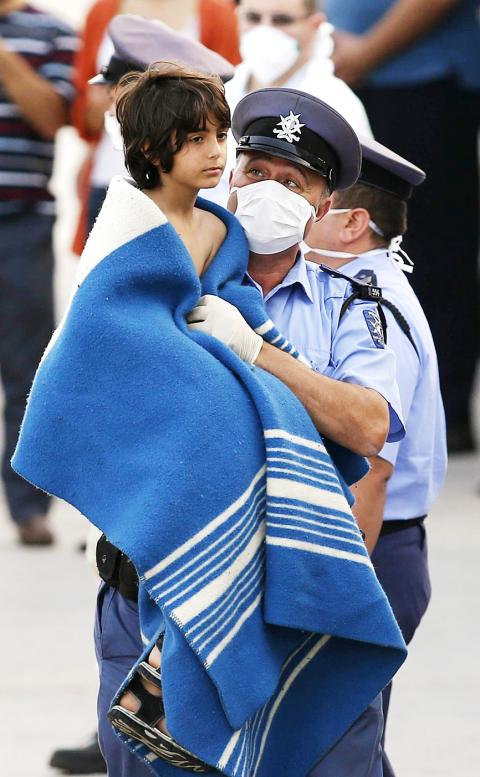
Photo: Reuters
Friday’s capsizing occurred 105km southeast of Lampedusa, but in waters where Malta has search and rescue responsibilities.
The two shipwrecks were the latest grim reminder of the extreme risks that migrants and asylum-seekers often take in an effort to slip into Europe every year by boat.
Facing unrest and persecution in Africa and the Middle East, many of the migrants think the Lampedusa escape route to Europe is worth the risk.
“They do know that they are risking their lives, but it is a rational decision,” said Maurizio Albahari, assistant professor of anthropology at the University of Notre Dame. “Because they know for a fact they will be facing death or persecution at home — whatever remains of their home, or assuming there is a home in the first place.”
What drives them is the hope that they will have a better life in Europe for themselves and their children, he said.
In the latest case, the Italian coast guard said it received a satellite phone call from the boat that it was in distress and was able to locate it based on the satellite coordinates, Italian coast guard spokesman Marco Di Milla said.
A Maltese aircraft was sent up and reported that the boat had capsized and that “numerous” people were in the water.
The aircraft dropped a life raft, and a patrol boat soon arrived at the scene, according to a statement from the Maltese armed forces.
Late on Friday, Maltese Prime Minister Joseph Muscat reported that 27 bodies had been recovered, three of them children.
He said 150 survivors were rescued aboard a Maltese ship.
An Italian patrol boat had another 56 survivors, while a fishing boat had 15, Italian navy commander Marco Maccaroni said.
Between the Italian and Maltese ships, the total of survivors came to 223.
The incident occurred as recovery operations continued on Friday off Lampedusa for victims of the shipwreck on Friday last week. The death toll stood on Friday at 339, including a newborn recovered with its umbilical cord still attached, Di Milla said.
The recent deaths prompted renewed calls for the EU to do more to better patrol the southern Mediterranean and prevent such tragedies — and for countries like Libya to crack down on smuggling operations.
“We cannot allow the Mediterranean to become a cemetery,” Muscat told a news conference in Valletta.
Lampedusa is the destination of choice for smugglers who usually charge more than 1,000 euros (US$1,355) a head and cram the migrants onto boats that routinely run into trouble and require rescue.
Fortress Europe, an Italian observatory that tracks migrant deaths reported by the media, says about 6,450 people died in the Canal of Sicily between 1994 and last year.
Once in Italy, the migrants are screened for asylum and often sent back home if they do not qualify.
During the 1990s and early 2000s, many of the arrivals were considered “economic migrants.”
However, many of the latest arrivals are fleeing persecution and conflict in places such as Syria and Eritrea, and qualify for refugee status, UN officials say.
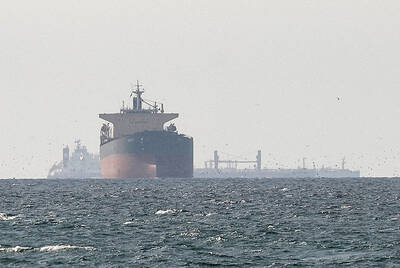
A ship that appears to be taking on the identity of a scrapped gas carrier exited the Strait of Hormuz on Friday, showing how strategies to get through the waterway are evolving as the Middle East war progresses. The vessel identifying as liquefied natural gas (LNG) carrier Jamal left the Strait on Friday morning, ship-tracking data show. However, the same tanker was also recorded as having beached at an Indian demolition yard in October last year, where it is being broken up, according to market participants and port agent’s reports. The ship claiming to be Jamal is likely a zombie vessel that

Japan is to downgrade its description of ties with China from “one of its most important” in an annual diplomatic report, according to a draft reviewed by Reuters, as relations with Beijing worsen. This year’s Diplomatic Bluebook, which Japanese Prime Minister Sanae Takaichi’s government is expected to approve next month, would instead describe China as an important neighbor and the relationship as “strategic” and “mutually beneficial.” The draft cites a series of confrontations with Beijing over the past year, including export controls on rare earths, radar lock-ons targeting Japanese military aircraft and increased pressure around Taiwan. The shift in tone underscores a deterioration

LAW CONSTRAINTS: The US has been pressing allies to send warships to open the Strait, but Tokyo’s military actions are limited under its postwar pacifist constitution Japan could consider deploying its military for minesweeping in the Strait of Hormuz if a ceasefire is reached in the war on Iran, Japanese Minister of Foreign Affairs Toshimitsu Motegi said yesterday. “If there were to be a complete ceasefire, hypothetically speaking, then things like minesweeping could come up,” Motegi said. “This is purely hypothetical, but if a ceasefire were established and naval mines were creating an obstacle, then I think that would be something to consider.” Japan’s military actions are limited under its postwar pacifist constitution, but 2015 security legislation allows Tokyo to use its Self-Defense Forces overseas if an attack,

German Chancellor Friedrich Merz’s conservative Christian Democratic Union (CDU) yesterday faced a regional election battle in Rhineland-Palatinate, now held by the center-left Social Democratic Party (SPD). Merz’s CDU has enjoyed a narrow poll lead over the SPD — their coalition partners at the national level — who have ruled the mid-sized state for 35 years. Polling third is the far-right Alternative for Germany (AfD), which spells a greater threat to the two centrist parties in several state elections in September in the country’s ex-communist east. The picturesque state of Rhineland-Palatinate, bordering France, Belgium and Luxembourg and with a population of about 4 million,


 RSS
RSS