


Australia’s Great Barrier Reef has lost more than half its coral cover in the past 27 years due to storms, predatory starfish and bleaching linked to climate change, a study released yesterday found.
The research by scientists from the Australian Institute of Marine Sciences (AIMS) and the University of Wollongong warned that coral cover on the heritage-listed reef — the world’s largest — could halve again by 2022 if trends continued.
Intense tropical cyclones — 34 in total since 1985 — were responsible for much of the damage, accounting for 48 percent, with outbreaks of the coral-feeding crown-of-thorns starfish linked to 42 percent.
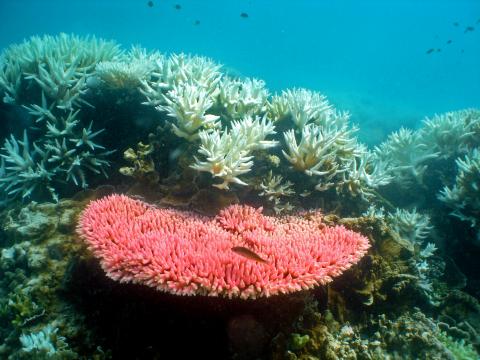
Photo: AFP / Ray Berkelmans / Australian Institute of Marine Science
Two severe coral bleaching events in 1998 and 2002 due to ocean warming also had “major detrimental impacts” on the central and northern parts of the reef, the study found, putting the impact at 10 percent.
Two-thirds of the loss had occurred since 1998, with the rate of decline increasing substantially and only three of the 214 individual reefs surveyed across the sprawling 345,000km2 site escaping any impact.
“This loss of over half of initial cover is of great concern, signifying habitat loss for the tens of thousands of species associated with tropical coral reefs,” the study said.
Author Hugh Sweatman said the findings, which were drawn from the world’s largest ever reef monitoring project involving 2,258 surveys over 27 years, showed that coral could recover from such trauma.
“But recovery takes 10-20 years. At present, the intervals between the disturbances are generally too short for full recovery and that’s causing the long-term losses,” Sweatman said.
The study said cyclone intensities were increasing as the world’s oceans warmed and bleaching deaths would “almost certainly increase” as a result of climate changes.
“The recent frequency and intensity of mass coral bleaching are of major concern, and are directly attributable to rising atmospheric greenhouse gases,” it said. “Mitigation of global warming and ocean acidification is essential for the future of the great barrier reef.”
AIMS chief John Gunn said it was difficult to stop the storms and bleaching, but researchers could focus their short-term efforts on the large, poisonous and spiny starfish, which feasts on coral polyps and can devastate reef cover.
The study said improving water quality was key to controlling starfish outbreaks, with increased agricultural run-off such as fertilizer along the reef coast causing algal blooms that starfish larvae feed on.
“We can’t stop the storms but perhaps we can stop the starfish,” Gunn said. “If we can, then the reef will have more opportunity to adapt to the challenges of rising sea temperatures and ocean acidification.”
He said researchers would try to “better predict and reduce the periodic population explosions” of the starfish and explore whether direct intervention methods could be useful.
According to the study, published in Proceedings of the National Academy of Sciences, coral cover would be able to rejuvenate by 0.89 percent every year without the starfish.
“So even with losses due to cyclones and bleaching there should be slow recovery,” Gunn said.
UNESCO warned it was considering listing the reef as a heritage site in danger earlier this year due to the unprecedented gas and coal mining boom in northern Australia and increasing coastal development.

Four contenders are squaring up to succeed Antonio Guterres as secretary-general of the UN, which faces unprecedented global instability, wars and its own crushing budget crisis. Chile’s Michelle Bachelet, Argentina’s Rafael Grossi, Costa Rica’s Rebeca Grynspan and Senegal’s Macky Sall are each to face grillings by 193 member states and non-governmental organizations for three hours today and tomorrow. It is only the second time the UN has held a public question-and-answer, a format created in 2016 to boost transparency. Ultimately the five permanent members of the UN’s top body, the Security Council, hold the power, wielding vetoes over who leads the

A humanoid robot that won a half-marathon race for robots in Beijing on Sunday ran faster than the human world record in a show of China’s technological leaps. The winner from Honor, a Chinese smartphone maker, completed the 21km race in 50 minutes and 26 seconds, said a WeChat post by the Beijing Economic-Technological Development Area, also known as Beijing E-Town, where the race began. That was faster than the human world record holder, Ugandan Jacob Kiplimo, who finished the same distance in about 57 minutes in March at the Lisbon road race. The performance by the robot marked a significant step forward

An earthquake registering a preliminary magnitude of 7.7 off northern Japan on Monday prompted a short-lived tsunami alert and the advisory of a higher risk of a possible mega-quake for coastal areas there. The Cabinet Office and the Japan Meteorological Agency said there was a 1% chance for a mega-quake, compared to a 0.1% chance during normal times, in the next week or so following the powerful quake near the Chishima and Japan trenches. Officials said the advisory was not a quake prediction but urged residents in 182 towns along the northeastern coasts to raise their preparedness while continuing their daily lives. Prime
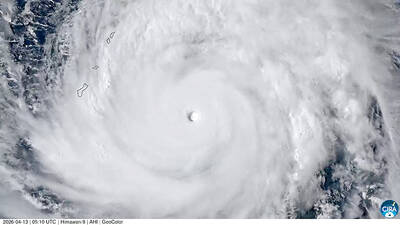
HAZARDOUS CONDITION: The typhoon’s sheer size, with winds extending 443km from its center, slowed down the ability of responders to help communities, an official said The US Coast Guard was searching for six people after losing contact with their disabled boat off the coast of Guam following Typhoon Sinlaku. The crew of the 44m dry cargo vessel, the US-registered Mariana, on Wednesday notified the coast guard that the boat had lost its starboard engine and needed assistance, Petty Officer 3rd Class Avery Tibbets said yesterday. The coast guard set up a one-hour communication schedule with the vessel, but lost contact on Thursday. A Coast Guard HC-130 Hercules aircraft was launched to search for the six people on board, but it had to return to Guam because of


 RSS
RSS