


Yemen’s defense minister narrowly escaped assassination on Tuesday when a powerful car bomb ripped through his motorcade as it traveled in the nation’s capital, killing at least 13 people in an attack that bore the hallmarks of al-Qaeda.
The bombing came a day after Yemeni authorities announced the killing of the No. 2 leader of the militant group’s Yemeni branch — which is al-Qaeda’s most active — in an apparent US airstrike.
0POPULAR OFFICIAL
There was no immediate claim of responsibility for the mid-morning blast in Sana’a, but al-Qaeda’s Yemeni branch is believed to be behind at least five other failed assassination attempts against the minister, Major General Mohammed Nasser Ahmed, who has recently won national acclaim as a seasoned and popular commander in the fight against al-Qaeda militants.
Hours after the attack, Yemeni President Abd Rabbuh Mansur al-Hadi fired the chiefs of national security and military intelligence, as well as the stepbrother of ousted Yemeni president Ali Abdullah Saleh, Ali Saleh al-Ahmar. Al-Ahmar was the director of the office of the supreme commander of the armed forces, a position from which he wielded vast power.
The bombing appeared to be in the vein of a string of attacks blamed on al-Qaeda since the terror network suffered a series of setbacks at the hands of US-backed government troops. The offensive has dislodged the group from a large swath of southern Yemen it had occupied for more than a year.
BRUTAL ATTACKS
The battlefield defeats came as many residents in the south turned against the militants, mostly out of anger over their brutality or because of the disruptions caused by fighting with government forces.
Al-Qaeda responded to the defeats by staging brutal attacks that cost them even more local support. In recent months, it has attacked mourners at funerals, targeted troops praying in mosques and sent a suicide bomber to a military parade rehearsal.
Tuesday’s bombing hit the last vehicle in Ahmed’s three-car convoy as it was traveling through the neighborhood of al-Izaa, according to Yemeni security officials. The blast left the car a charred hulk of twisted metal, with burnt bodies strapped inside, and blew out the windows of storefronts and scorched a nearby building. Pools of blood stained the pavement as hundreds of soldiers and onlookers converged on the site.
Eight of the minister’s security guards and five civilian bystanders were killed, the officials said on condition of anonymity because they were not authorized to brief the media.
“This is awful,” said Mohamed El-Mehdi, who works in the area. “The people and children are unable to grasp what happened.”
Some of the five civilians killed were the owners of nearby shops, he added.
Al-Qaeda’s Yemeni branch is seen by Washington as the world’s most active, planning and carrying out attacks against targets in both Yemen and the US, including the failed attempt by an al-Qaeda operative to detonate an underwear bomb aboard a flight bound for Detroit on Dec. 25, 2009.
SUICIDE BOMBERS
Earlier this year, nearly 100 Yemeni soldiers were killed and at least 200 wounded when an al-Qaeda suicide bomber blew himself up at the parade rehearsal in May. Al-Qaeda said at the time it was targeting Ahmed, who was not hurt in the attack.
Earlier this month, a suicide attacker driving an explosives-laden car blew himself up in the southern city of Aden next to the minister’s passing convoy. Ahmed escaped that attack unscathed as well. There was no claim of responsibility, but Yemeni military forces were battling al-Qaeda militants there at the time.
A month earlier, the minister’s convoy also came under attack in the southern province of Abyan, which was an al-Qaeda stronghold at the time.


Through the noise of rushing papers and whirring belts at a print factory in Kyoto, two creators watch their photo essay come to life in broadsheet form — part of an effort to win new audiences in the age of artificial intelligence (AI). Despite the decline of the publishing industry, self-publication and handmade “zine” magazines are growing in popularity in Japan, reflecting the nation’s enduring love of paper in the digital era. While speaking to Agence France-Presse at the plant, his hands black with ink, one of the creators, Kazuma Obara, said: “I think [paper] is a medium that engages all five
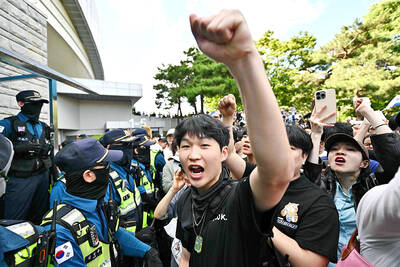
‘ABSURD MISTAKE’: The election commission said that there had been a failure to anticipate turnout after 14 polling stations ran short of ballot papers South Korean riot police yesterday cleared protesters from a Seoul polling station after a 35-hour blockade sparked by a shortage of ballot papers during local elections earlier this week. Wednesday’s election was the first nationwide vote since South Korean President Lee Jae-myung took office following the ouster of Yoon Suk-yeol over his short-lived martial law declaration. Lee’s ruling Democratic Party swept most races, but failed to flip the crucial Seoul mayoral seat. The South Korean National Election Commission apologized, blaming a failure to anticipate turnout after 14 polling stations in Seoul ran short of ballot papers. Some polling stations stayed open until 10pm to

France experienced its hottest spring on record, the French weather service said on Tuesday, after an exceptional early heat wave that also broke highs for the season in England and Wales. Meteo-France said the average nationwide temperature over March to May was 13.8°C — about 1.7°C above the norm, and surpassing records set in 2011 and 2020. “The warmest spring since records began in 1900,” it said in a bulletin. All three months were warmer than average, but the onset of an “unprecedented heatwave” late last month pushed the mercury to highs typically seen at the height of the summer. “Our country had never
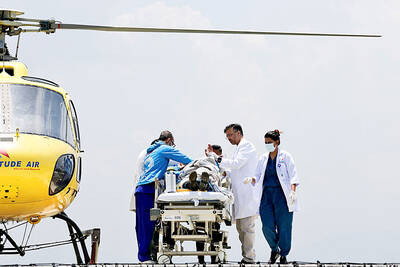
A Sherpa guide was found crawling to base camp on Mount Everest a week after he went missing and was reunited with his family, who had given up hope he would return. Dawa Sherpa was last seen on Friday last week descending the mountain, but he did not reach base camp even though his client did. The pair were among the last climbers on the mountain as the climbing season came to an end and the route was dismantled. Dawa was located by a cleaning crew on Thursday morning as he was crawling down the snowy slopes around the Khumbu Icefall, just above


 RSS
RSS