


Ageing Muslim rebel leaders in the southern Philippines are voicing growing frustration that efforts to end one of Asia’s longest and deadliest insurgencies have hit a diplomatic brick wall.
Moro Islamic Liberation Front (MILF) chairman Murad Ebrahim expressed hope after an historic meeting with Philippine President Benigno Aquino III in August that peace talks were on a “fast-track” and a final deal was within sight.
However, negotiations stalled soon after when the government offered its roadmap for peace, a document Murad called an “exercise in futility” and said could lead to reigniting a conflict that has claimed an estimated 150,000 lives.
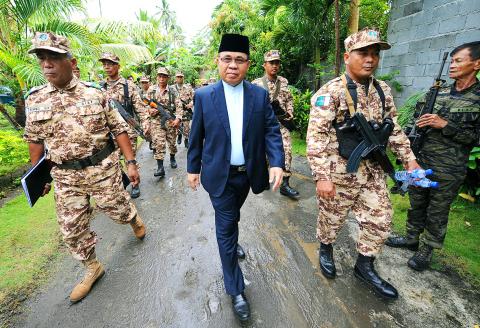
PHOTO: AFP
“There is an impression that it is even heaven and earth,” Murad told reporters recently at the MILF’s rural Camp Darapanan headquarters in the southern Philippines, in reference to the two sides’ positions.
Murad insisted there would be no more direct talks between two sides’ peace panels until the government produced a more realistic and workable blueprint. The government has rejected the MILF’s demand.
The stalemate is the latest setback to 10 years of talks that some observers say are inevitably doomed because the national government will not be able to meet the MILF’s core requirement of an autonomous substate in the south.
There are about 4 million Muslims in the southern Philippine region of Mindanao, an area they see as their ancestral homeland dating back to Islamic sultanates established long before Spanish Christians arrived in the 1500s.
The region is among the most fertile and resource-rich in the Philippines, but it is also one of the country’s poorest and undeveloped, a legacy of the conflict that began four decades ago.
Muslims, known as Bangsamoro, are now a minority in Mindanao, but insist they should be allowed to largely govern the region themselves and control its potential riches.
“We feel we are colonized,” Murad said.
The MILF, the largest Muslim rebel group with about 12,000 soldiers, has for the past decade sought to negotiate a settlement rather than achieve its aims through armed insurgency, which peaked in the 1970s when an all-out war raged.
However negotiations have gone virtually nowhere since 2008 when the Supreme Court blocked a peace deal that would have opened the door to an autonomous Muslim substate, ruling it was “unconstitutional.”
Aquino, who came to power last year, promised to reinvigorate the peace process and invested much personal capital by meeting Murad in August.
Their encounter in Japan was the first ever face-to-face talks between a sitting Philippine president and a MILF leader.
However the optimism within the MILF faded after the government put forward its peace plan a few weeks later with the explicit condition that it will only work within the Constitution, effectively ruling out a substate.
At this stage, Aquino is unwilling to invest further political capital by lobbying Congress to change the Constitution for what many among the majority Catholic population would oppose, security analyst Rommel Banlaoi said.
“Right now there is a huge gap in misunderstanding,” Banlaoi, head of the Philippine Institute for Peace, Violence and Terrorism, said after he met with Murad.
“The Philippine government insists on using the constitutional framework to address the Bangsamoro problem, but the Moro Islamic Liberation Front is insisting that what they want is a substate,” Banlaoi said.
The government is instead offering the MILF “enhanced autonomy” as part of a self-coined “three-for-one” plan that also involves economic development and government recognition of the -Bangsamoros’ historical ties to the land.
Chief government negotiator Marvic Leonen has maintained in recent weeks that the two sides in fact have many positions in common and a peace deal is achievable before Aquino’s term ends in 2016.
“There are many sources for optimism,” Leonen said, although he conceded there was still no date yet for when the two sides would resume negotiations.

China’s military news agency yesterday warned that Japanese militarism is infiltrating society through series such as Pokemon and Detective Conan, after recent controversies involving events at sensitive sites. In recent days, anime conventions throughout China have reportedly banned participants from dressing as characters from Pokemon or Detective Conan and prohibited sales of related products. China Military Online yesterday posted an article titled “Their schemes — beware the infiltration of Japanese militarism in culture and sports.” The article referenced recent controversies around the popular anime series Pokemon, Detective Conan and My Hero Academia, saying that “the evil influence of Japanese militarism lives on in

ANTI-SEMITISM: Some newsletters promote hateful ideas such as white supremacy and Holocaust denial, with one describing Adolf Hitler as ‘one of the greatest men of all time’ The global publishing platform Substack is generating revenue from newsletters that promote virulent Nazi ideology, white supremacy and anti-Semitism, a Guardian investigation has found. The platform, which says it has about 50 million users worldwide, allows members of the public to self-publish articles and charge for premium content. Substack takes about 10 percent of the revenue the newsletters make. About 5 million people pay for access to newsletters on its platform. Among them are newsletters that openly promote racist ideology. One, called NatSocToday, which has 2,800 subscribers, charges US$80 for an annual subscription, although most of its posts are available

GLORY FACADE: Residents are fighting the church’s plan to build a large flight of steps and a square that would entail destroying up to two blocks of homes Barcelona’s eternally unfinished Basilica de la Sagrada Familia has grown to become the world’s tallest church, but a conflict with residents threatens to delay the finish date for the monument designed more than 140 years ago. Swathed in scaffolding on a platform 54m above the ground, an enormous stone slab is being prepared to complete the cross of the central Jesus Christ tower. A huge yellow crane is to bring it up to the summit, which will stand at 172.5m and has snatched the record as the world’s tallest church from Germany’s Ulm Minster. The basilica’s peak will deliberately fall short of the

Venezuelan Nobel peace laureate Maria Corina Machado yesterday said that armed men “kidnapped” a close ally shortly after his release by authorities, following former Venezuelan president Nicolas Maduro’s capture. The country’s Public Prosecutor’s Office confirmed later yesterday that former National Assembly vice president Juan Pablo Guanipa, 61, was again taken into custody and was to be put under house arrest, arguing that he violated the conditions of his release. Guanipa would be placed under house arrest “in order to safeguard the criminal process,” the office said in a statement. The conditions of Guanipa’s release have yet to be made public. Machado claimed that


 RSS
RSS