


Iran on Monday unveiled underground silos that can carry missiles capable of hitting Israel and US bases in the Persian Gulf as it began 10 days of war games, the country’s latest show of military force amid a standoff with the West over its disputed nuclear program.
State TV broadcast footage of deep underground silos, claiming that medium and long-range missiles stored in them are ready to launch in case of an attack on Iran. The silos are widely viewed as a strategic asset for Iran in the event of a US or Israeli attack on its nuclear facilities.
Iranian Colonel Asghar Qelichkhani, a spokesman for the war games, said the silos “function as a swift-reaction unit.”
“Missiles, which are permanently in the vertical position, are ready to hit the predetermined targets,” he was quoted as saying by state TV.
An officer in Iran’s powerful Revolutionary Guards, which is in charge of the missile program, said Tehran has constructed “numerous” underground missile silos which satellites cannot detect. He did not elaborate.
The state television report broadcast footage of underground launching pads for the Shahab-3 missile, which have a range of more than 2,000km — putting Israel, US bases in the Persian Gulf region and parts of southeastern and eastern Europe within reach.
The report also showed pictures of missiles being fired from one silo after a large metal roof opened to allow the missile to launch. The TV report said the missile silos are linked to a missile control center.
Iranian Aerospace Force Commander Amir Ali Hajizadeh, touted the silos as a crucial asset in its standoff with the West, saying that with “these facilities we are certain that we can confront unequal enemies and defend the Islamic Republic of Iran.”
Another unidentified Guards officer told state TV that “only few countries in the world possess the technology to construct underground missile silos. The technology required for that is no less complicated than building the missile itself.”
Qelichkhani said the silos are based on local technology developed by Iranian experts.
The Iranian war games, which began on Monday, are dubbed “The Great Prophet Six” and include tests of long-range missiles such as the Sajjil, which boasts a range similar to that of the Shahab-3.
Iran conducts several war games every year, as part of its military self-sufficiency program that started in 1992, and frequently unveils new weapons and military systems during the drills.


PHISHING: The con might appear convincing, as the scam e-mails can coincide with genuine messages from Apple saying you have run out of storage For a while you have been getting messages from Apple saying “your iCloud storage is full.” They say you have exceeded your storage plan, so documents are no longer being backed up, and photos you take are not being uploaded. You have been resisting Apple’s efforts to get you to pay a minimum of £0.99 (US$1.33) a month for more storage, but it seems that you cannot keep putting off the inevitable: You have received an e-mail which says your iCloud account has been blocked, and your photos and videos would be deleted very soon. To keep them you need

For two decades, researchers observed members of the Ngogo chimpanzee group of Kibale National Park in Uganda spend their days eating fruits and leaves, resting, traveling and grooming in their tropical rainforest abode, but this stable community then fractured and descended into years of deadly violence. The researchers are now describing the first clearly documented example of a group of wild chimpanzees splitting into two separate factions, with one launching a series of coordinated attacks against the other. Adult males and infants were targeted, with 28 deaths. “Biting, pounding the victim with their hands, dragging them, kicking them — mostly adult males,
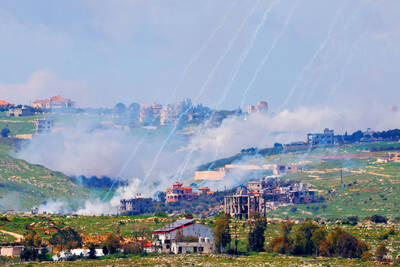
The Israeli military has demolished entire villages as part of its invasion of south Lebanon, rigging homes with explosives and razing them to the ground in massive remote detonations. The Guardian reviewed three videos posted by the Israeli military and on social media, which showed Israel carrying out mass detonations in the villages of Taybeh, Naqoura and Deir Seryan along the Israel-Lebanon border. Lebanese media has reported more mass detonations in other border villages, but satellite imagery was not readily available to verify these claims. The demolitions came after Israeli Minister of Defense Israel Katz called for the destruction of

SUPERFAN: The Japanese PM played keyboard in a Deep Purple tribute band in middle school and then switched to drums at university, she told the British rock band Legendary British rock band Deep Purple yesterday made Japanese Prime Minister Sanae Takaichi’s day with a brief visit to their high-profile superfan as they returned to the nation they first toured more than half a century ago. Takaichi’s reputation as an amateur drummer, and a fan of hard rock and heavy metal has been well documented, and she has referred to Deep Purple as one of her favorite bands along with the likes of Black Sabbath and Iron Maiden. “You are my god,” a giddy Takaichi said in English to Deep Purple drummer Ian Paice, presenting him with a set of made-in-Japan


 RSS
RSS