


The influential rights group Mothers of the Plaza de Mayo is struggling with a corruption scandal that forced it to fire a top executive accused of misusing taxpayer funds meant to build housing for the poor.
The group is a close ally of Argentina’s president and the scandal could have political consequences with only months to go before an Oct. 23 election.
Argentine President Cristina Fernandez enjoys a wide lead in the polls and is favored to win re-election should she announce her candidacy this month.
The judicial investigation has already been broadened to include any politicians and government appointees found to be involved in the scandal.
“If there wasn’t complicity, there was negligence in terms of government controls. This case is yet more proof that the controls aren’t working in Argentina,” Ricardo Alfonsin, the president’s leading challenger, said in an interview he promoted on Twitter.
On Wednesday, opposition members of Congress called for more transparency and controls in government spending, and governing party deputies defended the Mothers group as key to the president’s populist programs.
The human rights group began during the 1976 to 1983 dictatorship when its founders demanded information about their children who had disappeared in the military junta’s campaign to eliminate political dissenters. In recent years, the group has evolved into a political movement that backs specific candidates and unions. It is a fixture at governing party rallies and it runs a wide range of social programs, as well as radio and television stations.
Since 2008, the government has given the Mothers group about US$187 million for more than 2,000 housing and related construction sites, Argentine Deputy Public Works Secretary Abel Fatala told a congressional committee on Wednesday, but he insisted that local officials, not the federal government, were responsible for making sure the money was properly spent.
Opposition leaders said the Mothers and federal officials showed a shocking failure of responsibility.
Fernanda Reyes, a deputy with the opposition Civic Coalition, said that since 2004, only 35 percent of housing that should have been built with taxpayers’ money was actually finished. A Peronist party deputy, Gustavo Ferrari, countered that the Mothers group is now Argentina’s second-biggest house builder in terms of the number of people it employs.
Sergio Schoklender, the right hand of the Mothers’ president, Hebe de Bonafini, is accused along with his brother Pablo and more than a dozen others of fraud, money laundering and illegal enrichment. Sergio Schoklender served as the rights group’s legal representative, which gave him key financial and administrative responsibilities.
Prosecutor Jorge Di Lello’s complaint alleges Schoklender made a series of suspicious operations that shifted taxpayers’ funds into businesses he owns.
While earning about US$16,000 a year to help Argentina’s poor, Schoklender amassed a 19-room mansion, Ferrari and Porsche sports cars and a yacht, according to the opposition Clarin newspaper. Schocklender also frequently flew around the country in private jets, the paper said.
Judge Norberto Oyarbide barred the Schoklender brothers from leaving Argentina and ordered a series of raids to recover documents. At one point, Sergio Schoklender showed up unexpectedly at court to give the judge evidence, such as receipts, bank statements and other financial documents, that he said would prove he had committed no crimes, according to his lawyer, Adrian Tenca.
The government, meanwhile, has moved forcefully to support Bonafini and fix any blame on those who worked for her.
Bonafini, who visited the presidential palace on Wednesday, is seeking to distance herself from the Schoklenders, whom she had treated like sons. She founded the group after her own two sons disappeared during the military dictatorship and has long defended the Schoklenders, who were released early from life terms in prison after killing their parents in a 1981 crime that shocked Argentina.
“I’m neither the first nor the last mother whose son gets into big trouble,” Bonafini told the pro-government Tiempo Argentino on Sunday in an interview that set the tone for this week’s wagon-circling. “The accusations are against the legal representative, who was Sergio, and against his brother, and if they committed crimes, they will have to pay.”

China’s military news agency yesterday warned that Japanese militarism is infiltrating society through series such as Pokemon and Detective Conan, after recent controversies involving events at sensitive sites. In recent days, anime conventions throughout China have reportedly banned participants from dressing as characters from Pokemon or Detective Conan and prohibited sales of related products. China Military Online yesterday posted an article titled “Their schemes — beware the infiltration of Japanese militarism in culture and sports.” The article referenced recent controversies around the popular anime series Pokemon, Detective Conan and My Hero Academia, saying that “the evil influence of Japanese militarism lives on in

ANTI-SEMITISM: Some newsletters promote hateful ideas such as white supremacy and Holocaust denial, with one describing Adolf Hitler as ‘one of the greatest men of all time’ The global publishing platform Substack is generating revenue from newsletters that promote virulent Nazi ideology, white supremacy and anti-Semitism, a Guardian investigation has found. The platform, which says it has about 50 million users worldwide, allows members of the public to self-publish articles and charge for premium content. Substack takes about 10 percent of the revenue the newsletters make. About 5 million people pay for access to newsletters on its platform. Among them are newsletters that openly promote racist ideology. One, called NatSocToday, which has 2,800 subscribers, charges US$80 for an annual subscription, although most of its posts are available
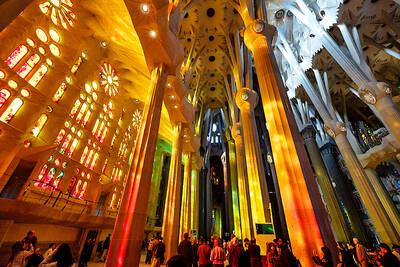
GLORY FACADE: Residents are fighting the church’s plan to build a large flight of steps and a square that would entail destroying up to two blocks of homes Barcelona’s eternally unfinished Basilica de la Sagrada Familia has grown to become the world’s tallest church, but a conflict with residents threatens to delay the finish date for the monument designed more than 140 years ago. Swathed in scaffolding on a platform 54m above the ground, an enormous stone slab is being prepared to complete the cross of the central Jesus Christ tower. A huge yellow crane is to bring it up to the summit, which will stand at 172.5m and has snatched the record as the world’s tallest church from Germany’s Ulm Minster. The basilica’s peak will deliberately fall short of the

Venezuelan Nobel peace laureate Maria Corina Machado yesterday said that armed men “kidnapped” a close ally shortly after his release by authorities, following former Venezuelan president Nicolas Maduro’s capture. The country’s Public Prosecutor’s Office confirmed later yesterday that former National Assembly vice president Juan Pablo Guanipa, 61, was again taken into custody and was to be put under house arrest, arguing that he violated the conditions of his release. Guanipa would be placed under house arrest “in order to safeguard the criminal process,” the office said in a statement. The conditions of Guanipa’s release have yet to be made public. Machado claimed that


 RSS
RSS