


Fifteen people died in a plane crash in eastern Venezuela, but 36 miraculously survived after the pilot alerted air traffic control that something was wrong moments before disaster struck.
The plane, carrying 47 passengers and four crew on Monday from the Venezuelan Caribbean resort island of Margarita, burst into flames as it hit the ground near a steel works owned by Sidor, in mainland Bolivar State.
“In total we have 36 survivors and 15 dead. The survivors are being looked after,” Venezuelan Transport and Communications Minister Francisco Garces said. “Given the condition of the plane, I think we were very lucky.”
Most of the survivors had sustained burns and were traumatized by the event, but none was in life-threatening condition, Garces said.
The Conviasa Airlines ATR-42-300 plane went down about 10km from Puerto Ordaz, on the Orinoco River. The cause of the crash was not immediately clear.
Officials said the quick response of the emergency services after the pilot warned air traffic control that the flight was in trouble prevented a higher death toll.
Rescuers arrived at the scene quickly with medical helicopters to fly the wounded to local hospitals that had been placed on alert. A burns unit was also on stand-by to treat those caught in the wreckage.
“There’s been a miracle here,” Bolivar State Governor Francisco Rangel Gomez said.
President Hugo Chavez issued a statement expressing his “deepest ... condolences and solidarity” with the victims of the crash.
“All of us in Venezuela are in mourning, heavy with sadness for this tragedy,” he said, and announced three days of official mourning across the South American country.
The plane went down at a site mostly used by Sidor and its employees were first at the scene helping rescue passengers, Rangel Gomez said.
The governor said the pilot appeared to have “lost control” of the plane and radioed a control tower to warn that the flight was having technical difficulties.
A spokesperson for ATR, the aircraft manufacturer, said the firm was investigating the accident.
“We are working in close cooperation with the company [Conviasa] and authorities to understand the causes of the accident. At the moment we do not know what caused it,” a spokesman in Paris said.
ATR aircraft like the one that crashed on Monday are made by a European consortium composed of EADS and Alenia.
The firm, based in Toulouse, France, employs 850 people and is considered a global leader in the manufacture of small turbo-propelled planes with 50-75 seats, with 52 percent of the market.
Conviasa is a state-owned airline started in 2004 that flies to destinations as varied as Tehran, Damascus, Buenos Aires and several Caribbean nations.
The last major air accident in Venezuela was in February 2008 and also involved an ATR-42-300, which crashed in the Andes, killing 46.
Three years earlier, 160 people were killed in a crash that was one of the world’s deadliest ever.
The flight was en route to Martinique and resulted in 152 deaths. An investigation into the disaster later concluded human error was to blame.
In a separate case of transport trouble involving Margarita, Venezuela’s busiest resort destination, authorities also said on Monday they rescued 21 passengers who went missing over the weekend on three small watercraft.
Interior Minister Tareck El Aissami said authorities however were still searching for 10 people on one of the three boats that went missing on Saturday crossing from Los Testigos an island group north of Margarita.

Through the noise of rushing papers and whirring belts at a print factory in Kyoto, two creators watch their photo essay come to life in broadsheet form — part of an effort to win new audiences in the age of artificial intelligence (AI). Despite the decline of the publishing industry, self-publication and handmade “zine” magazines are growing in popularity in Japan, reflecting the nation’s enduring love of paper in the digital era. While speaking to Agence France-Presse at the plant, his hands black with ink, one of the creators, Kazuma Obara, said: “I think [paper] is a medium that engages all five
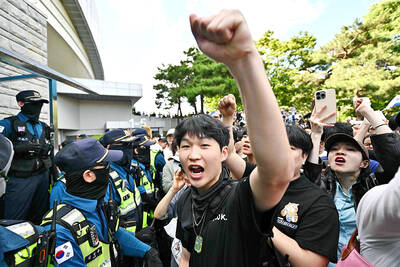
‘ABSURD MISTAKE’: The election commission said that there had been a failure to anticipate turnout after 14 polling stations ran short of ballot papers South Korean riot police yesterday cleared protesters from a Seoul polling station after a 35-hour blockade sparked by a shortage of ballot papers during local elections earlier this week. Wednesday’s election was the first nationwide vote since South Korean President Lee Jae-myung took office following the ouster of Yoon Suk-yeol over his short-lived martial law declaration. Lee’s ruling Democratic Party swept most races, but failed to flip the crucial Seoul mayoral seat. The South Korean National Election Commission apologized, blaming a failure to anticipate turnout after 14 polling stations in Seoul ran short of ballot papers. Some polling stations stayed open until 10pm to

Australian researchers have trained lab-grown brain cells on a silicon computer chip to play the 1990s shooter game Doom and said they are just scratching the surface of what the neurons could be capable of doing. It is the science-fiction work of biotech boffins at Cortical Labs, who researched and developed the technology that harnesses the workings of the brain’s networking system. Each so-called “biological computer” contains about 200,000 living human brain cells, grown from stem cells that were harvested from blood donations. Having mastered the simple computer game Pong, where a paddle is moved up and down to send a ball

France experienced its hottest spring on record, the French weather service said on Tuesday, after an exceptional early heat wave that also broke highs for the season in England and Wales. Meteo-France said the average nationwide temperature over March to May was 13.8°C — about 1.7°C above the norm, and surpassing records set in 2011 and 2020. “The warmest spring since records began in 1900,” it said in a bulletin. All three months were warmer than average, but the onset of an “unprecedented heatwave” late last month pushed the mercury to highs typically seen at the height of the summer. “Our country had never


 RSS
RSS