


Police struggled yesterday to quell rioting by Irish Catholics in several parts of Northern Ireland following a day of mass Protestant parades, an annual event that often pushes sectarian animosity past the boiling point.
Police and politicians accused Irish Republican Army (IRA) dissidents of orchestrating the violence following Monday’s province-wide marches by the Orange Order, a British Protestant brotherhood loathed by the province’s Irish Catholic minority.
The violence began in Ardoyne, a traditional IRA power base in north Belfast, where about 100 demonstrators tried to block one parade route while masked men and youths on side streets bombarded police with bricks, bottles, stones and Molotov cocktails.
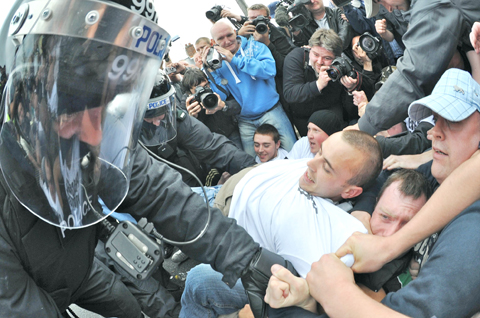
PHOTO: AFP
Riot police in helmets and shields dragged each protester off the street by their arms and legs, then officers used a massive mobile water cannon to douse the rioters.
A reporter saw one teenage rioter preparing to throw a brick get knocked off his feet by a blast from the police water cannon. Blood streamed from his face as he scrambled from the pavement. Other rioters stood further back and threw empty beer bottles blindly over rooftops into police lines.
Police also fired several snub-nosed plastic bullets to wallop or knock down rioters.
The violence spread to several other working-class Catholic districts in Belfast and other towns. Sporadic rioting continued into early yesterday — laying bare the communal hostilities that remain despite Northern Ireland’s nearly two decades of peacemaking.
Police said they had no doubt that officers and protesters had suffered multiple injuries in the Ardoyne confrontations, but did not expect to have accurate casualty numbers until yesterday morning.
They said one policewoman suffered a suspected fractured skull after being struck in the head in Ardoyne, and paramedics’ efforts to evacuate her were delayed by the rioters’ unrelenting barrage.
Police reported suffering salvos of stones, bottles and Molotov cocktails near the Ormeau Bridge in south Belfast, which also was barricaded with burning trash cans.
The latest trouble comes on top of rioting in two other Catholic parts of Belfast early on Monday. Police said 27 officers were hurt during those street battles, including three who suffered pellet wounds from a shotgun blast.
“Society wants to move forward, and the organized actions of the past 36 hours are doing nothing to reinforce the peace that the people of Ireland voted for,” said Belfast Mayor Pat Convery, a moderate Irish nationalist.
Police said their officers were ambushed early yesterday in the Bogside district of Londonderry, Northern Ireland’s second-largest city, after rioters set a police vehicle on fire. Police reinforcements tried to put out the blaze, but came under fire from a masked gunman using a nearby pub for cover. The gunman fired five rounds before fleeing but hit nobody, police said.
Earlier, masked men in Catholic west Belfast hijacked a bus, ordered it to be abandoned outside a police station and said a bomb had been hidden on the top deck of the bus. British Army explosives experts declared the threat a hoax.
In the town of Lurgan, southwest of Belfast, masked youths in a Catholic district called Kilwilkie threw Molotov cocktails both at police and at a passenger train stopped in the town. The engineer drove the train away after Molotov cocktails hit the side of one cabin, but it didn’t catch fire and none of the 55 passengers on board was reported hurt.
In the nearby town of Armagh, several hundred Irish nationalists in another Catholic district gathered around the burning hulk of a hijacked vehicle. Police monitored that scene, but didn’t intervene.
Since 1998, a British-appointed Parades Commission has imposed restrictions on Orange marching routes to prevent the Protestants — accompanied by “kick the pope” bands of tattooed men playing fife and drum — from passing most Catholic districts.
Still, authorities have failed to negotiate alternative routes for some parades, including the one past Ardoyne’s row of shops on Crumlin Road. The thoroughfare connects one Orange lodge to central Belfast.
The disputed Ardoyne parade involves a single Orange lodge of about 30 men and an accompanying band of about 50 men and boys, but it attracts several hundred Protestant supporters to match the Catholic crowds opposed to it, with police caught in the middle each summer.
Monday’s parade passed the conflict zone after a two-hour delay.
Some marchers in suits and ties shielded themselves with umbrellas as they walked quickly on a roadway littered with stones and broken glass. No marchers appeared to be hit.
The Orange Order commemorates July 12 — also known as the Glorious Twelfth, an official holiday in Northern Ireland — as the date when their community, descended largely from 17th century Scottish settlers, secured their place in northeast Ireland versus Catholic natives.

‘CROSSING THE LINE’: China’s embassy in Seoul criticized US Forces Korea Commander General Xavier Brunson, asking if his ‘hostile’ remarks were authorized by Washington South Korea and the US are in talks over recent public remarks by the commander of US Forces Korea, Seoul’s presidential office said yesterday, after the comments drew sharp criticism from China. In a recent podcast interview, US Forces Korea Commander General Xavier Brunson described South Korea as “the dagger in the heart of Asia” from China’s east coast, prompting the Chinese embassy in Seoul to say that he had “truly crossed the line.” The interview came amid growing speculation that Washington might seek to expand the role of US Forces Korea in countering the growing regional influence of China, a key

Through the noise of rushing papers and whirring belts at a print factory in Kyoto, two creators watch their photo essay come to life in broadsheet form — part of an effort to win new audiences in the age of artificial intelligence (AI). Despite the decline of the publishing industry, self-publication and handmade “zine” magazines are growing in popularity in Japan, reflecting the nation’s enduring love of paper in the digital era. While speaking to Agence France-Presse at the plant, his hands black with ink, one of the creators, Kazuma Obara, said: “I think [paper] is a medium that engages all five

Australian researchers have trained lab-grown brain cells on a silicon computer chip to play the 1990s shooter game Doom and said they are just scratching the surface of what the neurons could be capable of doing. It is the science-fiction work of biotech boffins at Cortical Labs, who researched and developed the technology that harnesses the workings of the brain’s networking system. Each so-called “biological computer” contains about 200,000 living human brain cells, grown from stem cells that were harvested from blood donations. Having mastered the simple computer game Pong, where a paddle is moved up and down to send a ball

France experienced its hottest spring on record, the French weather service said on Tuesday, after an exceptional early heat wave that also broke highs for the season in England and Wales. Meteo-France said the average nationwide temperature over March to May was 13.8°C — about 1.7°C above the norm, and surpassing records set in 2011 and 2020. “The warmest spring since records began in 1900,” it said in a bulletin. All three months were warmer than average, but the onset of an “unprecedented heatwave” late last month pushed the mercury to highs typically seen at the height of the summer. “Our country had never


 RSS
RSS