


“Keep moving ... keep moving,” Lieutenant Wilson Santos bellowed at 50 sweaty soldiers as they hacked their way up a hillside through a sea of coca plants in Bolivia’s La Asunta region.
The army’s eradication campaign began earlier this month after La Paz decided to trim back the country’s overproduction of coca leaf, which can be processed into illegal cocaine or used for chewing or drinking in a centuries-old local tradition.
The eradication program — the government calls it “rationalization” — is supported by the US, the chief destination of cocaine trafficking, but frowned upon by the locals, who watch their livelihood being cut down amid uncertainty over their future.
The military hopes to slash 5,000 to 8,000 hectares of coca plantations per year until the world’s third-biggest producer reaches the legally sanctioned level of 12,000 hectares.
That’s how much coca leaf the country needs for traditional use as a mild stimulant either chewed or swallowed as an infusion, estimates suggest.
Harvesting coca leaf for the illegal drugs market, however, is a lucrative, mushrooming industry. More than 30,000 hectares are currently devoted to coca cultivation, the government said.
In Sud Yungas Province, at the foothills of the Andes 200km east of La Paz, much of the coca cultivation is deemed superfluous.
The authorities said it was not a forced eradication campaign, but one reached in agreement with coca growers who are offered substitute crops and government investment in local infrastructure, including roads and sanitation.
The agreement is fragile, however, and coca’s bad reputation does not sit well with La Asunta’s estimated 15,000 farmers, who mostly grow coca leaf for its yield of three crops a year, far more abundant than citrus fruit or coffee.
Locals chafe when people say their coca is snorted up in foreign markets. They say their plant has been used for thousands of years for chewing, drinking and in the religious ceremonies of the indigenous Aymara.
“This is a traditional coca-producing area. What we grow goes to the legal markets of La Paz. It’s under control,” local farmers leader Emilio Mayta said.
Coca grown in Yungas is reputedly the sweetest and best suited for chewing. Farmers say the leaf for cocaine is best reaped in the central region of Chapare, birthplace of Bolivian President Evo Morales, who was a coca growers’ union leader before taking office.
They said Sud Yungas has seen precious little of the promised government investment: There are no bridges over the rivers, the roads are mined with potholes and the villages are powered by electric generators.
“The government is all confused,” farmer Severino Mamani said. “We need development right here, right now if they want us to switch from coca to growing some other crop.”
“Because if the government simply continues slashing away, what are we going to live on?” he asked.

A humanoid robot that won a half-marathon race for robots in Beijing on Sunday ran faster than the human world record in a show of China’s technological leaps. The winner from Honor, a Chinese smartphone maker, completed the 21km race in 50 minutes and 26 seconds, said a WeChat post by the Beijing Economic-Technological Development Area, also known as Beijing E-Town, where the race began. That was faster than the human world record holder, Ugandan Jacob Kiplimo, who finished the same distance in about 57 minutes in March at the Lisbon road race. The performance by the robot marked a significant step forward
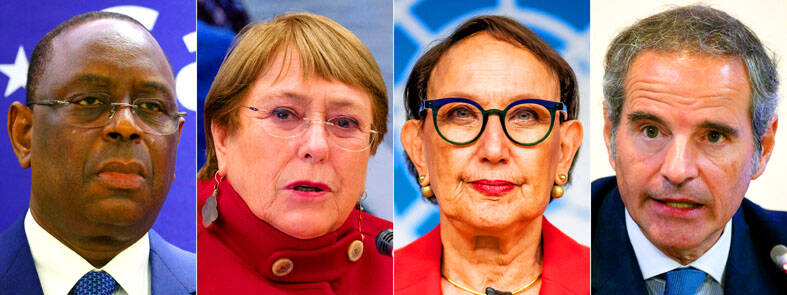
Four contenders are squaring up to succeed Antonio Guterres as secretary-general of the UN, which faces unprecedented global instability, wars and its own crushing budget crisis. Chile’s Michelle Bachelet, Argentina’s Rafael Grossi, Costa Rica’s Rebeca Grynspan and Senegal’s Macky Sall are each to face grillings by 193 member states and non-governmental organizations for three hours today and tomorrow. It is only the second time the UN has held a public question-and-answer, a format created in 2016 to boost transparency. Ultimately the five permanent members of the UN’s top body, the Security Council, hold the power, wielding vetoes over who leads the
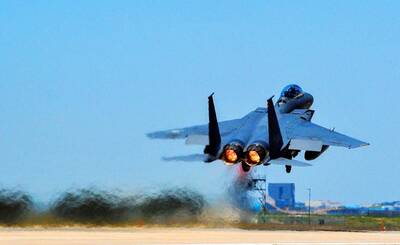
South Korea’s air force yesterday apologized for a 2021 midair collision involving two fighter jets, a day after auditors said the pilots were taking selfies and filming during the flight and held them responsible for the accident. “We sincerely apologize to the public for the concern caused by the accident that occurred in 2021,” an air force spokesman told a news conference, adding that one of the pilots involved had been suspended from flying duties, received severe disciplinary action and has since left the military. The apology followed a report released on Wednesday by the South Korean Board of Audit and Inspection,

An earthquake registering a preliminary magnitude of 7.7 off northern Japan on Monday prompted a short-lived tsunami alert and the advisory of a higher risk of a possible mega-quake for coastal areas there. The Cabinet Office and the Japan Meteorological Agency said there was a 1% chance for a mega-quake, compared to a 0.1% chance during normal times, in the next week or so following the powerful quake near the Chishima and Japan trenches. Officials said the advisory was not a quake prediction but urged residents in 182 towns along the northeastern coasts to raise their preparedness while continuing their daily lives. Prime


 RSS
RSS