


A Chilean judge on Tuesday ordered the arrest of at least 129 former Chilean soldiers and police for human rights violations during the military dictatorship of Augusto Pinochet, court sources said.
The arrest warrants issued by Judge Victor Montiglio were directed against former agents of the National Intelligence Directorate, a feared political police unit known as the DINA by its Spanish initials.
Named in the order were retired military officers who had never before been brought before the court and former non-commissioned officers from the air force, navy and police services, the source who had access to the order said.
The warrants are related to “Operation Condor,” a violent campaign in the 1970s by the governments of Argentina, Bolivia, Brazil, Chile, Paraguay and Uruguay to assassinate opponents of their regimes.
Hundreds of people are believed to have disappeared in the operation.
They also target those who oversaw and conducted “Operation Colombo,” during which 119 Chilean members of the opposition were killed in 1975.
Also concerned are the cases of 10 communists who disappeared from their Santiago headquarters on Conferencia Street in 1976.
“Basically we are investigating anyone who was in the barracks, in so far as they participated in, sought to participate in or had knowledge of deprivation of victims’ freedoms. We are much closer to the end,” the judge told Radio Cooperativa.
A legal source said the arrest order would be carried out in a staggered manner through the end of the week and that all those targeted for arrest would face charges of kidnapping.
Montiglio took over the investigation in 2006, replacing judge Juan Guzman, who in 1998 began the inquest marked by contradictory testimony and other disputes that delayed any decision.
“There are important elements in this case that need to be resolved, so the minister [judge] has asked us to use discretion so that the exhaustive work on these important human rights investigations of Operation Colombo, Operation Condor and Conferencia can be completed,” said Boris Paredes, a lawyer representing the interior ministry.
Pinochet’s 1973-1990 military regime is blamed for human rights abuses including some 3,000 deaths and disappearances.
Pinochet died in December 2006 at a military hospital in Santiago at the age of 91 after evading repeated attempts to bring him to trial.
Two weeks before his death, Pinochet took responsibility for actions committed under his rule, but never apologized for the suffering he caused.

Australians were downloading virtual private networks (VPNs) in droves, while one of the world’s largest porn distributors said it was blocking users from its platforms as the country yesterday rolled out sweeping online age restriction. Australia in December became the first country to impose a nationwide ban on teenagers using social media. A separate law now requires artificial intelligence (AI)-powered chatbot services to keep certain content — including pornography, extreme violence and self-harm and eating disorder material — from minors or face fines of up to A$49.5 million (US$34.6 million). The country also joined Britain, France and dozens of US states requiring

Hungarian authorities temporarily detained seven Ukrainian citizens and seized two armored cars carrying tens of millions of euros in cash across Hungary on suspicion of money laundering, officials said on Friday. The Ukrainians were released on Friday, following their detention on Thursday, but Hungarian officials held onto the cash, prompting Ukraine to accuse Hungary’s Russia-friendly government of illegally seizing the money. “We will not tolerate this state banditism,” Ukrainian Minister of Foreign Affairs Andrii Sybiha said. The seven detained Ukrainians were employees of the Ukrainian state-owned Oschadbank, who were traveling in the two armored cars that were carrying the money between Austria and
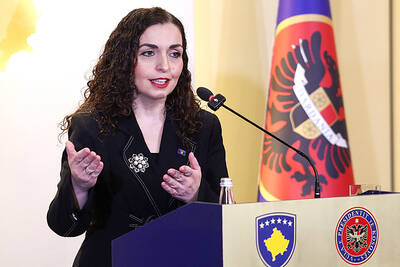
Kosovar President Vjosa Osmani on Friday after dissolving the Kosovar parliament said a snap election should be held as soon as possible to avoid another prolonged political crisis in the Balkan country at a time of global turmoil. Osmani said it is important for Kosovo to wrap up the upcoming election process and form functional institutions for political stability as the war rages in the Middle East. “Precisely because the geopolitical situation is that complex, it is important to finish this electoral process which is coming up,” she said. “It is very hard now to imagine what will happen next.” Kosovo, which declared

MORE BANS: Australia last year required sites to remove accounts held by under-16s, with a few countries pushing for similar action at an EU level and India considering its own ban Indonesia on Friday said it would ban social media access for children under 16, citing threats from online pornography, cyberbullying, online fraud and Internet addiction. “Accounts belonging to children under 16 on high-risk platforms will start to be deactivated, beginning with YouTube, TikTok, Facebook, Instagram, Threads, X, Bigo Live and Roblox,” Indonesian Minister of Communications and Digital Meutya Hafid said. “The government is stepping in so that parents no longer have to fight alone against the giants of the algorithm. Implementation will begin on March 28, 2026,” she said. The social media ban would be introduced in stages “until all platforms fulfill their


 RSS
RSS