


They came in the small hours, just as the dormitories were settling down for the night. Outside, Tehran was still in ferment, a city gripped by fury two days after a “stolen election.” Inside the dorms on Amirabad Street, students were trying to sleep, though nerves were jangling; just hours earlier several had been beaten in front of the main gate to the university.
What happened next developed into one of the seminal events of Iran’s post-election unrest: Police broke locks and then bones as they rampaged through the dormitories, attacked dozens of students, carted off more than 100 and killed five. The authorities still deny the incursion took place. But the account pieced together from interviews with five of those present tells a different story.
“We were getting ready to go to sleep when we suddenly heard them breaking the locks to enter our rooms,” said one of the 133 students arrested that night. “I’d seen them earlier beating students but I didn’t imagine that they would come inside. It’s even against Iranian law.”
Forty-six students from one dorm were arrested and taken to the basement of the Interior Ministry on nearby Fatemi Street. It was there, on the building’s upper floors, that the vote-counting and — opposition supporters claim — the rigging, was going on. Another 87 were taken to a security police building on Hafez Street.
Students spoke of torture and mistreatment.
Five died: They were Fatemeh Barati, Kasra Sharafi, Mobina Ehterami, Kambiz Shoaee and Mohsen Imani — buried the following day in Tehran’s famous Behesht-e-Zahra cemetery, reportedly without their families being informed. Their names were confirmed by Tahkim Vahdat, a student organization.
Witnesses said the two women and three men were repeatedly beaten on the head with electric batons. Their families were warned not to talk about their children or hold funerals.
Under Iranian law, police, revolutionary guards and other militia may not enter universities — a legacy of the 1999 student riots.
“The police threw teargas into the dorms, beat us, broke the windows and forced us to lie on the ground,” one student said. “I had not even been protesting, but one of them jumped on me, sat on my back and beat me. And then, while pretending to search me for guns or knives, he abused me sexually.”
Another described the scene: “The riot police stood in two lines, formed a tunnel with their shields as its roof and made us run through it again and again while beating us and banging on their shields.”
“One of my roommates had a broken leg but they still made him run,” the student said.
Others spoke of similar experiences at the hands of the basij, or paramilitary militia.
“The basiji was on my back and told me: ‘I have not fucked anyone for the past seven years, you cute boy! I’ll show you what I can do to you when we arrive.’ They were harassing us and claiming we insulted them or the supreme leader.”
Injuries were ignored. One student who had lost an eye after being hit by a plastic bullet was not given medical attention.
“We were begging them to transfer these two who were suffering more than others to the hospital but they just said: ‘Let them die,’” a witness said.

The death of a former head of China’s one-child policy has been met not by tributes, but by castigation of the abandoned policy on social media this week. State media praised Peng Peiyun (彭珮雲), former head of China’s National Family Planning Commission from 1988 to 1998, as “an outstanding leader” in her work related to women and children. The reaction on Chinese social media to Peng’s death in Beijing on Sunday, just shy of her 96th birthday, was less positive. “Those children who were lost, naked, are waiting for you over there” in the afterlife, one person posted on China’s Sina Weibo platform. China’s
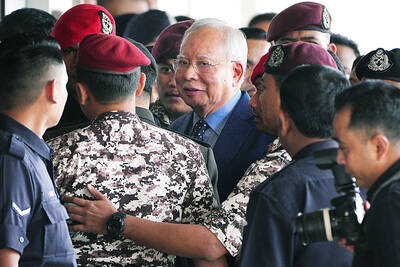
‘NO COUNTRY BUMPKIN’: The judge rejected arguments that former prime minister Najib Razak was an unwitting victim, saying Najib took steps to protect his position Imprisoned former Malaysian prime minister Najib Razak was yesterday convicted, following a corruption trial tied to multibillion-dollar looting of the 1Malaysia Development Berhad (1MDB) state investment fund. The nation’s high court found Najib, 72, guilty on four counts of abuse of power and 21 charges of money laundering related to more than US$700 million channeled into his personal bank accounts from the 1MDB fund. Najib denied any wrongdoing, and maintained the funds were a political donation from Saudi Arabia and that he had been misled by rogue financiers led by businessman Low Taek Jho. Low, thought to be the scandal’s mastermind, remains

Australian Prime Minister Anthony Albanese yesterday announced plans for a national bravery award to recognize civilians and first responders who confronted “the worst of evil” during an anti-Semitic terror attack that left 15 dead and has cast a heavy shadow over the nation’s holiday season. Albanese said he plans to establish a special honors system for those who placed themselves in harm’s way to help during the attack on a beachside Hanukkah celebration, like Ahmed al-Ahmed, a Syrian-Australian Muslim who disarmed one of the assailants before being wounded himself. Sajid Akram, who was killed by police during the Dec. 14 attack, and
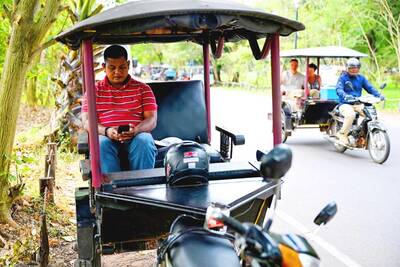
VISHNU VANDALS: A Cambodian official accused Thailand of destroying a statue in a disputed border area, with video showing the Hindu structure being torn down The Thai military said ceasefire talks with Cambodia, set to begin yesterday, are expected to conclude with a meeting of the countries’ defense ministers on Saturday, as the two sides seek to end weeks of deadly clashes. The talks started at 4pm in Thailand’s Chanthaburi Province, which borders Cambodia. The Thai Ministry of Defense outlined several demands to be discussed ahead of the bilateral meeting of the General Border Committee (GBC) on Saturday. If secretariat-level discussions fail to reach agreement on key technical frameworks such as troop deployments, the Thai side would not proceed with the GBC meeting or sign any agreement on


 RSS
RSS