


More than 30 people died in the Somali capital of Mogadishu as government forces launched an attack to retake territory lost to Islamist insurgents in the last few weeks, reports said yesterday.
Witnesses said that government forces attacked insurgent positions in three different locations in north Mogadishu on Friday and that the warring parties exchanged mortar fire.
Insurgents in headscarves exchanged fire with pro-government militia as members of both groups roamed the streets in pickups mounted with machine guns.
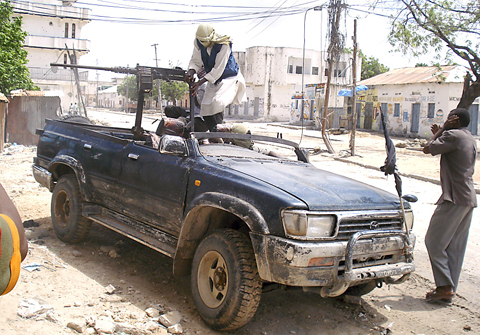
PHOTO: REUTERS
Witness said they saw bodies of both government soldiers and insurgents lying in the streets. A prominent journalist and other civilians were killed by stray bullets and shells and casualties streamed into the Medina Hospital. More than 90 people were injured.
Fighting continued all day, with both sides claiming victory.
Somali Defense Minister Mohamed Abdi Gandi said that the government had managed to retake some of its positions, but a spokesman for the al-Shabaab insurgent group said that it had successfully defended its positions, Radio Garowe reported.
Insurgent groups al-Shabaab and Hizbul Islam launched an offensive two weeks ago in an attempt to push out the weak government of Somali President Sheikh Sharif Sheikh Ahmed, a moderate Islamist who once worked alongside the insurgents.
Hundreds of people, many of them civilians, have died and almost 50,000 have fled Mogadishu during that period.
Sheik Sharif’s government, propped up by 4,300 African Union (AU) peacekeepers from Uganda and Burundi, controls only small sections of Mogadishu, while the insurgents hold sway across much of southern and central Somalia.
The peacekeepers were not involved in the fighting, as they do not have a mandate to pursue the insurgents.
Sheikh Sharif has implemented Shariah, or Islamic law, and has attempted to build bridges with the warring groups. However, the insurgents say Sheikh Sharif, who came to power earlier this year as part of a UN-backed peace process, is too close to the West.
The insurgency, which began after Ethiopian forces invaded in late 2006 to kick out the Islamic Courts Union, has claimed the lives of over 17,000 people, mainly civilians.
Ethiopia pulled out in January, but in recent days there have been reports that its troops have once again crossed the Somali border.
Eritrea has been accused of arming the insurgents, and the AU on Friday added its voice to regional calls for the UN Security Council to impose sanctions on Eritrea and also implement a no-fly zone and a sea blockade to stop arms coming in.
Eritrea’s UN Ambassador said his country has been falsely accused of supplying arms to Islamist militants intent on toppling Somalia’s new government, a letter released on Friday said.
“I wish to put on record my government’s strong opposition to, and categorical rejection of, the unsubstantiated accusations leveled against my country,” Eritrean Ambassador Araya Desta wrote in a letter to the UN Security Council, dated May 20.

‘CROSSING THE LINE’: China’s embassy in Seoul criticized US Forces Korea Commander General Xavier Brunson, asking if his ‘hostile’ remarks were authorized by Washington South Korea and the US are in talks over recent public remarks by the commander of US Forces Korea, Seoul’s presidential office said yesterday, after the comments drew sharp criticism from China. In a recent podcast interview, US Forces Korea Commander General Xavier Brunson described South Korea as “the dagger in the heart of Asia” from China’s east coast, prompting the Chinese embassy in Seoul to say that he had “truly crossed the line.” The interview came amid growing speculation that Washington might seek to expand the role of US Forces Korea in countering the growing regional influence of China, a key

Through the noise of rushing papers and whirring belts at a print factory in Kyoto, two creators watch their photo essay come to life in broadsheet form — part of an effort to win new audiences in the age of artificial intelligence (AI). Despite the decline of the publishing industry, self-publication and handmade “zine” magazines are growing in popularity in Japan, reflecting the nation’s enduring love of paper in the digital era. While speaking to Agence France-Presse at the plant, his hands black with ink, one of the creators, Kazuma Obara, said: “I think [paper] is a medium that engages all five

Australian researchers have trained lab-grown brain cells on a silicon computer chip to play the 1990s shooter game Doom and said they are just scratching the surface of what the neurons could be capable of doing. It is the science-fiction work of biotech boffins at Cortical Labs, who researched and developed the technology that harnesses the workings of the brain’s networking system. Each so-called “biological computer” contains about 200,000 living human brain cells, grown from stem cells that were harvested from blood donations. Having mastered the simple computer game Pong, where a paddle is moved up and down to send a ball

France experienced its hottest spring on record, the French weather service said on Tuesday, after an exceptional early heat wave that also broke highs for the season in England and Wales. Meteo-France said the average nationwide temperature over March to May was 13.8°C — about 1.7°C above the norm, and surpassing records set in 2011 and 2020. “The warmest spring since records began in 1900,” it said in a bulletin. All three months were warmer than average, but the onset of an “unprecedented heatwave” late last month pushed the mercury to highs typically seen at the height of the summer. “Our country had never


 RSS
RSS