


Nitin Karani didn’t know it at the time but in 2002 he co-edited the last edition of India’s first gay magazine.
Twelve years after the groundbreaking Bombay Dost (Bombay Friends) first hit the streets and despite selling some 5,000 copies every quarter, lack of funding and advertising revenue forced it to close.
But last month, the first edition of the new Bombay Dost was launched at a Mumbai bookstore, with funding from a local men’s sexual health charity and the UN Development Program as well as star backing from a Bollywood actress.
For Karani, the magazine’s mission remains the same — to help give India’s marginalized gay community its own voice and be more accepted by society.
“The most important thing about the magazine was in the case of people like me,” he told reporters ahead of today’s International Day Against Homophobia.
“It made me realize I wasn’t the only ‘freak’ around and not isolated, that there are lots of other people like me, not just in India but abroad, and I could reach out to them and interact with them,” he said. “It gave me a tremendous sense of validity.”
Bombay Dost, originally set up by the gay rights activist Ashok Row Kavi, seems tame in comparison with its mainstream US or European counterparts.
Where Britain’s Attitude features pictures of near-naked models and celebrities and sells in the tens of thousands, Bombay Dost has only one shot of “Mr Gay India” in swimming trunks and an initial print run of 1,500.
Most of its glossy 56 pages are instead taken up with lengthy book and art reviews and features on gay issues both in India and abroad.
But in a country that is largely conservative and either ignores homosexuality, denies it exists or treats it as a disease, the magazine can justly claim its tagline of being “bolder than ever.”
In the seven years between publications, Karani said much had changed, even if a British colonial-era law banning unnatural sex “against the order of nature” is still on the statute books.
The original Bombay Dost was not even sold in bookstores and would either come in a plain, brown envelope or under the counter at roadside vendors.
“People would have been afraid to walk into a store and ask for it in the same way they wouldn’t walk into a chemist and ask for a condom. It was basically still contraband,” Karani said.
The now half-yearly Bombay Dost is still available via mail order or from gay-friendly non-governmental organizations but is also sold in a number of large bookstore chains.
Karani said his parents and colleagues in his day job at a large financial services firm know he is gay and are supportive.
Being gay is now more acceptable in certain jobs such as journalism, at call centers or in the entertainment or fashion industries and younger people are more accepting, he said.
The 38-year-old attributes that change in part to globalization as well as the explosion in India’s cable and satellite television sector, which brought among other things chat shows discussing homosexuality more openly.
Indian editions of the Time Out lifestyle and entertainment magazine now have regular gay listings sections and columns, while numbers at the annual Pride march, first held in Kolkata with just 14 men in 1999, are growing.
Prejudice still remains, though, whether it is through blackmail of closeted homosexuals or persecution of groups such as India’s sizeable transgendered hijra community.
Editor Vikram Phukan writes in the magazine that there remains fear of being associated with a lifestyle that is still effectively underground and where homosexual sex remains illegal.
Former Miss India turned Bollywood actress Celina Jaitley, one of India’s most outspoken campaigners for gay rights, received hate mail for supporting the relaunch of Bombay Dost.
The 27-year-old said she was saddened by the reaction but is undeterred, hoping that publications such as Bombay Dost would help break down barriers.
“We have to accept differences rather than be afraid of them,” she told reporters. “We’ve got to talk about it. Bring the change within yourself, accept the first person you come across with love.”

ROCKY RELATIONS: The figures on residents come as Chinese tourist numbers drop following Beijing’s warnings to avoid traveling to Japan The number of Chinese residents in Japan has continued to rise, even as ties between the two countries have become increasingly fractious, data released on Friday showed. As of the end of December last year, the number of Chinese residents had increased by 6.5 percent from the previous year to 930,428. Chinese people accounted for 22.6 percent of all foreign residents in Japan, making them by far the largest group, Japanese Ministry of Justice data showed. Beijing has criticized Tokyo in increasingly strident terms since Japanese Prime Minister Sanae Takaichi last year suggested that a military conflict around Taiwan could

A retired US colonel behind a privately financed rocket launch site in the Dominican Republic sees the project as a response to China’s dominance of the space race in Latin America. Florida-based Launch on Demand is slated to begin building a US$600 million facility in a remote region near the border with Haiti late this year. The project is designed to meet surging demand for the heavy-lift rockets needed to put clusters of satellites into orbit. It is also an answer to China’s growing presence in the region, said CEO Burton Catledge, a former commander of the US Air Force’s 45th Operations

Germany is considering Australia’s Ghost Bat robot fighter as it looks to select a combat drone to modernize its air force, German Minister of Defense Boris Pistorius said yesterday. Germany has said it wants to field hundreds of uncrewed fighter jets by 2029, and would make a decision soon as it considers a range of German, European and US projects developing so-called “collaborative combat aircraft.” Australia has said it will integrate the Ghost Bat, jointly developed by Boeing Australia and the Royal Australian Air Force, into its military after a successful weapons test last year. After inspecting the Ghost Bat in Queensland yesterday,
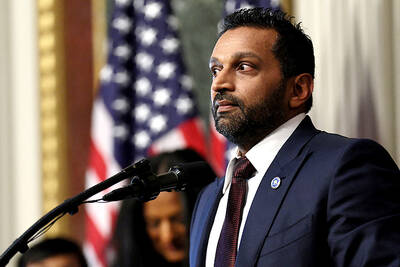
A pro-Iran hacking group claimed to breach FBI Director Kash Patel’s personal e-mail inbox and posted some of the contents online. The e-mails provided by the hacking group include travel details, correspondence with leasing agents in Washington and global entry, and loyalty account numbers. The e-mail address the hackers claim to have compromised has been previously tied to Patel’s personal details, and the leaked e-mails contain photos of Patel and others, in addition to correspondence with family members and colleagues. “The FBI is aware of malicious actors targeting Director Patel’s personal email information,” the agency said in a statement on


 RSS
RSS