

The UN peacekeeping force in the Democratic Republic of the Congo (DRC) is stretched to the limit with an upsurge in fighting in the volatile east and needs more troops quickly from wherever it can get them, the top UN envoy to the country said on Tuesday.
Alan Doss said ideally a temporary troop increase through the UN is needed “tomorrow, but I don’t think that’s likely to happen” because an increase would require budget approval and pledges of additional soldiers.
That leaves the possibility of an outside force coming in to help for specific purposes for a limited period, he said.
Doss said this has been done before not only in the DRC but in Ivory Coast and Sierra Leone. He pointed to Operation Artemis, when a French-led EU force helped stabilize security in Bunia, the capital of violence-wracked Ituri province in the DRC for three months in 2003, saying it was “one of the ideas that’s surfaced.”
A UN official said DRC President Joseph Kabila held talks with Doss and other UN officials on Tuesday and will be asking the international community for a temporary troop increase.
The official spoke on condition of anonymity because the discussion was private.
Alain Le Roy, the UN peacekeeping chief, told reporters late on Tuesday after briefing the UN Security Council that diplomats shared “a sense of urgency” and seemed receptive to sending additional battalions and other reinforcements to shore up the UN force.
French Ambassador to the UN Jean-Maurice Ripert said his government did not have troops ready to deploy immediately, stressing instead the need for “concerted international action” to reinforce the UN peacekeeping force.
“This is obvious,” he told reporters. “It will go fast. I just called my minister a few minutes ago and I can tell you it’s on the mind of ministers all over the planet, especially throughout Africa and the Europeans.”
The Security Council late on Tuesday called for an immediate ceasefire and implementation of a disengagement plan in the DRC.
It “strongly condemned the offensive operations” battling UN peacekeepers and expressed “grave concern” about the resurgence in violence and the dangers it posed to meeting humanitarian needs.
The 17,000-strong UN force has less than 6,000 troops deployed in North Kivu, where Nkunda is threatening not only to take the capital, Goma, but to “liberate” all of the DRC, Doss told reporters at UN headquarters in New York in a video-conference from the DRC capital, Kinshasa.
That’s because the UN also needs to keep troops in three other restive provinces: South Kivu, Ituri — where there have been flare-ups in fighting — and Orientale — where rebels from the Lord’s Resistance Army, a group originally from Uganda, are active — he said.
Bombs, rockets and mortar shells exploded in the DRC yesterday and the army claimed it came under attack by troops from Rwanda.
The DRC has accused Rwanda’s Tutsi-led government of sending troops across the nearby border to help the fighters of renegade General Laurent Nkunda. Rwanda denies it.
The bombardments could be heard by journalists at an army camp in the DRC. Jeeps of officers sped along the road stopping to give instructions to soldiers toting rocket launchers and assault rifles.
The bombardment appeared to be taking place less than 8km from a village where thousands of refugees huddled amid heavy rain.
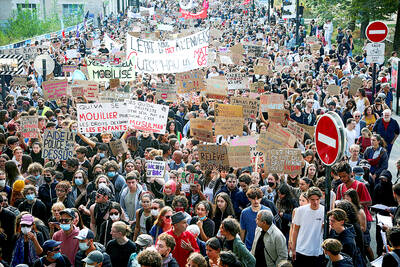
VIOLENT STANDOFFS: The government said 215 students have been injured since the start of the movement last month, including a teenager who lost a hand on Monday Thousands of demonstrators yesterday massed under heavy police surveillance in Paris and cities across France, as unions and teachers joined high-school students who for days have been demanding better conditions in protests punctuated by violent clashes. Students have blocked the entrances to hundreds of high schools for 15-to-17-year-olds since late last month, complaining of missing teachers, overloaded schedules, dilapidated classrooms and buildings that cannot cope with rising temperatures. In the Paris suburb of Creteil, where the protests started last month, students piled barriers outside the Saint-Exupery high school. “We are here to make our voice heard, all too often forgotten,” student Abderrahmane Abdelkader

As shark attack survivor Mel Ismail fought the predator that severed his leg, he noticed something odd. “I saw its eye ... a big black eye,” Ismail said. “But it was winking back at me — I was trying to get my fingers in its eye and just pushing its eye as I was being dragged.” When the shark swam off, he managed to struggle back to shore, the surfer and professional firefighter said in an Australian Broadcasting Corp interview broadcast on Thursday. He was surfing at Glenfield Beach near Geraldton on Australia’s west coast when he was attacked on Sept. 14. He
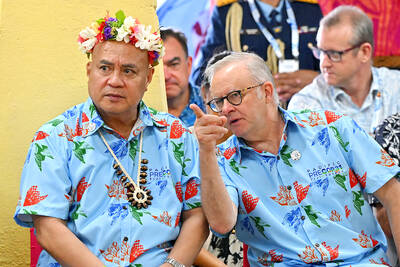
A Tuvalu government adviser yesterday said it felt like Australia had “taken over” the tiny country’s sovereignty during a visit by leaders to the Pacific island. The official — a senior government adviser who asked to remain anonymous because they were not authorized to speak to the media — said they were disappointed in Australia’s handling of the visit. The comments came during a visit by Australian Prime Minister Anthony Albanese and other leaders to Tuvalu, which has become a symbol of the existential threat posed by rising seas and is a key partner in Canberra’s Pacific strategy. “Just because we signed the

Halfway around the world from Russia, in a Caribbean tourism hot spot, men young and old are being lured by Moscow with tantalizing job offers, only to find themselves en route to the front lines in Ukraine. Moscow and Kyiv have recruited thousands of foreign nationals into their armies since Russia launched its invasion of Ukraine in 2022. Moscow is accused, in some cases, of using fake job ads to hoodwink men from deprived backgrounds in Africa, Asia and Latin America into traveling to Russia and then forcing them to fight on arrival. From countries such as India, Kenya, Equatorial Guinea, Colombia and


 RSS
RSS