


US Assistant Secretary of State Christopher Hill traveled to North Korea yesterday in a bid to rescue a faltering nuclear disarmament deal and prevent Pyongyang from rebuilding a plant that made weapons-grade plutonium.
Hill’s visit, at the invitation of the North Koreans, comes days after the North threatened to break away from the disarmament-for-aid package and try to start separating plutonium at its nuclear plant that was being taken apart under the deal.
Hill arrived by car in Pyongyang in the afternoon, the North’s KCNA news agency said.
A senior US official has described Hill’s visit as a “last-ditch effort to get things on track.”
Analysts have said the North might be trying to pressure the outgoing US President George W. Bush looks for diplomatic successes to bolster its legacy. The North might also be thinking it can seek a better deal under a new US president.
Hill told reporters in Seoul on Tuesday he would press Pyongyang to accept a system to verify statements it made about its nuclear program and answer US suspicions of a secret project to enrich uranium for weapons.
“What they have been doing, obviously, goes against the spirit of what we have been trying to accomplish,” Hill said on Tuesday.
He did not say when he planned to return.
Minor activity has been spotted at the site of the North’s 2006 nuclear test, on the east coast and away from Yongbyon, indicating the North may be working to restore the test site, South Korea’s Yonhap news agency quoted a government source as saying.
Smoke was seen rising from the site, probably from workers burning clothing and equipment, the source was quoted as saying, but there was no indication that heavy equipment was being moved. The South’s spy agency could not confirm the report.
Seoul and Pyongyang have also agreed to hold military talks today, the South Korean defense ministry said yesterday.
The meeting is to be held at the truce village of Panmunjom in the demilitarized zone dividing the Korean Peninsula, the ministry said.
The North proposed last week to resume working-level military talks in a rare overture to the South.
It has suspended all government-to-government contacts with Seoul since conservative South Korean President Lee Myung-bak took office in February with promises of a tougher North Korea policy.
Ties soured further after North Korean soldiers in July shot dead a Seoul tourist who strayed into a restricted zone at a North Korean resort.
The North has blamed the South for the incident and refused to let it send an investigation team. Seoul canceled tours to the resort and withdrew staff.
In related news, South Korea showcased guided missiles and other new weaponry in a parade marking the 60th anniversary of its armed forces yesterday.
The parade through Seoul involved 86 new weapons — developed locally or introduced from abroad — such as tanks, armored vehicles, anti-aircraft guns and guided missiles, organizers said.
About 2,500 soldiers and hundreds of veterans from South Korea and other countries took part in the first street parade in five years.
On display were SLAM-ER air-to-ground missiles with a range of 278km displayed on a truck. Ground-to-ground Hyun Moo missiles with a maximum range of 180km were also on show.
Two Patriot missiles were also on display for the first time locally.
South Korea has agreed to buy 48 second-hand Patriot missiles from Germany to build its defenses against the North.
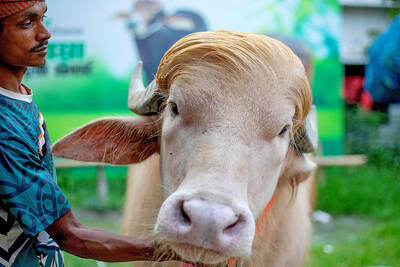
Crowds in Bangladesh are flocking to snap photographs with an unlikely social media star — an albino buffalo with flowing blond hair nicknamed “Donald Trump” that is due to be sacrificed within days. Owner Zia Uddin Mridha, 38, said his brother named the 700kg bull over its flowing helmet of hair resembling the signature look of the US president. “My younger brother picked this name because of the buffalo’s extraordinary hair,” he said at his farm in Narayanganj, just outside the capital, Dhaka. Mridha said that a constant stream of curious visitors — social media fans, onlookers and children — have come throughout

It began as a satirical online project. Now millions of young people in India are flocking to it as an outlet for their frustration. A parody political party called the Cockroach Janta Party, with the insect as its symbol, has exploded across India’s social media by turning absurdist humor into protest. Memes and short videos mocking corruption, joblessness and political dysfunction have flooded social media sites, where millions of users are embracing the cockroach — known for its ability to survive harsh conditions — as a tongue-in-cheek symbol of endurance. The online movement’s rise has been unusually rapid. The Cockroach Janta Party (CJP)
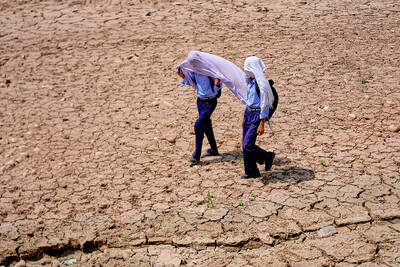
HOTTER: While Indians are accustomed to summer heat, climate change has caused northwestern India to warm faster than other parts of the country, an academic said Roads and markets have emptied during afternoons and some farmers have switched to nighttime work to avoid scorching temperatures as a heat wave grips large parts of India. The India Meteorological Department forecast maximum temperatures for yesterday of about 45°C in the capital, New Delhi, where authorities have opened temporary “cooling zones” to help people cope. The weather department warned that conditions would likely persist across several northern regions in the coming days, with temperatures staying well above seasonal averages. Authorities urged people to stay indoors during the hottest hours and take precautions against heat-related illnesses. India declares a heat wave whenever maximum temperatures
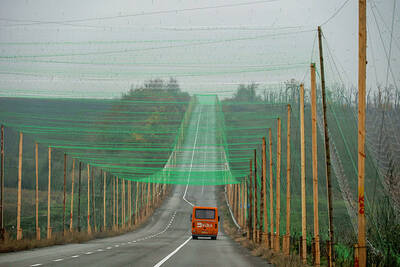
BIGGER ROLE: Beijing has said it maintains an impartial stance on the war in Ukraine, but by training Russian troops, China is far more involved than previously known China’s armed forces secretly trained about 200 Russian military personnel in China late last year, and some have since returned to fight in Ukraine, according to three European intelligence agencies and documents seen by Reuters. While China and Russia have held a number of joint military exercises since Moscow’s full-scale invasion of Ukraine in 2022, Beijing has repeatedly said that it is neutral in the conflict and presents itself as a peace mediator. The covert training sessions, which predominantly focused on the use of drones, were outlined in a dual-language Russian-Chinese agreement signed by senior Russian and Chinese officers in Beijing on


 RSS
RSS