


Police launched an intense manhunt across the Indian capital yesterday for two suspected Islamic extremists who escaped a dramatic gunbattle in which two militants and a police officer died.
The two militants killed during Friday’s shootout in a Muslim area of New Delhi included one of the leaders of a shadowy group responsible for a series of deadly bomb attacks including blasts in the city a week ago, officials said.
The hour-long gunbattle erupted in Jamia Nagar in the capital’s south when police acting on a tip found at least five armed men holed up in an apartment in a maze of streets.
Police Inspector Mohan Chand Sharma, one of the police force’s top officers, died in the hospital from gunshot wounds, police commissioner Y.S. Dadhwal said, adding one suspected militant arrested at the scene was being interrogated.
One of the dead militants was Indian Mujahideen leader “Atif alias Bashir” who was “linked with the blasts all over the country,” he said.
Detectives arrested a suspected aide of Atif at a New Delhi TV studio late on Friday.
“We had a tip he would visit this studio to make a statement on behalf of the militants and we picked him up from the studio,” a senior anti-terrorism squad official said, declining to reveal the name of the studio.
Police identified the arrested Muslim man as Zeeshan but said he was not one of the two suspected militants who escaped during Friday’s gunbattle.
“He had perhaps left the apartment much earlier in the morning and we’re probing if he was among those who planted the bombs in New Delhi on Sept. 13,” the anti-terrorism official said.
The Indian Mujahideen claimed responsibility for a series of blasts that ripped through busy shopping areas of New Delhi last Saturday and left 22 dead and around 100 wounded. Five bombs exploded while three were defused.
Police spokesman Rajan Bhagat said a massive hunt was underway across the national capital for the missing guerrillas but would not comment further.
Over the past five months, serial bombings claimed by the Indian Mujahideen have hit the cities of Jaipur, Bangalore, Ahmedabad and New Delhi, leaving at least 130 dead and many more wounded.
The recent wave of attacks has forced the government to confront the emergence of an indigenous Muslim militancy.
The shoot-out in India’s capital came a day after the government unveiled new security measures to tackle what Indian Prime Minister Manmohan Singh said were “vast gaps” in intelligence gathering.
The plans include recruiting 7,000 more police in New Delhi, installing surveillance cameras in busy areas and creating a research wing in its intelligence agency.
Singh said India had to face up to the growing involvement of home-grown militants in attacks.
In the past, India has focused its limited counter-terrorism and intelligence resources on neighboring Pakistan, which it accuses of orchestrating militant attacks.
Hindu-majority India has 140 million Muslims. While tensions have always existed, India’s Muslims have in the past largely resisted organized militancy.
Indian Muslim leaders, however, have complained their community was being victimized by security forces.

Hungarian authorities temporarily detained seven Ukrainian citizens and seized two armored cars carrying tens of millions of euros in cash across Hungary on suspicion of money laundering, officials said on Friday. The Ukrainians were released on Friday, following their detention on Thursday, but Hungarian officials held onto the cash, prompting Ukraine to accuse Hungary’s Russia-friendly government of illegally seizing the money. “We will not tolerate this state banditism,” Ukrainian Minister of Foreign Affairs Andrii Sybiha said. The seven detained Ukrainians were employees of the Ukrainian state-owned Oschadbank, who were traveling in the two armored cars that were carrying the money between Austria and

Kosovar President Vjosa Osmani on Friday after dissolving the Kosovar parliament said a snap election should be held as soon as possible to avoid another prolonged political crisis in the Balkan country at a time of global turmoil. Osmani said it is important for Kosovo to wrap up the upcoming election process and form functional institutions for political stability as the war rages in the Middle East. “Precisely because the geopolitical situation is that complex, it is important to finish this electoral process which is coming up,” she said. “It is very hard now to imagine what will happen next.” Kosovo, which declared

MORE BANS: Australia last year required sites to remove accounts held by under-16s, with a few countries pushing for similar action at an EU level and India considering its own ban Indonesia on Friday said it would ban social media access for children under 16, citing threats from online pornography, cyberbullying, online fraud and Internet addiction. “Accounts belonging to children under 16 on high-risk platforms will start to be deactivated, beginning with YouTube, TikTok, Facebook, Instagram, Threads, X, Bigo Live and Roblox,” Indonesian Minister of Communications and Digital Meutya Hafid said. “The government is stepping in so that parents no longer have to fight alone against the giants of the algorithm. Implementation will begin on March 28, 2026,” she said. The social media ban would be introduced in stages “until all platforms fulfill their
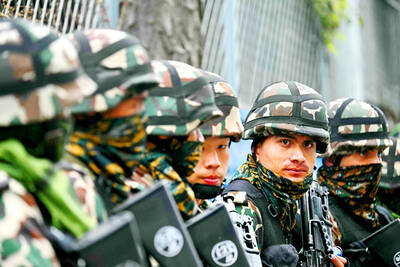
Counting was under way in Nepal yesterday, after a high-stakes parliamentary election to reshape the country’s leadership following protests last year that toppled the government. Key figures vying for power include former Nepalese prime minister K. P. Sharma Oli, rapper-turned-mayor Balendra Shah, who is bidding for the youth vote, and newly elected Nepali Congress party leader Gagan Thapa. In Kathmandu’s tea shops and city squares, people were glued to their phones, checking results as early trends flashed up — suggesting Shah’s centrist Rastriya Swatantra Party (RSP) was ahead. Nepalese Election Commission spokesman Prakash Nyupane said the counting was ongoing “in a peaceful manner”


 RSS
RSS