


Syria and Lebanon agreed yesterday to negotiate the demarcation of their border, a longtime demand of the Lebanese as they seek to normalize relations with their long- dominant larger neighbor.
A day after the countries’ presidents agreed to establish full diplomatic relations, the two men released a joint statement saying a joint committee would formally demarcate the border, which has been ill defined since the two countries became independent from French rule in the 1940s.
The agreements on diplomatic ties and the border are a victory for Lebanese President Michel Suleiman, who traveled to Syria on Wednesday in a landmark visit — the first by a Lebanese head of state to Syria in more than three years.
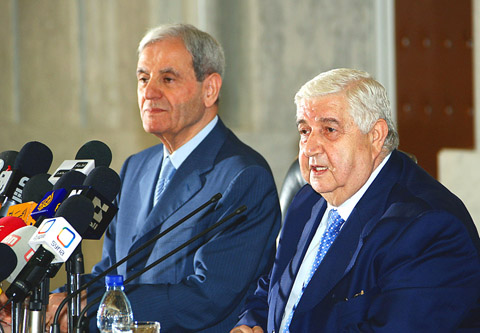
PHOTO: AFP
The border demarcation has long been a major demand of Lebanon’s anti-Syrian factions, along with diplomatic ties, as recognition by Syria of Lebanon’s sovereignty and independence.
Opening diplomatic ties was another step which countries including France and the US had demanded of Syria, which dominated its neighbor until 2005 when the assassination of former Lebanese prime minister Rafik al-Hariri forced it to withdraw troops from Lebanon.
It was not clear when action would be taken on the agreements. No date was set for the opening of embassies or for work on the border to begin.
There have not been any official attempts to define the border.
Syrian Foreign Minister Walid al-Moallem said at a news conference yesterday that one disputed area under Israeli control would not be demarcated while it remains under Israeli occupation.
Israel seized the area, known as Chebaa Farms, from Syria in the 1967 Middle East war. It is located where the borders of three countries meet. Lebanon and Syria claim it is Lebanese territory. But a UN-drawn border between Israel and Lebanon marks it as Syrian land under Israeli occupation.
The statement from the two presidents also said both sides agreed to review all bilateral agreements in an “objective” way.
Many Lebanese claim that political and economic agreements signed between the two countries during the 1990s were lopsided in Syria’s favor.
Syria controlled Lebanon for nearly 30 years, after sending its army in as peacekeepers during the 1975 to 1990 civil war.
Its direct hold was broken in 2005, when international pressure over the slaying of Hariri — blamed by many on Damascus — forced the troops to leave.
Even after the withdrawal, some Lebanese accused Damascus of trying to maintain its influence, saying it was encouraging Hezbollah to topple the Western-backed government of Lebanese Prime Minister Fuad Saniora.
They also accused Syria of being behind a string of assassinations of anti-Syria figures since 2005 to intimidate Beirut and destabilize the country.
Syria denies any role in the Hariri killing or the other attacks.
In their statement yesterday, Suleiman and Syrian President Bashar al-Assad also pledged to intensify efforts to determine the fate of their citizens believed to be missing in each other’s countries.
International human rights groups say hundreds of Lebanese have been imprisoned in Syria since Damascus first sent troops into Lebanon in 1976.
The Syrian government says it freed the last of the prisoners nearly eight years ago.
Saad al-Hariri, Rafik al-Hariri’s son, welcomed the establishment of diplomatic ties, describing it as an accomplishment for the Lebanese people.

‘CROSSING THE LINE’: China’s embassy in Seoul criticized US Forces Korea Commander General Xavier Brunson, asking if his ‘hostile’ remarks were authorized by Washington South Korea and the US are in talks over recent public remarks by the commander of US Forces Korea, Seoul’s presidential office said yesterday, after the comments drew sharp criticism from China. In a recent podcast interview, US Forces Korea Commander General Xavier Brunson described South Korea as “the dagger in the heart of Asia” from China’s east coast, prompting the Chinese embassy in Seoul to say that he had “truly crossed the line.” The interview came amid growing speculation that Washington might seek to expand the role of US Forces Korea in countering the growing regional influence of China, a key

Through the noise of rushing papers and whirring belts at a print factory in Kyoto, two creators watch their photo essay come to life in broadsheet form — part of an effort to win new audiences in the age of artificial intelligence (AI). Despite the decline of the publishing industry, self-publication and handmade “zine” magazines are growing in popularity in Japan, reflecting the nation’s enduring love of paper in the digital era. While speaking to Agence France-Presse at the plant, his hands black with ink, one of the creators, Kazuma Obara, said: “I think [paper] is a medium that engages all five

Australian researchers have trained lab-grown brain cells on a silicon computer chip to play the 1990s shooter game Doom and said they are just scratching the surface of what the neurons could be capable of doing. It is the science-fiction work of biotech boffins at Cortical Labs, who researched and developed the technology that harnesses the workings of the brain’s networking system. Each so-called “biological computer” contains about 200,000 living human brain cells, grown from stem cells that were harvested from blood donations. Having mastered the simple computer game Pong, where a paddle is moved up and down to send a ball
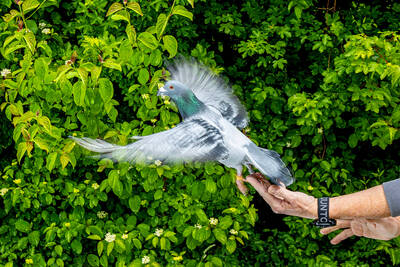
A surprising gut feeling may help pigeons find their way home. Animals use various techniques to navigate, including following the stars and remembering key landmarks. Birds, fish and turtles orient themselves using Earth’s magnetic field as a compass, but it is not yet clear how exactly they do this. Pigeons are a well-known group of frequent flyers that can traverse hundreds of kilometers in a single day. For thousands of years, humans have used them to carry news, notes and military messages. Scientists have long tried to untangle how pigeons travel without getting lost. Some think the birds detect magnetic cues using light-sensitive


 RSS
RSS