


The future of India’s coalition government and a controversial nuclear deal with the US were hanging in the balance yesterday as parliament opened debate ahead of a key confidence vote.
The Indian government would collapse and early elections would be called if the coalition of Indian Prime Minister Manmohan Singh were to lose a vote today, and experts said the outcome was far too close to call.
Singh stirred up anger among his left-wing and communist allies by signing a nuclear accord with the US that his government insists was essential to meet the energy needs of India’s fast-growing economy and its 1 billion people.
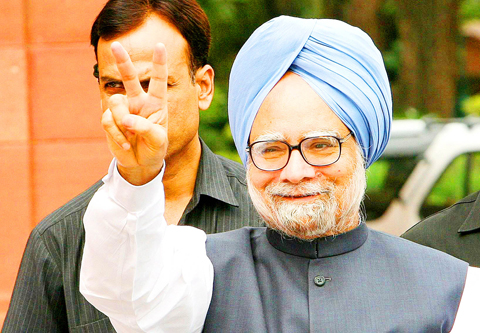
PHOTO: EPA
Left-wingers, who sparked the vote by withdrawing their support, said the deal tied traditionally non-aligned India too close to the US, and would compromise the country’s nuclear weapons program.
After days of trying to woo even tiny parties with just a handful of votes, Singh voiced confidence that his government would survive and see through its last year in office.
“We will prove our majority on the floor of the House,” he told reporters outside the Lok Sabha, or parliament.
The government would need a simple majority of votes, but opposition parties — including the left and the Hindu nationalist Bharatiya Janata Party (BJP) — were equally confident they could push the world’s largest democracy into early elections.
If the government were to lose the vote, elections must be held within six months.
The race was so tight, and the stakes so high, that the government has let six MPs serving jail terms out to vote. Meanwhile the opposition has paid for charter flights to bring in ailing lawmakers, politicians said.
“The government is today like a patient in an intensive care unit. The first question naturally asked is, ‘is he going to survive or not?’” BJP leader Lal Krishna Advani said as the marathon debate opened.
The communists and BJP were also trying to widen the terms of the debate.
They have been speaking out against rising food and fuel prices — inflation has been up to about 12 percent lately — and arguing that hundreds of millions of poor have been left behind by India’s economic boom.
But the core issue was the nuclear deal — a topic spanning India’s energy security as well as its place in the world.
India, which tested nuclear weapons in 1974 and 1998 and refused to sign the nuclear Non-Proliferation Treaty, has been barred from buying nuclear technology and fuel.
The deal would allow such purchases but subject India’s civilian nuclear sites to international controls — aimed at ensuring that any purchases are not diverted for military uses.
Opponents have said the deal would compromise India’s position as a beacon of neutrality, and that the requisite UN inspections would limit India’s ability to develop its weapons program to deter its main regional rival Pakistan.
They also argued that there were strings attached — and doing a deal with Washington would undermine its freedom to buy oil and gas from countries like Iran, or shop for armaments with traditional suppliers like Russia.
“We are not against nuclear energy. We are not against a very close relationship with America. But we would never like India to become party to an agreement which is unequal,” the BJP’s Advani told parliament.
“This deal makes us a subservient partner. It makes India a junior partner,” he said, adding the BJP wanted the deal to be renegotiated but not scrapped.

ROCKY RELATIONS: The figures on residents come as Chinese tourist numbers drop following Beijing’s warnings to avoid traveling to Japan The number of Chinese residents in Japan has continued to rise, even as ties between the two countries have become increasingly fractious, data released on Friday showed. As of the end of December last year, the number of Chinese residents had increased by 6.5 percent from the previous year to 930,428. Chinese people accounted for 22.6 percent of all foreign residents in Japan, making them by far the largest group, Japanese Ministry of Justice data showed. Beijing has criticized Tokyo in increasingly strident terms since Japanese Prime Minister Sanae Takaichi last year suggested that a military conflict around Taiwan could

A retired US colonel behind a privately financed rocket launch site in the Dominican Republic sees the project as a response to China’s dominance of the space race in Latin America. Florida-based Launch on Demand is slated to begin building a US$600 million facility in a remote region near the border with Haiti late this year. The project is designed to meet surging demand for the heavy-lift rockets needed to put clusters of satellites into orbit. It is also an answer to China’s growing presence in the region, said CEO Burton Catledge, a former commander of the US Air Force’s 45th Operations

Germany is considering Australia’s Ghost Bat robot fighter as it looks to select a combat drone to modernize its air force, German Minister of Defense Boris Pistorius said yesterday. Germany has said it wants to field hundreds of uncrewed fighter jets by 2029, and would make a decision soon as it considers a range of German, European and US projects developing so-called “collaborative combat aircraft.” Australia has said it will integrate the Ghost Bat, jointly developed by Boeing Australia and the Royal Australian Air Force, into its military after a successful weapons test last year. After inspecting the Ghost Bat in Queensland yesterday,
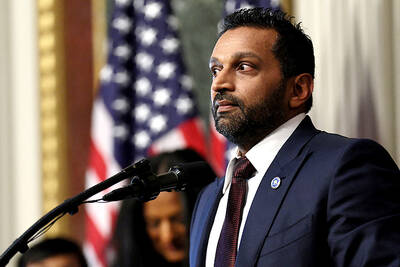
A pro-Iran hacking group claimed to breach FBI Director Kash Patel’s personal e-mail inbox and posted some of the contents online. The e-mails provided by the hacking group include travel details, correspondence with leasing agents in Washington and global entry, and loyalty account numbers. The e-mail address the hackers claim to have compromised has been previously tied to Patel’s personal details, and the leaked e-mails contain photos of Patel and others, in addition to correspondence with family members and colleagues. “The FBI is aware of malicious actors targeting Director Patel’s personal email information,” the agency said in a statement on


 RSS
RSS