


The US has warned Beijing over reported use of Chinese weapons by insurgents in Iraq and Afghanistan as well as the Asian giant’s continued sale of arms to Iran, US Deputy Secretary of State John Negroponte said on Thursday.
He said he conveyed the concerns personally to Chinese officials during his visit to Beijing this week.
“Just the other day, Monday, when I was in Beijing, this was one of the issues I raised — concern about Chinese weapons or Chinese-designed weapons showing up in some of these battle areas, be it Iraq or Afghanistan,” he told a congressional hearing on US-China ties.
The US military in Iraq had said its troops had found Chinese-made missiles, which they believe were smuggled in by groups in Iran aiming to arm militants fighting US-led forces.
The US military has repeatedly accused Iranian-linked groups of training Iraqi extremists in the use of armor-piercing weapons known as explosively formed penetrators.
Afghan authorities had also seized dozens of Iranian and Chinese-made weapons from Taliban fighters near the border with Iran.
The weapons, including land mines and rocket-propelled grenades, appeared to have been manufactured in Iran and China, reports have said.
Negroponte told the US senators that Washington “made it clear” to Beijing that Chinese entities’ continued sale of conventional weapons to Iran “is unacceptable.”
He said Chinese officials told him “they have scaled way back their sale of conventional weapons to Iran.”
“They had relationships previously where they exported these weapons but they have dialed that back,” he said.
Negroponte, a former US intelligence chief, said that China understood Washington’s position that Iran presented “a grave international and regional security concern.”
Beijing also understood that the US government “reserves the right to apply all multilateral, bilateral and unilateral measures at our disposal to ensure that our concerns are addressed.”
“We reinforce this message at every opportunity,” he said.
Negroponte also slammed China for expanding trade and investment links with Iran, particularly in its oil and gas sector.
“We believe this expansion undermines international efforts to pressure Iran and sends the wrong signal to the Iranian regime, especially at a time when other oil companies are heeding their governments’ wishes to forgo new investments in Iran,” he said.
Negroponte said the Chinese government shared the US’ “strategic objective of preventing Iran from acquiring a nuclear weapons capability.”
Washington has spearheaded efforts at the UN to rein in Iran’s ambitions to master the nuclear fuel cycle, accusing Tehran of seeking to build atomic weapons.
China has voted in the UN Security Council for sanctions on Iranian individuals and companies linked to nuclear weapons and ballistic missile programs.
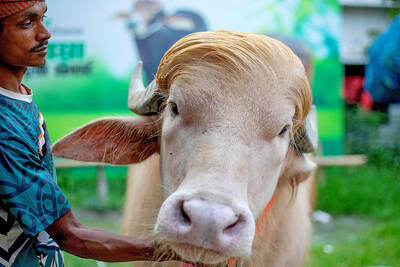
Crowds in Bangladesh are flocking to snap photographs with an unlikely social media star — an albino buffalo with flowing blond hair nicknamed “Donald Trump” that is due to be sacrificed within days. Owner Zia Uddin Mridha, 38, said his brother named the 700kg bull over its flowing helmet of hair resembling the signature look of the US president. “My younger brother picked this name because of the buffalo’s extraordinary hair,” he said at his farm in Narayanganj, just outside the capital, Dhaka. Mridha said that a constant stream of curious visitors — social media fans, onlookers and children — have come throughout

It began as a satirical online project. Now millions of young people in India are flocking to it as an outlet for their frustration. A parody political party called the Cockroach Janta Party, with the insect as its symbol, has exploded across India’s social media by turning absurdist humor into protest. Memes and short videos mocking corruption, joblessness and political dysfunction have flooded social media sites, where millions of users are embracing the cockroach — known for its ability to survive harsh conditions — as a tongue-in-cheek symbol of endurance. The online movement’s rise has been unusually rapid. The Cockroach Janta Party (CJP)
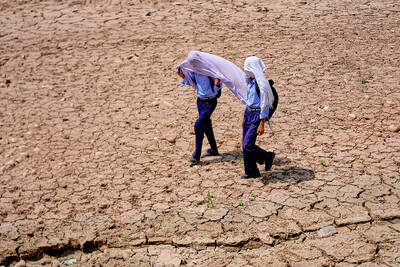
HOTTER: While Indians are accustomed to summer heat, climate change has caused northwestern India to warm faster than other parts of the country, an academic said Roads and markets have emptied during afternoons and some farmers have switched to nighttime work to avoid scorching temperatures as a heat wave grips large parts of India. The India Meteorological Department forecast maximum temperatures for yesterday of about 45°C in the capital, New Delhi, where authorities have opened temporary “cooling zones” to help people cope. The weather department warned that conditions would likely persist across several northern regions in the coming days, with temperatures staying well above seasonal averages. Authorities urged people to stay indoors during the hottest hours and take precautions against heat-related illnesses. India declares a heat wave whenever maximum temperatures

SPEAKING OUT: After Siranudh Scott’s allegations surfaced, celebrities and public figures took to social media to share their own experiences of sexual misconduct and abuse A high-profile alleged sexual abuse case within a wealthy Thai beer brewing family has prompted a wave of painful accounts from survivors of unconnected abuse in the conservative nation. Siranudh Scott, a member of the billionaire Thai family that founded the ubiquitous Singha beer brand, posted an emotional video this month accusing his elder brother Sunit of repeatedly abusing him when he was a teenager. Sunit, who is in his 30s, later denied the allegations in a video posted online, but Singha parent Boonrawd dismissed him from his executive role with the company on Tuesday last week. “I felt I needed to speak


 RSS
RSS