


Bombardments by suspected militants killed four US soldiers as troops tried to push Shiite fighters farther from the US-protected Green Zone and out of range of their rockets and mortars.
Meanwhile, at the UN, US Ambassador Zalmay Khalilzad on Monday accused Iranian-backed groups of launching numerous attacks on Iraqi civilians and multinational forces this year. He also said estimates suggest that 90 percent of foreign terrorists enter Iraq through Syria.
“Iran and Syria must stop the flow of weapons and foreign fighters into Iraq,” Khalilzad said in a report to the Security Council on behalf of the multinational force in Iraq.
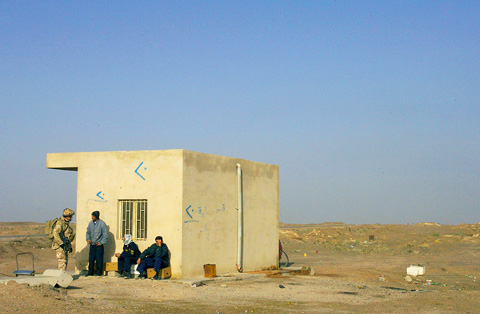
PHOTO: AFP
Iraq’s UN Ambassador Hamid Al Bayati told reporters “we know [there is] interference by neighbors. I can’t state names, but we know some neighbors are helping militias, armed groups.”
The Iranian and Syrian governments have repeatedly denied trying to destabilize Iraq and insist there is no proof.
At least 44 US soldiers have been killed in Iraq this month, making it the deadliest month for US forces since September.
The US military said three soldiers were killed on Monday in eastern Baghdad by indirect fire, a reference to mortars or rockets.
The statement did not give an exact location for the attack, but the Shiite stronghold of Sadr City has been the scene of intense fighting recently with Shiite militiamen.
A fourth US soldier was killed by a shell in western Baghdad, the military said.
A showdown between the Iraqi government and the Mehdi Army — led by the anti-US cleric Moqtada al-Sadr — has increasingly drawn US forces into battles. US commanders are particularly focused on trying to curb a rise in mortar and rocket attacks on the Green Zone.
At least three more salvos hit the Green Zone in central Baghdad, but there were no reports of injuries. In Sadr City — the stronghold of the Mehdi Army militia — US soldiers battled deeper into the district a day after fierce clashes that killed at least 38 suspected militants, the military said.
US soldiers killed seven more extremists on Monday after coming under small-arms fire in Sadr City, the military said. Four of the suspects were killed in an airstrike and three others by an Abrams tank crew, a statement said.
On Monday, 30 Iraqi lawmakers from various political parties urged Iraqi Prime Minister Nouri al-Maliki to end the monthlong confrontation, saying innocent civilians and children were the main victims of the fighting.
“Yes, you can do it if you remember your own children,” said a joint statement read by Mustafa al-Heeti, a Sunni member of parliament. “Your people are demanding of you to intervene and solve the crisis peacefully.”
Their appeal came after US forces, backed by Abrams tanks and Bradley armored personnel carriers, fired on insurgents positions in Sadr City. The military said 38 militants were killed. Iraqi health officials said 58 people, including five children and eight women, were injured.
The fighting erupted after militants took advantage of a sandstorm to unleash a barrage of 107mm rockets and 82mm mortar shells at the Green Zone, which includes the US and British embassies and some key Iraqi government offices.
The near-daily shelling of the Green Zone has become acutely embarrassing for both Iraqi authorities and the US military.
Rather than mount an all-out assault, US commanders have tried to limit the shelling by walling off the southern third of Sadr City and trying to put the Green Zone out of range of light rockets and mortars.
Chinese-made 107mm Katyushas have a range of about 8km, while 82mm mortars can exceed 5km. Much of the Green Zone is more than 8km from firing positions beyond the new wall.
“It’s a tried and true strategy that we’ll continue to prosecute here because it has worked well in other locations, and we think it’ll work well here,” said Brigadier General Will Grimsley, an assistant division commander.
Colonel John Hort, who commands US troops on the southern edge of Sadr City, said the heavy sandstorm sharply limits sensors and targeting lasers on helicopters and unmanned drones used to identify firing positions.

‘CROSSING THE LINE’: China’s embassy in Seoul criticized US Forces Korea Commander General Xavier Brunson, asking if his ‘hostile’ remarks were authorized by Washington South Korea and the US are in talks over recent public remarks by the commander of US Forces Korea, Seoul’s presidential office said yesterday, after the comments drew sharp criticism from China. In a recent podcast interview, US Forces Korea Commander General Xavier Brunson described South Korea as “the dagger in the heart of Asia” from China’s east coast, prompting the Chinese embassy in Seoul to say that he had “truly crossed the line.” The interview came amid growing speculation that Washington might seek to expand the role of US Forces Korea in countering the growing regional influence of China, a key

Through the noise of rushing papers and whirring belts at a print factory in Kyoto, two creators watch their photo essay come to life in broadsheet form — part of an effort to win new audiences in the age of artificial intelligence (AI). Despite the decline of the publishing industry, self-publication and handmade “zine” magazines are growing in popularity in Japan, reflecting the nation’s enduring love of paper in the digital era. While speaking to Agence France-Presse at the plant, his hands black with ink, one of the creators, Kazuma Obara, said: “I think [paper] is a medium that engages all five

Australian researchers have trained lab-grown brain cells on a silicon computer chip to play the 1990s shooter game Doom and said they are just scratching the surface of what the neurons could be capable of doing. It is the science-fiction work of biotech boffins at Cortical Labs, who researched and developed the technology that harnesses the workings of the brain’s networking system. Each so-called “biological computer” contains about 200,000 living human brain cells, grown from stem cells that were harvested from blood donations. Having mastered the simple computer game Pong, where a paddle is moved up and down to send a ball

France experienced its hottest spring on record, the French weather service said on Tuesday, after an exceptional early heat wave that also broke highs for the season in England and Wales. Meteo-France said the average nationwide temperature over March to May was 13.8°C — about 1.7°C above the norm, and surpassing records set in 2011 and 2020. “The warmest spring since records began in 1900,” it said in a bulletin. All three months were warmer than average, but the onset of an “unprecedented heatwave” late last month pushed the mercury to highs typically seen at the height of the summer. “Our country had never


 RSS
RSS