


UN Secretary-General Ban Ki-moon urged the international community to seize "the strategic moment" to build the foundations for peace in Somalia by beefing up UN political efforts and deploying an 8,000-strong multinational force to the conflict-wracked nation.
This could pave the way for the withdrawal of Ethiopian troops who helped Somalia rout the Islamic movement in December 2006 and the possible deployment of a UN peacekeeping force of up to 27,000 soldiers and 1,500 police, he said.
In a long-delayed report to the Security Council, Ban said on Tuesday that the UN is developing a three-pronged strategy to promote dialogue between Somalia's transitional government and opposition elements, to ensure "a credible security presence" even before a formal ceasefire, and to strengthen government institutions, humanitarian aid and economic recovery.
Somalia has not had a functioning government since clan-based warlords toppled dictator Mohamed Siad Barre in 1991 and then turned on each other, sinking the poverty-stricken nation of 7 million people into chaos.
Its weak transitional government, backed by Ethiopian troops, is struggling to quash the re-emerging Islamic insurgency that has killed thousands of civilians. The insurgents, who US officials have repeatedly linked to al-Qaeda, are backed by Ethiopia's arch-enemy, Eritrea.
In December, the Security Council called on Ban to begin planning for the possible deployment of UN peacekeepers to replace the African Union force now in Somalia. The council was reiterating a request it initially made in August that Ban rejected.
The council is scheduled to discuss Somalia today.
The secretary-general said in Tuesday's report that he was encouraged by the appointment of Somali Prime Minister Nur Hassan Hussein last November, his selection of "an able and competent Cabinet," and efforts by the transitional government "to reach out to opposition groups."
Last week, Hussein announced that the government was willing to talk with the military wing of the country's Islamist extremist movement, a major change in government policy.
"Recent developments in Somalia indicate that the political situation in the country provides a unique opportunity for proactive engagement by the international community to support domestic initiatives," Ban said.
"We must seize, without delay, the strategic moment, and move decisively to build the foundations for durable peace and stability in Somalia," he said.
At the same time, however, Ban stressed that the security situation remains a major concern as does "the dire humanitarian condition of the Somali people."
The UN estimates that 700,000 Somalis fled their homes in and around Mogadishu last year, the vast majority to a "hunger zone" in the south and southwest.
A fact-finding mission led by the UN Department of Peacekeeping Operations found that "the security situation remains volatile throughout the country, despite significant regional variations, the north being relatively more stable than southern and central Somalia," he said.
Ban said the fact-finding mission developed four scenarios leading to the deployment of a possible UN peacekeeping operation.
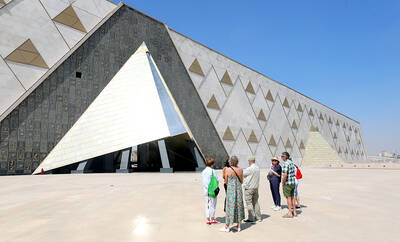
With much pomp and circumstance, Cairo is today to inaugurate the long-awaited Grand Egyptian Museum (GEM), widely presented as the crowning jewel on authorities’ efforts to overhaul the country’s vital tourism industry. With a panoramic view of the Giza pyramids plateau, the museum houses thousands of artifacts spanning more than 5,000 years of Egyptian antiquity at a whopping cost of more than US$1 billion. More than two decades in the making, the ultra-modern museum anticipates 5 million visitors annually, with never-before-seen relics on display. In the run-up to the grand opening, Egyptian media and official statements have hailed the “historic moment,” describing the

‘CHILD PORNOGRAPHY’: The doll on Shein’s Web site measure about 80cm in height, and it was holding a teddy bear in a photo published by a daily newspaper France’s anti-fraud unit on Saturday said it had reported Asian e-commerce giant Shein (希音) for selling what it described as “sex dolls with a childlike appearance.” The French Directorate General for Competition, Consumer Affairs and Fraud Control (DGCCRF) said in a statement that the “description and categorization” of the items on Shein’s Web site “make it difficult to doubt the child pornography nature of the content.” Shortly after the statement, Shein announced that the dolls in question had been withdrawn from its platform and that it had launched an internal inquiry. On its Web site, Le Parisien daily published a

China’s Shenzhou-20 crewed spacecraft has delayed its return mission to Earth after the vessel was possibly hit by tiny bits of space debris, the country’s human spaceflight agency said yesterday, an unusual situation that could disrupt the operation of the country’s space station Tiangong. An impact analysis and risk assessment are underway, the China Manned Space Agency (CMSA) said in a statement, without providing a new schedule for the return mission, which was originally set to land in northern China yesterday. The delay highlights the danger to space travel posed by increasing amounts of debris, such as discarded launch vehicles or vessel

RUBBER STAMP? The latest legislative session was the most productive in the number of bills passed, but critics attributed it to a lack of dissenting voices On their last day at work, Hong Kong’s lawmakers — the first batch chosen under Beijing’s mantra of “patriots administering Hong Kong” — posed for group pictures, celebrating a job well done after four years of opposition-free politics. However, despite their smiles, about one-third of the Legislative Council will not seek another term in next month’s election, with the self-described non-establishment figure Tik Chi-yuen (狄志遠) being among those bowing out. “It used to be that [the legislature] had the benefit of free expression... Now it is more uniform. There are multiple voices, but they are not diverse enough,” Tik said, comparing it


 RSS
RSS