


Canada's Conservative government introduced a motion in parliament on Friday to extend the Canadian combat mission in Afghanistan indefinitely, contingent on other NATO countries sending 1,000 more troops to southern Afghanistan.
This appeared more likely after Canada received signs of support from France as the NATO nation considered sending troops to join the fight against the Taliban in southern Afghanistan to support Canada's beleaguered force.
"They were very receptive to our message," Canadian Defense Minister Peter MacKay said in Vilnius, Lithuania, on Friday, speaking of the French. "We want to talk in more detail about logistics."
Sandra Buckler, a spokeswoman for Canadian Prime Minister Stephen Harper, said a follow-up discussion between the two nations took place on Friday in Paris. French officials, however, were unable to confirm the meeting.
French officials cautioned that it was unlikely Paris would provide all the troops Canada was seeking and said a decision on whether to deploy was unlikely before April, when NATO leaders meet for a summit in Bucharest, Romania.
France, under its US-friendly President Nicolas Sarkozy, has sought to turn the page on its often prickly relations with NATO, and is considering returning to the alliance's military command.
That would reverse General Charles de Gaulle's dramatic 1966 withdrawal from the command -- and upset those French voices seeking a greater military role for the EU instead.
Canadian news reports quoted French Defense Minister Herve Morin as saying on Thursday that France would help Canada, but a French Defense Ministry spokesman said the remarks had been mistranslated.
Canada's 2,500 troops are the main NATO combat force in Afghanistan's increasingly volatile south and have suffered heavy casualties: 78 soldiers and a diplomat have been killed there, mainly in Kandahar Province.
The casualties have created resentment back home that other nations have avoided combat missions.
But the motion's prospects were far from certain. It will come to a vote next month.
Canada's Conservatives, led by Prime Minister Stephen Harper, do not control a majority in parliament, and the leaders of the other three major parties all oppose continuing the combat mission in Afghanistan.
In a bid to press those parties, the Conservatives said on Friday that if the motion were defeated, the government would be dissolved and a national election called.
That threat led the Liberals to charge that the government was trying to engineer its own defeat in a bid for early elections, a charge that the Conservatives denied.
The demand for a greater military role by other nations mirrors a recommendation made last month by a government panel that examined the future of the mission once its authorization lapses in February next year.
The other parties are divided about Afghanistan. The Liberals, the largest opposition party, would keep the country's 2,500 troops in Afghanistan but restrict them to training and to aid and reconstruction.
The New Democratic Party, the smallest group, favors an immediate withdrawal, while Bloc Quebecois wants them returned when the mission ends next year.
Stephane Dion, the Liberal leader, said in an interview that Canada accepted its combat mission with the understanding that it was of limited duration and that other NATO countries would rotate through the region.
"There's no way a country like Canada can carry the most dangerous combat mission for decades," Dion said.
No NATO member has previously offered to send a large force to the south. The US, which has 26,000 troops in Afghanistan, has said it will temporarily redeploy 3,200 from Iraq, 2,200 of which are headed to southern Afghanistan.
But the Pentagon said those troops should not be viewed as long-term reinforcements for Canada.
Meanwhile, Norway confirmed it would add to its 500 soldiers in Afghanistan next month with the deployment of special forces and helicopters, a total of 200 extra troops, Defense Minister Anne-Grete Strom-Erichsen said.
Many European governments are under public pressure not to send their troops to the Afghan frontlines.
Some think it better to focus on reconstruction in the more stable areas rather than pursuing the insurgents; others say that their militaries are stretched elsewhere.
Afghanistan's Defense Minister Abdul Rahim Wardak, who joined the talks, said that the Afghan army was rapidly improving and was determined to beat the Taliban.
However, he appealed for NATO nations to give his troops better equipment, saying that he was better armed in the days when he led rebels against the Soviets.

ROCKY RELATIONS: The figures on residents come as Chinese tourist numbers drop following Beijing’s warnings to avoid traveling to Japan The number of Chinese residents in Japan has continued to rise, even as ties between the two countries have become increasingly fractious, data released on Friday showed. As of the end of December last year, the number of Chinese residents had increased by 6.5 percent from the previous year to 930,428. Chinese people accounted for 22.6 percent of all foreign residents in Japan, making them by far the largest group, Japanese Ministry of Justice data showed. Beijing has criticized Tokyo in increasingly strident terms since Japanese Prime Minister Sanae Takaichi last year suggested that a military conflict around Taiwan could

A retired US colonel behind a privately financed rocket launch site in the Dominican Republic sees the project as a response to China’s dominance of the space race in Latin America. Florida-based Launch on Demand is slated to begin building a US$600 million facility in a remote region near the border with Haiti late this year. The project is designed to meet surging demand for the heavy-lift rockets needed to put clusters of satellites into orbit. It is also an answer to China’s growing presence in the region, said CEO Burton Catledge, a former commander of the US Air Force’s 45th Operations
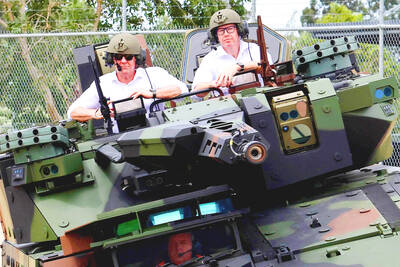
Germany is considering Australia’s Ghost Bat robot fighter as it looks to select a combat drone to modernize its air force, German Minister of Defense Boris Pistorius said yesterday. Germany has said it wants to field hundreds of uncrewed fighter jets by 2029, and would make a decision soon as it considers a range of German, European and US projects developing so-called “collaborative combat aircraft.” Australia has said it will integrate the Ghost Bat, jointly developed by Boeing Australia and the Royal Australian Air Force, into its military after a successful weapons test last year. After inspecting the Ghost Bat in Queensland yesterday,
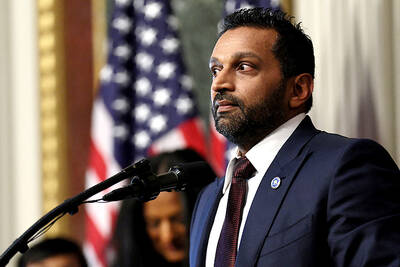
A pro-Iran hacking group claimed to breach FBI Director Kash Patel’s personal e-mail inbox and posted some of the contents online. The e-mails provided by the hacking group include travel details, correspondence with leasing agents in Washington and global entry, and loyalty account numbers. The e-mail address the hackers claim to have compromised has been previously tied to Patel’s personal details, and the leaked e-mails contain photos of Patel and others, in addition to correspondence with family members and colleagues. “The FBI is aware of malicious actors targeting Director Patel’s personal email information,” the agency said in a statement on


 RSS
RSS