


Luxury villas, flat screen TVs and mobile phones will all go up in smoke this Tet Lunar New Year as newly affluent Vietnamese burn paper models of the latest modern conveniences for their dead relatives.
In a sign of Vietnam's growing wealth, especially in the big cities, the product range of votive offerings burnt for passed ancestors has shifted from common household items to a catalogue of high-end luxury goods.
Among the latest paper and bamboo replicas meant to make life easier in the afterlife are models of new Japanese scooters, sleek Sony television sets and DVD players, karaoke sound systems and even multi-story family villas.

PHOTO: AFP
Under Vietnam's tradition of ancestor worship -- discouraged by the communist government but still widespread -- families at Tet burn these items to ritualistically send them through the smoke to the world of the dead.
"The Honda SH150 and Dylan models are now the favorite scooters for the departed," said craftsman Nguyen Huu Nang, 60, at a paper workshop in Dong Ho, a village outside Hanoi that specializes in making the paper objects, called hang ma.
"People now want more powerful and more expensive motorbikes," he said.
"We also sometimes make luxury cars, but only when we have a special order because a company director or a political leader has recently died," he said.
For centuries Dong Ho, a labyrinth of alleys and red-tiled roofs, has been famed for its traditional woodblock prints, depicting ancient folk tales with natural colors on rice paper to make artwork popular especially during Tet.
But tastes have changed and the number of households making traditional prints has dwindled from 150 in the 1950s to about five.
Today most families -- instead of chiselling woodblocks and mixing colors from indigo leaves and eggshell -- make paper mobile telephones and motorcycle helmets, which recently became compulsory in the world of the living.
Two decades after starting doi moi (renewal) market reform, Vietnam is undergoing rapid economic and social change, with annual GDP growth rates of more than 8 percent creating a new economic elite.
"In the 1990s people were content to provide quite basic hang ma items, such as bicycles and local currency," writes cultural anthropologist Shaun Kingsley Malarney in Vietnam -- Journey of Body, Mind, and Spirit.
"Ten years later some families are offering motorcycles, refrigerators and even cars, while others prefer to burn copies of the American dollar, which is regarded as a more stable currency than the dong," he said.
Families are now upgrading every year, said the Dong Ho craftsman, as he used scissors and a glue gun to turn piles of cardboard -- mostly scrap paper from industrial packaging -- into rows of fashionably red motor scooters.
"The living are enjoying a comfortable life, and they want their dead relatives to feel good, too," he said.
Yet Vietnam, a country of 86 million, remains a developing and mostly rural economy with average incomes below US$900 per year.
The World Bank has praised Vietnam for achieving one of the world's fastest declines in poverty, with the ratio of people surviving on less than a dollar a day falling from 58 percent in 1993 to 16 percent in 2006.
But Vietnam's new wealth has not trickled down to everyone. The boom has fueled double-digit inflation that has made life harder for the poor.
A survey by the state-run General Statistical Office found that the richest 20 percent of households had incomes over eight times higher than those of the poorest 20 percent last year, state media reported.
Monthly inflation surged above 14 percent last month compared with the same month last year and was expected to rise further as shops hiked prices ahead of Tet.
The spiralling prices of food, gasoline and other basic goods have fueled labor unrest, especially around Ho Chi Minh City.
In the year's first 20 days, more than 25,000 workers walked off the job in nearly 40 strikes, demanding higher pay and better conditions, mostly at Taiwanese and South Korean owned textile and shoe factories, the Saigon Times reported.
As Vietnam has industrialized, change has not spared the village of Dong Ho where families in past centuries, when they were not doing artwork, worked farming rice.
"We no longer have enough land to cultivate," said Nang, the craftsman.
Former rice fields have become industrial parks, and Nang said that at age 60 he is too old, and lacks the qualifications, to work in the factories.
Making the votive paper models is now his best option.
"I have to do something to survive, to support my family," he said.
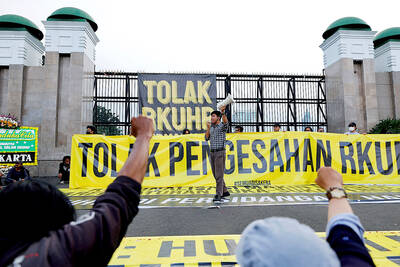
Indonesia yesterday began enforcing its newly ratified penal code, replacing a Dutch-era criminal law that had governed the country for more than 80 years and marking a major shift in its legal landscape. Since proclaiming independence in 1945, the Southeast Asian country had continued to operate under a colonial framework widely criticized as outdated and misaligned with Indonesia’s social values. Efforts to revise the code stalled for decades as lawmakers debated how to balance human rights, religious norms and local traditions in the world’s most populous Muslim-majority nation. The 345-page Indonesian Penal Code, known as the KUHP, was passed in 2022. It

‘DISRESPECTFUL’: Katie Miller, the wife of Trump’s most influential adviser, drew ire by posting an image of Greenland in the colors of the US flag, captioning it ‘SOON’ US President Donald Trump on Sunday doubled down on his claim that Greenland should become part of the US, despite calls by the Danish prime minister to stop “threatening” the territory. Washington’s military intervention in Venezuela has reignited fears for Greenland, which Trump has repeatedly said he wants to annex, given its strategic location in the arctic. While aboard Air Force One en route to Washington, Trump reiterated the goal. “We need Greenland from the standpoint of national security, and Denmark is not going to be able to do it,” he said in response to a reporter’s question. “We’ll worry about Greenland in
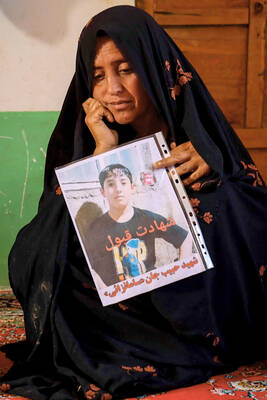
PERILOUS JOURNEY: Over just a matter of days last month, about 1,600 Afghans who were at risk of perishing due to the cold weather were rescued in the mountains Habibullah set off from his home in western Afghanistan determined to find work in Iran, only for the 15-year-old to freeze to death while walking across the mountainous frontier. “He was forced to go, to bring food for the family,” his mother, Mah Jan, said at her mud home in Ghunjan village. “We have no food to eat, we have no clothes to wear. The house in which I live has no electricity, no water. I have no proper window, nothing to burn for heating,” she added, clutching a photograph of her son. Habibullah was one of at least 18 migrants who died
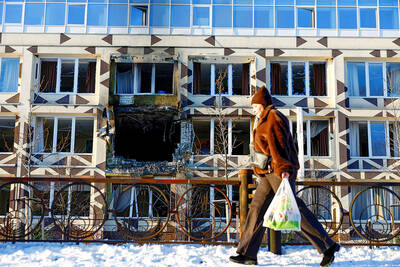
Russia early yesterday bombarded Ukraine, killing two people in the Kyiv region, authorities said on the eve of a diplomatic summit in France. A nationwide siren was issued just after midnight, while Ukraine’s military said air defenses were operating in several places. In the capital, a private medical facility caught fire as a result of the Russian strikes, killing one person and wounding three others, the State Emergency Service of Kyiv said. It released images of rescuers removing people on stretchers from a gutted building. Another pre-dawn attack on the neighboring city of Fastiv killed one man in his 70s, Kyiv Governor Mykola


 RSS
RSS