


David Alan Harvey is one of the world's most famous photographers, his shots appearing in National Geographic and many other prestigious publications.
For years, he has lived inside a building called the "kibbutz" in the Williamsburg section of Brooklyn, which is dotted with orthodox Hasidic Jews and hipsters.
On Sunday, Harvey, who is in India teaching a photography class, had his life upended as his most valuable belongings -- including irreplaceable negatives -- were boxed up and carted away.
"Now I have no home," Harvey wrote on his blog. "No place to go. I quite literally have no plan. ... Does anyone out there have an extra sofa for me to sleep?"
Harvey joins a group of renowned photojournalists and artists who suddenly find themselves without a place to live, work or both after authorities discovered a clandestine matzo bakery with silos of potentially dangerous grain and evacuated the building at 475 Kent St. on Sunday evening.
The list of talent with ties to the building is long: Robert Clark, a contributor to National Geographic who took a series of unforgettable shots of the second plane slamming into the World Trade Center from atop the Williamsburg building; Paolo Pellegrin and Alex Majoli, two noted war photographers and members of Magnum Photos.
Stanley Greene, who has repeatedly documented the devastation in Chechnya; Kadir van Lohuizen, who has trained his sharp eye on the conflicts that have ravaged Africa; Simon Lee, a visual artist; and Eve Sussman, Lee's wife, whose exhibit 89 Seconds at Alcazar was a favorite at the 2004 Whitney Biennial.
"There's a lot of talent in that building," Clark said.
On Tuesday, the situation was chaotic. Some of the tenants like Clark's wife had gathered at a nearby condominium, as others waited in the cold building as police let people in floor by floor to get their prized possessions. Outside, moving trucks lined the street.
While Harvey wasn't there, his assistants were able to rescue most of his belongings.
"We've got his most valuable ... prints out," said Marie Arago. However, she was still scrambling to get everything before authorities locked everyone out.

‘CROSSING THE LINE’: China’s embassy in Seoul criticized US Forces Korea Commander General Xavier Brunson, asking if his ‘hostile’ remarks were authorized by Washington South Korea and the US are in talks over recent public remarks by the commander of US Forces Korea, Seoul’s presidential office said yesterday, after the comments drew sharp criticism from China. In a recent podcast interview, US Forces Korea Commander General Xavier Brunson described South Korea as “the dagger in the heart of Asia” from China’s east coast, prompting the Chinese embassy in Seoul to say that he had “truly crossed the line.” The interview came amid growing speculation that Washington might seek to expand the role of US Forces Korea in countering the growing regional influence of China, a key

Through the noise of rushing papers and whirring belts at a print factory in Kyoto, two creators watch their photo essay come to life in broadsheet form — part of an effort to win new audiences in the age of artificial intelligence (AI). Despite the decline of the publishing industry, self-publication and handmade “zine” magazines are growing in popularity in Japan, reflecting the nation’s enduring love of paper in the digital era. While speaking to Agence France-Presse at the plant, his hands black with ink, one of the creators, Kazuma Obara, said: “I think [paper] is a medium that engages all five

Australian researchers have trained lab-grown brain cells on a silicon computer chip to play the 1990s shooter game Doom and said they are just scratching the surface of what the neurons could be capable of doing. It is the science-fiction work of biotech boffins at Cortical Labs, who researched and developed the technology that harnesses the workings of the brain’s networking system. Each so-called “biological computer” contains about 200,000 living human brain cells, grown from stem cells that were harvested from blood donations. Having mastered the simple computer game Pong, where a paddle is moved up and down to send a ball
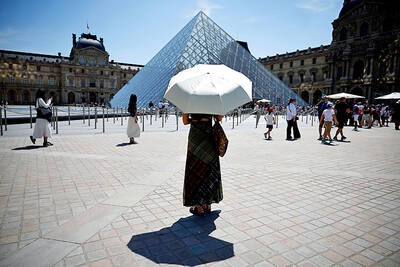
France experienced its hottest spring on record, the French weather service said on Tuesday, after an exceptional early heat wave that also broke highs for the season in England and Wales. Meteo-France said the average nationwide temperature over March to May was 13.8°C — about 1.7°C above the norm, and surpassing records set in 2011 and 2020. “The warmest spring since records began in 1900,” it said in a bulletin. All three months were warmer than average, but the onset of an “unprecedented heatwave” late last month pushed the mercury to highs typically seen at the height of the summer. “Our country had never


 RSS
RSS